
Gap Up and Gap Down in Trading: What They Mean and How to Trade Them
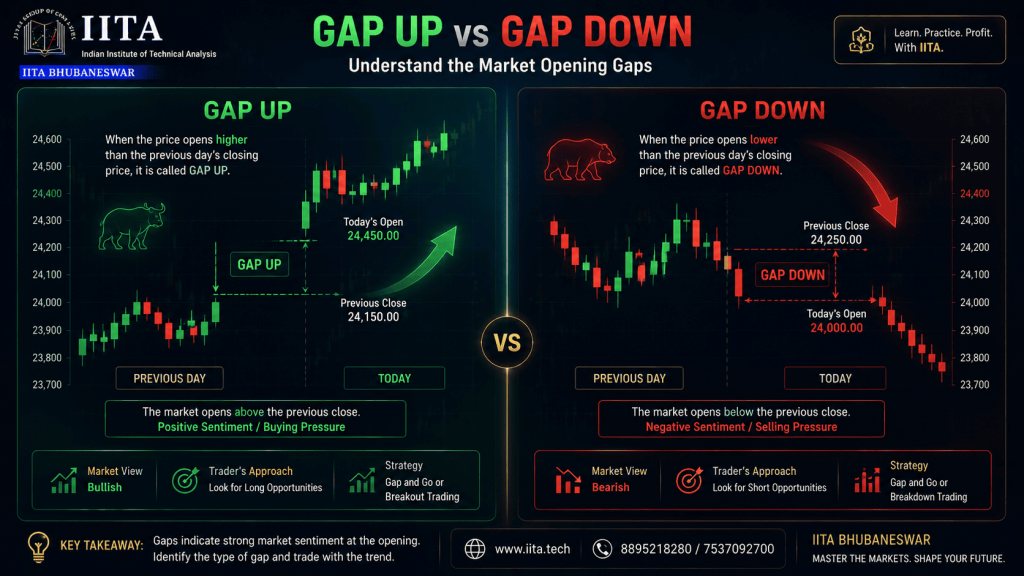
Every trader has experienced it: you check the market at opening and Nifty is already 150 points higher or lower than yesterday’s close – before a single trade has happened during the session. That jump is called a gap. A gap up means the opening price is above the previous close. A gap down means it is below. These gaps create both opportunities and traps, and understanding them is essential for any trader, especially intraday traders.
This guide explains why gaps happen, what different gap types signal, and the two main strategies traders use to trade them – with honest warnings about the risks.
Why Do Gaps Happen?
The Indian market is open from 9:15 AM to 3:30 PM. But the world does not stop when India closes. Events that happen overnight directly affect where the market opens the next morning:
- Global market movements: US markets (Dow Jones, S&P 500, Nasdaq) trade until 1:30 AM IST. A sharp rally or crash in the US often causes a corresponding gap in India the next morning
- Overnight news: corporate earnings announced after market hours, government policy announcements, RBI decisions, geopolitical events
- SGX Nifty / GIFT Nifty: Nifty futures trade internationally even when Indian markets are closed. Their movement forecasts the gap
- Global economic data: US jobs data, inflation numbers, Federal Reserve announcements – all released outside Indian market hours
Essentially, gaps reflect information that arrived while the market was closed, resolved instantly at the opening bell.
Types of Gaps and What They Signal
1. Common Gap
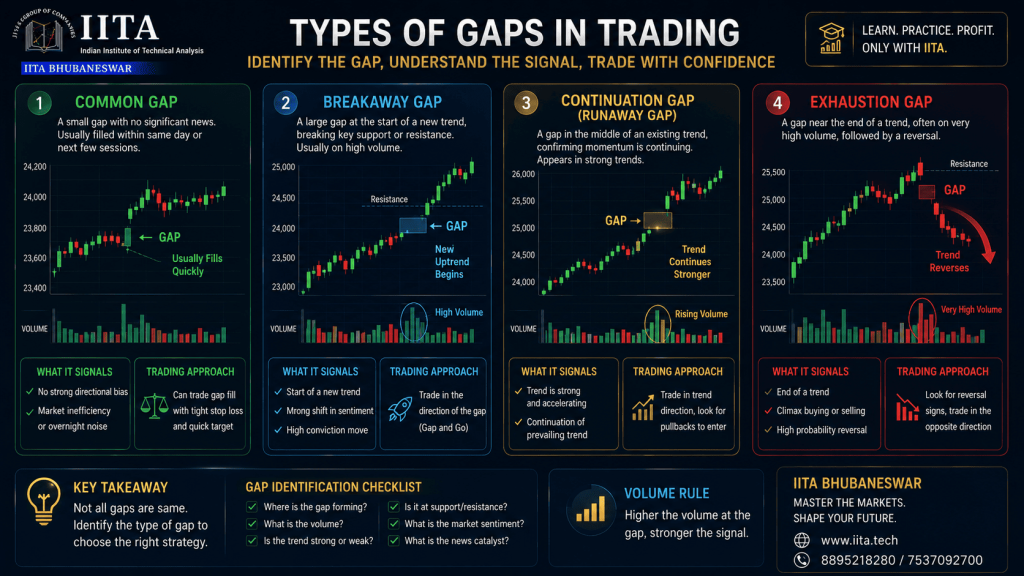
A small gap with no significant news behind it, usually filled (price retraces back to the previous close) within the same day or the next few sessions. Most gaps are common gaps and carry no strong directional signal. They happen frequently and are often noise.
2. Breakaway Gap
A large gap that occurs at the start of a new trend, often breaking through a key support or resistance level. Breakaway gaps usually happen on high volume and signal a powerful shift in sentiment. These gaps often do NOT fill for a long time because the move is genuine and sustained.
3. Continuation Gap (Runaway Gap)
A gap that occurs in the middle of an existing strong trend, confirming that the trend is accelerating. Also called a “measuring gap” because it often marks the midpoint of the total move. These gaps appear in strongly trending markets with increasing volume.
4. Exhaustion Gap
A gap that occurs near the end of a trend, often on very high volume, followed by a reversal. It signals that the last wave of buyers (in an uptrend) or sellers (in a downtrend) have entered, and the trend is running out of fuel. Exhaustion gaps are typically filled quickly as the trend reverses.
Gap Trading Strategy 1: Gap and Go
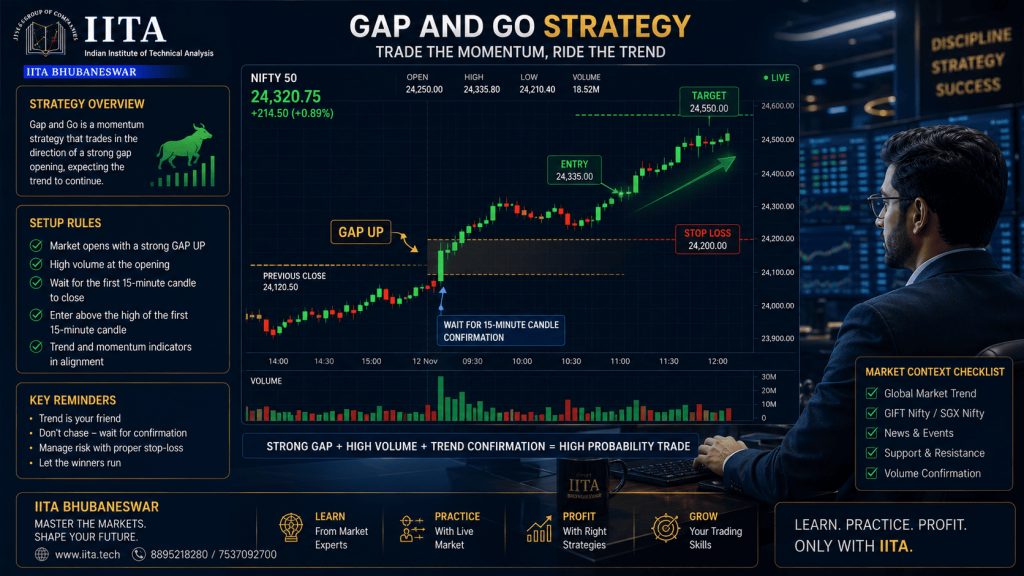
The gap-and-go strategy trades in the direction of the gap, based on the logic that the gap represents genuine momentum that will continue. It works best with breakaway and continuation gaps backed by high volume.
- Setup: Market opens with a large gap up on strong volume. Wait 5–15 minutes for the opening volatility to settle. If price holds above the gap zone (does not fall back to the previous close), enter in the gap direction
- Stop loss: Below the low of the first 15-minute candle or below the gap zone
- Target: Next resistance level (for gap up) or support level (for gap down)
Critical filter: Check WHY the gap happened. News-driven gaps on high volume are more likely to sustain. Random small gaps without a catalyst are more likely to fill. Also check the global context – is GIFT Nifty/SGX confirming the direction?
Gap Trading Strategy 2: Gap Fill
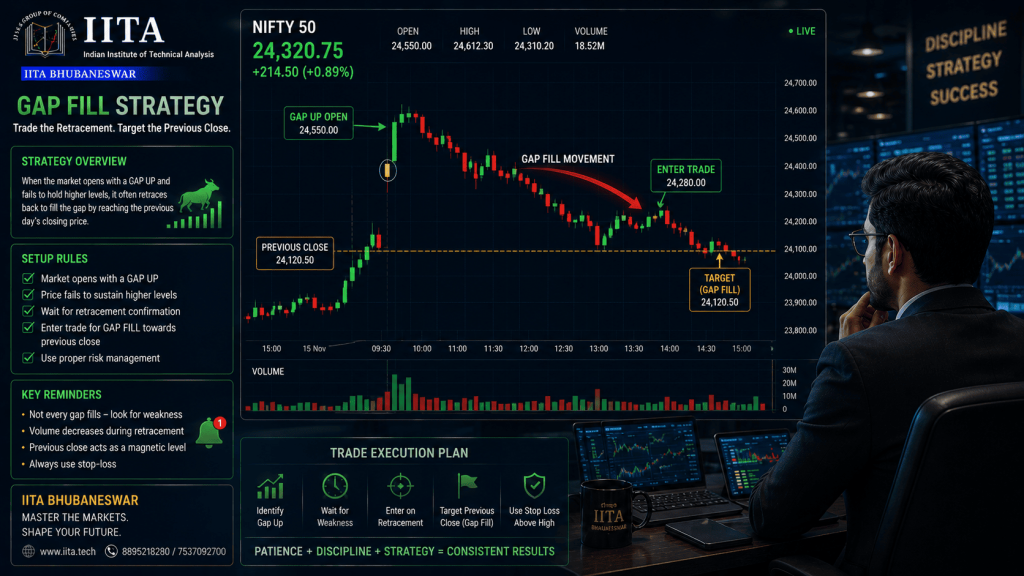
The gap fill strategy trades against the gap, betting that price will retrace back to the previous day’s close. Statistically, many gaps – especially smaller common gaps – do eventually fill.
- Setup: Market opens with a moderate gap (not on major news). If price fails to continue in the gap direction within the first 15–30 minutes and starts retracing, enter a trade toward the previous close
- Stop loss: Above the day’s high (for gap up fill trades) or below the day’s low (for gap down fill trades)
- Target: Previous day’s closing price – the “fill” level
Warning: Never try to fade (trade against) a large, news-driven, high-volume gap. These are breakaway or continuation gaps and fighting them is fighting the trend. Gap fill works on small, catalyst-less gaps where the move is more likely noise than signal.
Pre-Market Analysis for Gap Trading
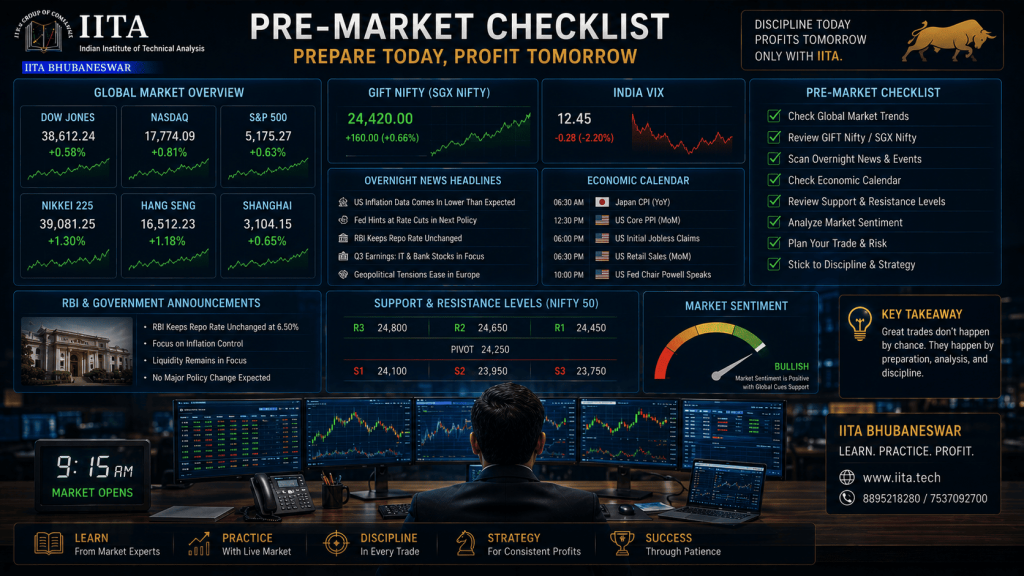
Successful gap traders prepare before 9:15 AM by checking:
- GIFT Nifty / SGX Nifty levels – indicates the likely gap size and direction
- US market close – how did the Dow, S&P, and Nasdaq perform overnight?
- Asia market opens – Japan (Nikkei), Hong Kong (Hang Seng) – confirming global sentiment
- News scan – any major overnight announcement that explains the gap
- Previous day’s support/resistance levels – where will the gap open relative to key technical levels?
This five-minute routine tells you whether the gap is news-driven or noise, which determines which strategy to apply.
Common Mistakes in Gap Trading
- Trading in the first 5 minutes of opening – this period is chaotic with wild swings; let it settle
- Fading every gap – large news-driven gaps should not be faded; they often continue powerfully
- Ignoring volume – a gap on low volume is suspicious; a gap on high volume has conviction
- No stop loss – gaps can extend significantly; without a stop loss, a wrong gap trade can cause outsized losses
- Trading gaps without checking the cause – the “why” behind the gap determines the strategy

Frequently Asked Questions
What is gap up and gap down in simple words?
A gap up means the market opens higher than yesterday’s close, creating a visible empty space (gap) on the chart. A gap down means it opens lower. Gaps happen because of overnight events, global market movements, or news that shifts sentiment before the market opens.
Do all gaps get filled?
Many gaps fill eventually, but not all. Common (small, random) gaps tend to fill quickly. Breakaway gaps (large, news-driven) may never fill or take months. The type of gap and the context determine the probability of a fill.
Should beginners trade gaps?
Beginners should first observe and study gaps for several weeks before trading them. Gap trading requires quick decisions, proper stop losses, and the ability to distinguish gap types in real time. Paper trading gap strategies is highly recommended before using real capital.
Learn Gap Trading and Intraday Strategies with IITA Bhubaneswar
At IITA (Indian Institute of Technical Analysis), Bhubaneswar, concepts like these are not taught from slides alone. Our trainers demonstrate on live market charts, letting you practise in real conditions with mentor guidance.
- Live market sessions – learn by doing, not just watching
- Experienced traders as trainers who practise what they teach
- Small batches for personal attention and doubt-clearing
- Post-course mentorship so support continues after class ends
- Classroom and online options available across Odisha
Visit iita.tech or call us to book a free introductory workshop.
Disclaimer: Stock market trading involves financial risk. This article is for educational purposes only and is not investment advice.
IITA – iita.tech