
Stock Market Taxes in India: What Every Trader and Investor Must Know

Making money in the stock market is one skill. Keeping it – after the government takes its share – requires understanding how stock market taxation works in India. Tax rules differ based on what you traded (shares, options, futures), how long you held it, and how you traded (delivery, intraday, derivatives). Getting this wrong does not just cost you money in penalties; it can turn a profitable year into a losing one after tax.
This guide explains every tax that applies to stock market activities in India, in plain language, so you know exactly what you owe and why.
1. STT (Securities Transaction Tax) – Charged on Every Trade
STT is a tax charged automatically on every stock market transaction. You do not file for it separately; your broker deducts it from every trade. It applies to equity delivery, intraday, and options trades at different rates:
- Equity delivery (buy + sell): 0.1% on buy side and 0.1% on sell side
- Intraday (sell side only): 0.025% on sell value
- Options (sell side only): 0.0625% on the premium at the time of selling/exercising
- Futures (sell side only): 0.0125% on sell value
STT is small per trade but adds up over a year of active trading. It is the only stock market tax you never have to think about – it is deducted automatically.

2. Capital Gains Tax – Tax on Your Profits
When you sell shares at a profit, the profit is called a capital gain, and it is taxed. The rate depends on how long you held the shares:
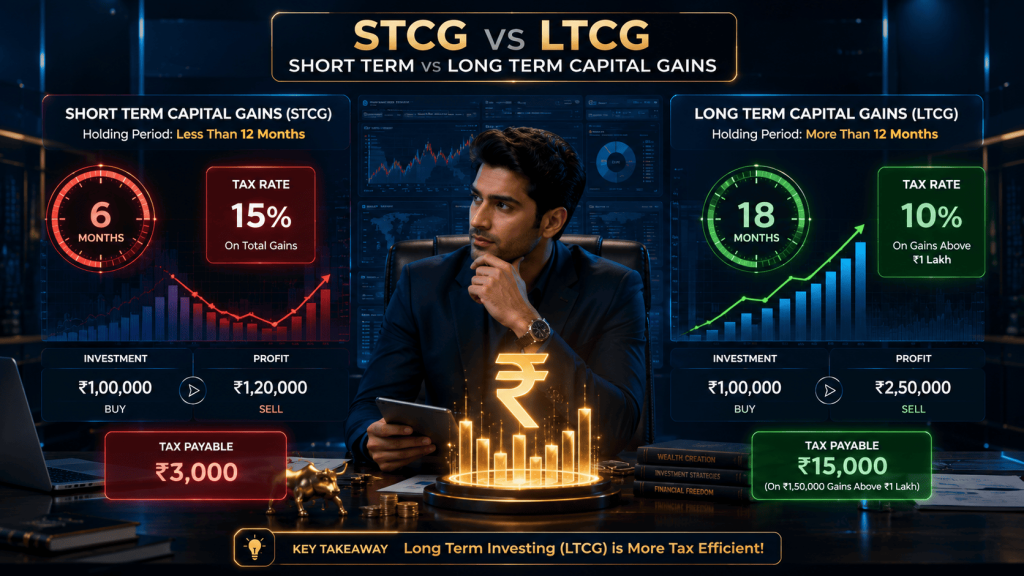
Short Term Capital Gains (STCG) – Shares Held Less Than 12 Months
If you buy shares and sell them within 12 months at a profit, the gain is classified as STCG and taxed at a flat 15% (plus applicable surcharge and cess). This applies to equity delivery trades through recognised exchanges where STT has been paid.
Example: Buy shares for ₹1,00,000. Sell for ₹1,20,000 after 6 months. Profit = ₹20,000. STCG tax = 15% of ₹20,000 = ₹3,000.
Long Term Capital Gains (LTCG) – Shares Held Over 12 Months
If you hold shares for more than 12 months, the profit is classified as LTCG. LTCG on listed equity shares is taxed at 10% on gains exceeding ₹1 lakh per financial year (no indexation benefit).
Example: You sell shares after 18 months and make a profit of ₹1,50,000. The first ₹1,00,000 is exempt. Tax = 10% of ₹50,000 = ₹5,000.
This ₹1 lakh exemption is per financial year across all equity LTCG, not per transaction.
3. Intraday Trading – Taxed as Business Income
Intraday (day trading) profits are NOT classified as capital gains. They are classified as speculative business income and taxed at your regular income tax slab rate. This is an important distinction because slab rates can be significantly higher than the 15% STCG rate.
Example: If your total income including intraday profits puts you in the 30% tax bracket, your intraday profits are taxed at 30% (plus surcharge and cess). The same profit on a delivery trade would be taxed at 15% STCG. This is why many traders prefer delivery or swing trading over pure intraday from a tax perspective.
Intraday trading losses can be set off against intraday profits in the same year and carried forward for 4 years (against speculative income only).
4. Futures and Options (F&O) – Non-Speculative Business Income
F&O profits are classified as non-speculative business income and taxed at your income tax slab rate, similar to intraday but with one advantage: F&O losses can be set off against any income except salary, and carried forward for 8 years.
F&O traders are also required to maintain proper books of accounts and may need a tax audit if their turnover exceeds the threshold prescribed by tax laws (currently ₹10 crore for digital transactions with profit less than 6% of turnover – consult a CA for the latest thresholds).
5. Tax on Dividends
Dividends received from Indian companies are taxed at your income tax slab rate. TDS (Tax Deducted at Source) at 10% is applied on dividends exceeding ₹5,000 per financial year from a company. You report the full dividend income in your ITR and pay any remaining tax.
6. Advance Tax for Traders
If your total tax liability for the year exceeds ₹10,000, you are required to pay advance tax in quarterly instalments (15% by June 15, 45% by September 15, 75% by December 15, 100% by March 15). Active traders with significant profits need to estimate their annual trading income and pay advance tax accordingly. Missing advance tax deadlines attracts interest under Sections 234B and 234C. Many traders ignore this and face unexpected interest charges at filing time – a completely avoidable cost with basic planning.

Practical Tax Tips for Traders and Investors
- Set off losses against gains: Short-term losses can be set off against both short-term and long-term gains in the same year. This can significantly reduce your tax liability
- Carry forward losses: If you cannot set off all losses this year, carry them forward (2 years for STCL, 8 years for LTCL and F&O losses) – but you MUST file your ITR on time to claim this
- Maintain records: Keep all contract notes, profit/loss statements, and trading records. Your broker provides an annual tax P&L statement – download it
- File ITR correctly: Different forms apply depending on whether you have capital gains only (ITR-2) or business income from trading (ITR-3). Filing the wrong form is a common and costly mistake
- Consult a CA: Tax rules change periodically. A chartered accountant familiar with stock market taxation is a worthwhile annual investment, especially for active traders

Frequently Asked Questions
Do I need to pay tax even on small stock market profits?
Yes. All capital gains are taxable. LTCG has a ₹1 lakh exemption per year, but STCG, intraday, and F&O profits are fully taxable from the first rupee. Even if your broker does not deduct tax (except STT), you are responsible for reporting and paying through your income tax return.
What happens if I do not report stock market income?
The Income Tax Department receives your trading data from brokers and exchanges. Unreported income can result in notices, penalties, and interest. Always report your stock market income, even if it is a loss (which you may want to carry forward).
Are stock market losses tax-deductible?
Yes – they can be set off against gains (with specific rules for each type) and carried forward. But ONLY if you file your income tax return on time. Missing the filing deadline forfeits your right to carry forward losses.

Learn Tax-Aware Trading and Investment Strategies with IITA Bhubaneswar
At IITA (Indian Institute of Technical Analysis), Bhubaneswar, concepts like these are not taught from slides alone. Our trainers demonstrate on live market charts, letting you practise in real conditions with mentor guidance.
- Live market sessions – learn by doing, not just watching
- Experienced traders as trainers who practise what they teach
- Small batches for personal attention and doubt-clearing
- Post-course mentorship so support continues after class ends
- Classroom and online options available across Odisha
Visit iita.tech or call us to book a free introductory workshop.
Disclaimer: Stock market trading involves financial risk. This article is for educational purposes only and is not investment advice.