| Sensex vs Nifty Explained for Beginners | India GuideConfused between Sensex and Nifty? Understand the difference in simple language and how these indices affect your Trading in India. |
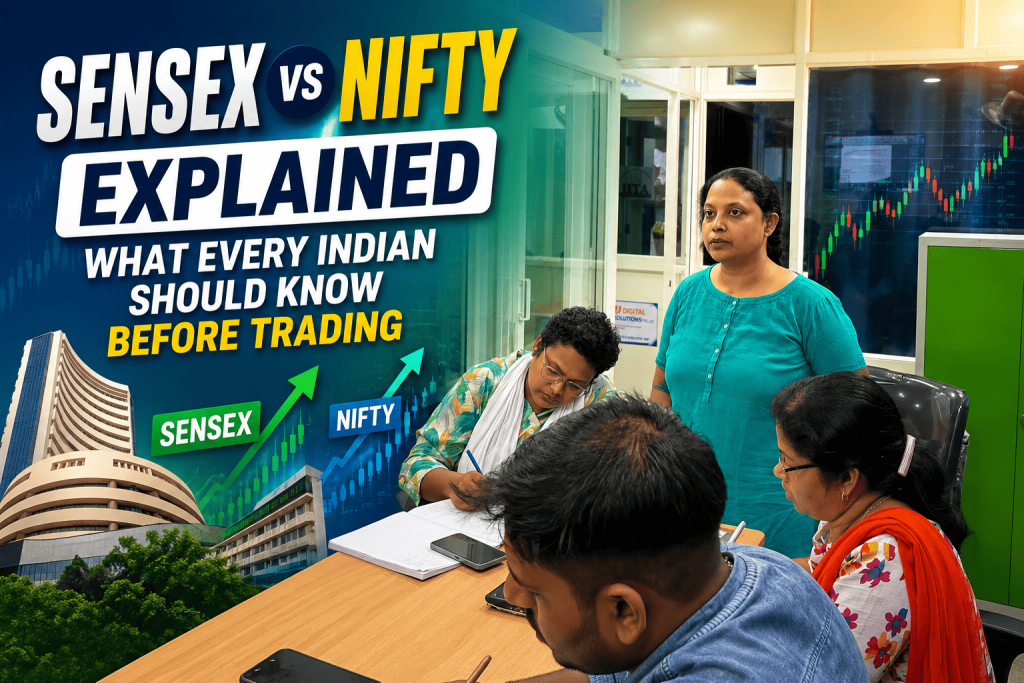
Sensex vs Nifty Explained: What Every Indian Should Know Before Trading
Senex Vs Nifty …If you’ve ever turned on the news and heard “Sensex gir gaya” or “Nifty ne naya record banaya,” you’ve probably wondered what these numbers actually mean — and why everyone in the market seems to track them so closely. Before you place your first trade, understanding Sensex and Nifty isn’t optional. It’s the foundation everything else is built on.
At IITA Mumbai, this is usually the very first topic we cover in our stock market course in Mumbai, because students who understand these two indices grasp everything else — from stock selection to trend analysis — much faster.
What Exactly Are Sensex and Nifty?
Think of Sensex and Nifty as report cards for the Indian stock market. Instead of tracking one company, they track a basket of top-performing companies to give you a snapshot of how the overall market is doing.
Sensex (short for Sensitive Index) is the benchmark index of the Bombay Stock Exchange (BSE). It tracks the 30 largest, most financially sound, and most actively traded companies listed on the BSE. Launched way back in 1986, it’s the oldest stock index in India.
Nifty 50, on the other hand, belongs to the National Stock Exchange (NSE). As the name suggests, it tracks 50 large-cap companies across various sectors of the Indian economy. It came a little later, in 1996, but today it’s just as widely followed — if not more. Both indices are calculated using the free-float market capitalization method, meaning only the shares available for public trading are considered, not the total shares issued by a company
Key Differences Between Sensex and Nifty
| Feature | Sensex | Nifty |
| Exchange | BSE | NSE |
| Number of Stocks | 30 | 50 |
| Base Year | 1978-79 | 1995 |
| Base Value | 100 | 1,000 |
| Launched | 1986 | 1996 |
While the numbers differ, both indices generally move in the same direction because they largely represent the same top Indian companies — think Reliance, TCS, HDFC Bank, Infosys, and ICICI Bank, which feature in both lists.
Why Do These Indices Matter to a Beginner Trader

If you’re someone who’s just starting out and searching for a good share market classes in Mumbai to build your foundation, here’s why Sensex and Nifty deserve your attention from day one:
1. They show market sentiment. When Sensex or Nifty rises, it generally reflects investor confidence in the economy. A falling index often signals caution or uncertainty.
2. They act as a performance benchmark. If your portfolio is growing slower than the Nifty, that’s useful feedback. Fund managers and traders constantly compare their returns against these indices.
3. They’re used for index-based trading. Many traders don’t just buy individual stocks — they trade Nifty and Sensex futures and options directly. This is a popular strategy taught in most intraday trading course Mumbai programs because index derivatives tend to be more liquid than individual stock options.
4. They help with macro-level decisions. Before entering any stock, seasoned traders often check what the broader index is doing. A strong stock in a falling market behaves very differently than the same stock in a bullish market.
Common Confusion: Which One Should You Track?
A question we hear often in our stock market training institute Mumbai sessions is: “Sir, Sensex dekhein ya Nifty?” Honestly, there’s no strict right answer. Most professional traders in India actually track Nifty more closely because NSE has higher trading volumes and liquidity compared to BSE. However, Sensex still holds cultural and historical importance, and it’s frequently referenced in mainstream financial news.
For someone learning technical analysis course Mumbai style chart reading, Nifty is usually the preferred index because of tighter spreads, better option chain data, and higher participation from institutional traders.
How Are These Indices Calculated?
Without getting too technical, both indices use a weighted average approach. Companies with a larger free-float market cap have a bigger influence on the index’s movement. So if Reliance Industries or HDFC Bank has a big move, it will pull the entire index up or down more than a smaller-weighted company would.
This is exactly why, in our share market course fees in Mumbai curriculum, we dedicate proper time to explaining index construction — because it directly affects how you interpret index movements versus individual stock movements.
Real-World Example
Let’s say Nifty rises by 1.2% in a day. That doesn’t mean every single stock listed on NSE went up. It simply means the weighted average of the top 50 companies moved up. Some smaller stocks in your portfolio could have actually fallen even on a “green day” for the market. This is a mistake many beginners make — assuming that a rising index means every stock is rising too.
Should Beginners Trade Sensex or Nifty Directly?
For absolute beginners, we usually recommend starting with index funds or ETFs that track Sensex or Nifty rather than jumping straight into futures and options trading on these indices. Once you build a solid understanding through structured share market seekhne ka process — proper classes, mock trading, and guided practice — you can gradually explore index derivatives with proper risk management.
This is precisely the structured path we follow at IITA, where students move from basic index concepts to advanced strategies like options and price action trading only after building strong fundamentals.
Final Thoughts
Sensex and Nifty aren’t just numbers flashing on a news ticker — they’re powerful tools that tell you the pulse of the Indian economy and stock market. Whether you’re planning to invest long-term or trade actively, understanding these indices is non-negotiable.
If you’re based in Mumbai and looking for a structured, beginner-friendly way to learn the stock market from scratch, IITA Mumbai offers live, practical training designed for real market conditions — not just theory.
📞 Book Your Free Career & Market Guidance Session Today!
Not sure where to begin? Speak with our academic counselors and discover the right learning path based on your goals.
📍 Mumbai Office: Crystal Plaza, Opposite Infinity Mall, Andheri West, Mumbai
💻 Training Mode: 100% Live Online Classes
📞 Call / WhatsApp: +91 88952 18280
🌐 Website: https://iita.tech/stockmarket-course-in-mumbai/
📸 Follow us on Instagram: @stockmarketcourse_iita
Subscribe to Our YouTube Channels: 🔹 IITA Official: www.youtube.com/@iitab 🔹 Sudha Das (Market Learning): www.youtube.com/@sudhadas8420
Disclaimer: Stock market trading involves financial risk. This article is for educational purposes only and is not investment advice.