
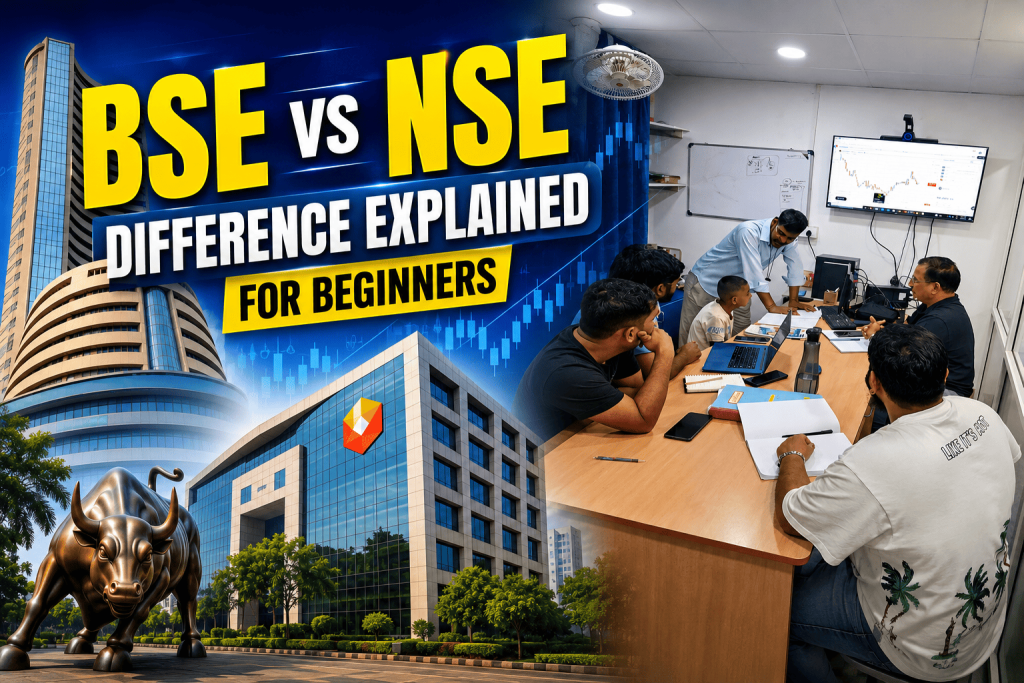
Learn the key differences between BSE and NSE, India’s two major stock exchanges, and which one is better for new Traders.
BSE vs NSE: What’s the Difference and Where Should Beginners Trade?
If you’re new to the stock market, you’ve probably come across two acronyms again and again — BSE and NSE. Every news report, every trading app, every price quote mentions one or both of these exchanges. But what exactly are they, how are they different, and which one should you actually use as a beginner? Let’s clear up the confusion once and for all.
At IITA Mumbai, this is one of the first concepts we cover in our stock market course in Mumbai, because understanding exchanges properly saves beginners a lot of unnecessary confusion later on.
What Are BSE and NSE?
BSE (Bombay Stock Exchange) is India’s oldest stock exchange, established way back in 1875. It’s located in Mumbai and was originally the go-to marketplace for buying and selling shares in India for over a century before electronic trading even existed.
NSE (National Stock Exchange) came much later, in 1992, and introduced fully electronic, screen-based trading to India — something that was revolutionary at the time. Today, NSE is the largest stock exchange in India by trading volume and is also headquartered in Mumbai.
Both exchanges are regulated by SEBI (Securities and Exchange Board of India), which ensures fair practices, transparency, and investor protection across both platforms.
Key Differences Between BSE and NSE
| Feature | BSE | NSE |
| Established | 1875 | 1992 |
| Benchmark Index | Sensex (30 stocks) | Nifty 50 (50 stocks) |
| Listed Companies | ~5,000+ | ~2,000+ |
| Trading Volume | Lower | Significantly higher |
| Liquidity | Moderate | High |
| Popular Segment | Equity, mutual funds | Equity, derivatives (F&O) |
While BSE technically has more listed companies, NSE dominates in terms of actual trading activity, especially in derivatives like futures and options.
Does It Matter Which Exchange You Trade On?
Here’s something that surprises many beginners: most large, actively traded companies — think Reliance, HDFC Bank, Infosys, TCS — are listed on both BSE and NSE. So in most cases, you’re not choosing between two separate markets for the same stock; you’re choosing which exchange executes your order for that same company.
Your broker’s trading app usually shows you both BSE and NSE prices for a stock, and you can select either at the time of placing your order. In practice, prices on both exchanges are almost identical, with only minuscule differences due to timing and liquidity.
Why NSE Is More Popular Among Traders
If you enroll in a share market classes in Mumbai program, you’ll notice most practical training — especially around intraday trading course in Mumbai and option trading course in Mumbai — focuses heavily on NSE. There are a few clear reasons for this:
- Higher liquidity – NSE has significantly higher trading volumes, meaning your buy/sell orders get executed faster and at better prices
- Tighter bid-ask spreads – Less difference between buying and selling price, reducing hidden trading costs
- Dominant derivatives market – Nifty and Bank Nifty options, which are extremely popular among Indian traders, are primarily traded on NSE
- Better price discovery – With more participants, NSE prices tend to reflect true market value more efficiently
This is why, in our technical analysis course in Mumbai, we primarily use NSE charts and data when teaching students how to read price action and identify trading opportunities

When Does BSE Make Sense?
BSE still holds relevance, particularly for:
- Long-term investors who don’t need high-frequency execution
- Certain small-cap and micro-cap stocks that may only be listed on BSE
- Historical and cultural significance, since Sensex remains a widely recognized market indicator
- Mutual fund transactions, where BSE’s StAR MF platform is commonly used by distributors
So while NSE tends to dominate active trading, BSE isn’t irrelevant — it simply serves a slightly different purpose depending on your goals.
A Common Beginner Question: Sensex or Nifty?
Since Sensex represents BSE and Nifty represents NSE, beginners often ask which index to follow. Honestly, both move in a similar direction most of the time since they track largely overlapping top companies. However, since NSE has higher participation, Nifty is generally considered the more “actively watched” index by professional traders and is more commonly used in price action trading course and index options strategies.
Practical Tips for Beginners Choosing Between BSE and NSE
If you’re just starting your trading journey in Mumbai, here’s what we generally recommend to students in our stock market training institute in Mumbai sessions:
- Default to NSE for active trading — better liquidity and tighter spreads generally benefit short-term traders
- Check both exchange prices before placing large orders — sometimes minor price differences exist, and getting the better price matters
- Understand your broker’s default exchange setting — most trading apps let you set NSE or BSE as your default, so double-check before placing your first order
- Don’t overthink it for long-term investing — for buy-and-hold investors, the exchange choice matters far less than stock selection itself
Why This Knowledge Matters Early On
Many beginners skip understanding exchanges altogether and just start trading — but this basic knowledge actually helps you understand order execution, price discrepancies, and even news headlines better. It’s a small but foundational piece of the bigger puzzle, which is exactly why we build it into the very beginning of our curriculum at IITA, alongside more hands-on modules like our candlestick chart course in Hindi for students who prefer learning technical concepts in their native language.
Final Thoughts
BSE and NSE aren’t rival platforms you need to pick sides on — they’re two pillars of India’s financial market infrastructure, each with its own strengths. For most active traders, NSE’s liquidity and derivatives market make it the practical default, while BSE remains relevant for specific use cases and its historic significance. As a beginner, understanding both — rather than blindly following one — will make you a more informed market participant from day one.
Not sure where to begin? Speak with our academic counselors and discover the right learning path based on your goals.
📍 Mumbai Office: Crystal Plaza, Opposite Infinity Mall, Andheri West, Mumbai
💻 Training Mode: 100% Live Online Classes
📞 Call / WhatsApp: +91 84520 18280 , +91 91870 98700
🌐 Website: https://iita.tech/stockmarket-course-in-mumbai/
📸 Follow us on Instagram: @stockmarketcourse_iita
Subscribe to Our YouTube Channels: 🔹 IITA Official: www.youtube.com/@iitab 🔹 Sudha Das (Market Learning): www.youtube.com/@sudhadas8420 🔹 www.youtube.com/@subratdas2506
Disclaimer: Stock market trading involves financial risk. This article is for educational purposes only and is not investment advice.