
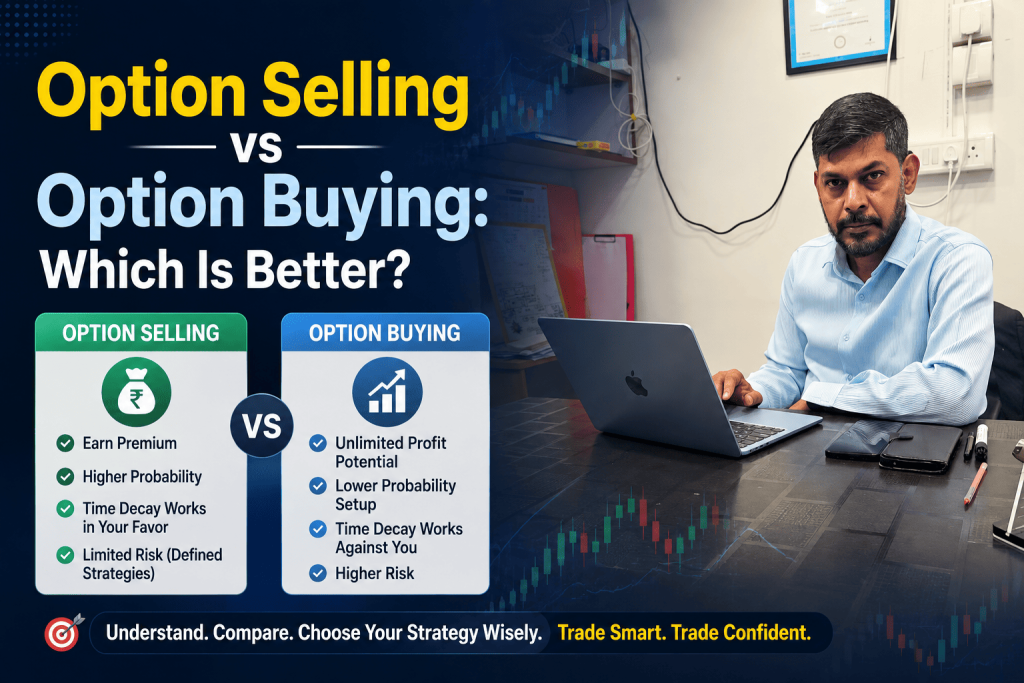
Option selling vs option buying — which strategy suits you? Compare risk, reward, capital needs, and probability with this detailed guide by IITA Mumbai.
Option Selling vs Option Buying: Which Is Better?
Few debates in the trading community are as persistent as option selling vs option buying. Walk into any trading community, online forum, or WhatsApp group, and you’ll find passionate arguments on both sides. The truth is, neither approach is universally “better” — each comes with distinct risk profiles, capital requirements, and psychological demands. This guide breaks down both sides so you can decide which fits your trading style.
Understanding the Basics
Before comparing option selling vs option buying, let’s revisit what each actually means.
Option Buying means purchasing a call or put option, paying a premium for the right (not obligation) to buy or sell the underlying asset at a fixed strike price before expiry. Your maximum loss is limited to the premium paid, while your potential profit is theoretically unlimited (for calls) or substantial (for puts).
Option Selling (Writing) means you sell a call or put option and collect the premium upfront. In exchange, you take on the obligation to fulfill the contract if the buyer exercises it. Your maximum profit is limited to the premium received, but your potential loss can be significant, especially for uncovered (naked) positions.
Option Selling vs Option Buying: Risk and Reward
This is the most fundamental difference in the option selling vs option buying debate:
- Option Buyers have limited risk (premium paid) and unlimited reward potential
- Option Sellers have limited reward (premium received) and potentially unlimited risk
At first glance, buying might sound like the obviously safer choice. But there’s a catch — probability.
The Probability Factor
Statistically, most options expire worthless. This means option sellers, who profit when the option expires without value, tend to win more often — but each win is typically small (the premium collected). Option buyers, on the other hand, lose more often but occasionally land a large win when the market moves significantly in their favor.
This is the core trade-off in option selling vs option buying: sellers aim for frequent small wins, while buyers aim for occasional large wins.
Capital Requirements
Option buying requires relatively less capital — you simply pay the premium. Option selling, however, requires margin, which can be substantial, especially for index options, because your broker needs to ensure you can cover potential losses if the trade moves against you. This makes option selling generally less accessible to traders with smaller capital.
Time Decay (Theta)
Time decay works against option buyers and in favor of option sellers. As expiry approaches, an option’s extrinsic value erodes daily, even if the underlying price doesn’t move. This is one of the most important factors in the option selling vs option buying decision — sellers effectively earn from the passage of time, while buyers need the underlying asset to move meaningfully and quickly to overcome this decay.
Volatility Impact
Rising implied volatility increases option premiums, benefiting buyers who already hold positions and hurting sellers who may see the value of their sold options rise against them. Falling volatility does the opposite. Understanding how volatility affects both sides of option selling vs option buying is essential before choosing either approach.

Which Strategy Suits Beginners?
Many beginners are drawn to option buying because of its limited, well-defined risk and low capital requirement — you know exactly how much you can lose before entering the trade. However, this doesn’t mean it’s more profitable; consistent option buying without a well-timed strategy can lead to a string of small, repeated losses due to time decay.
Option selling, while statistically more favorable in terms of win rate, requires stronger risk management, more capital, and often more market experience, since a single unexpected move can result in outsized losses if positions aren’t hedged.
Combining Both Approaches
Experienced traders often don’t pick a side in the option selling vs option buying debate — they use both, depending on market conditions. For example:
- Buying options during periods of expected high volatility or before major news events
- Selling options during range-bound, low-volatility market phases
- Spreads, which combine buying and selling simultaneously, to define risk on both sides
Risk Management Considerations
Regardless of which side of option selling vs option buying you lean toward, risk management remains non-negotiable:
- Option buyers should avoid holding losing positions purely on hope, and set clear exit rules
- Option sellers should always consider hedged strategies (like spreads) rather than naked positions, especially as beginners
- Both approaches require position sizing rules to prevent a single trade from causing significant account damage

Frequently Asked Questions
1. In option selling vs option buying, which has higher win rate? Option selling generally has a higher win rate because most options expire worthless, allowing sellers to keep the premium. However, each win is typically small, while occasional losses can be large.
2. Is option buying safer than option selling? In terms of maximum loss, yes — option buying limits your loss to the premium paid, while option selling can expose you to larger, sometimes unlimited, losses on uncovered positions.
3. Which requires more capital, option selling or option buying? Option selling requires margin, which is usually much higher than the premium needed for option buying, making selling less accessible for traders with smaller capital.
4. Does time decay favor option buyers or option sellers? Time decay (theta) works against option buyers and in favor of option sellers, since option value naturally erodes as expiry approaches, even without price movement.
5. Should beginners start with option buying or option selling? Most beginners start with option buying due to its limited, well-defined risk and lower capital requirement, gradually exploring option selling as they build experience and risk management skills.
📞 Book Your Free Career & Market Guidance Session Today!
Not sure where to begin? Speak with our academic counselors and discover the right learning path based on your goals.
📍 Office: Andheri West, Mumbai
💻 Training Mode: Both Offline & Online Classes available
📞 Call / WhatsApp: +91 84520 18280, +91 91870 98700
🌐 Website: https://iita.tech/stockmarket-course-in-mumbai/
📸 Follow us on Instagram: @stockmarketcourse_iita
Subscribe to Our YouTube Channels: 🔹 IITA Official: www.youtube.com/@iitab 🔹 Sudha Das (Market Learning): www.youtube.com/@sudhadas8420 🔹 www.youtube.com/@subratdas2506
Disclaimer: Stock market trading involves financial risk. This article is for educational purposes only and is not investment advice.
IITA – https://iita.tech/stockmarket-course-in-mumbai/