
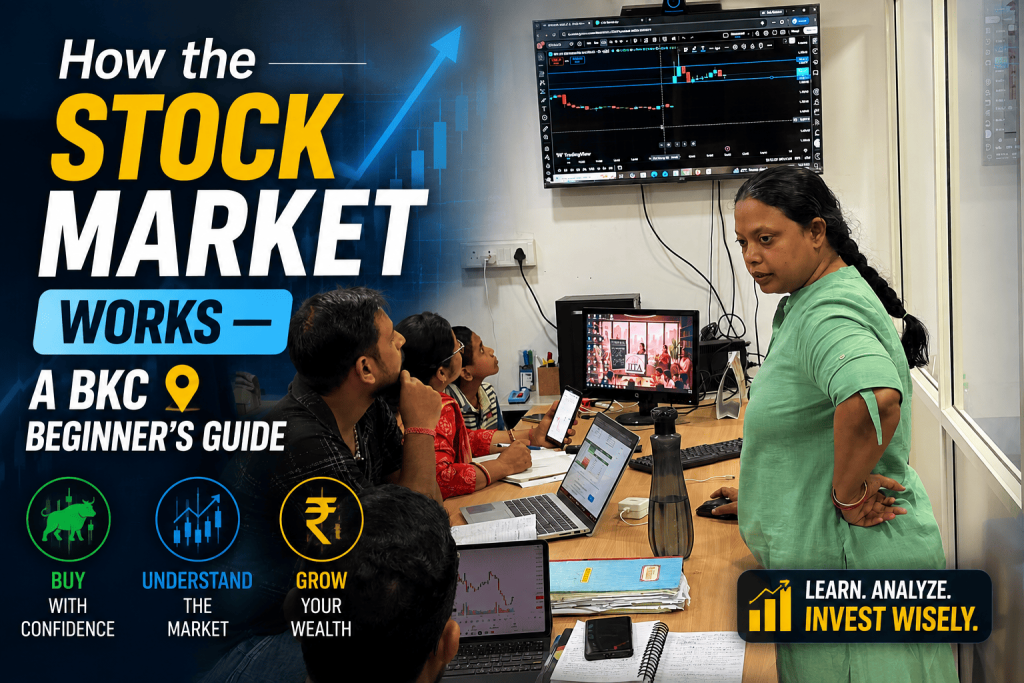
New to investing? Learn how the stock market works in simple terms with this beginner’s guide from IITA, Andheri West. Perfect for professionals near BKC.
How the Stock Market Works — A BKC Beginner’s Guide
If you work anywhere near Bandra Kurla Complex, you’ve probably walked past a dozen conversations about “the market” without really knowing what people are talking about. Someone’s phone shows a green number, someone else is stressed about a red one, and you’re left wondering what any of it actually means. You’re not alone. Most people who eventually become confident investors started exactly where you are right now — curious, a little intimidated, and unsure where to begin.
This guide breaks down how the stock market works in plain language, without the jargon that usually scares beginners away.
What Exactly Is the Stock Market?
At its simplest, the stock market is a marketplace — just like a vegetable market, except instead of buying tomatoes, you’re buying tiny ownership pieces of companies. When a company like Tata Motors or Infosys wants to raise money to grow, it sells small portions of itself called “shares” to the public. When you buy a share, you literally own a small slice of that business.
The stock market is simply the platform where these shares are bought and sold. In India, the two major exchanges are the Bombay Stock Exchange (BSE) and the National Stock Exchange (NSE). Every time you place a buy or sell order through your broker’s app, it gets matched with someone else’s order on one of these exchanges.
How Does the Stock Market Actually Work?
Here’s a simplified breakdown of how the stock market works from start to finish:
- A company lists on the exchange through an IPO (Initial Public Offering), offering shares to the public for the first time.
- Investors buy and sell these shares based on how much they believe the company is worth, or will be worth in the future.
- Prices move up and down depending on demand and supply — more buyers than sellers pushes the price up, and vice versa.
- News, earnings reports, government policy, and global events influence how investors feel about a company, which in turn moves its share price.
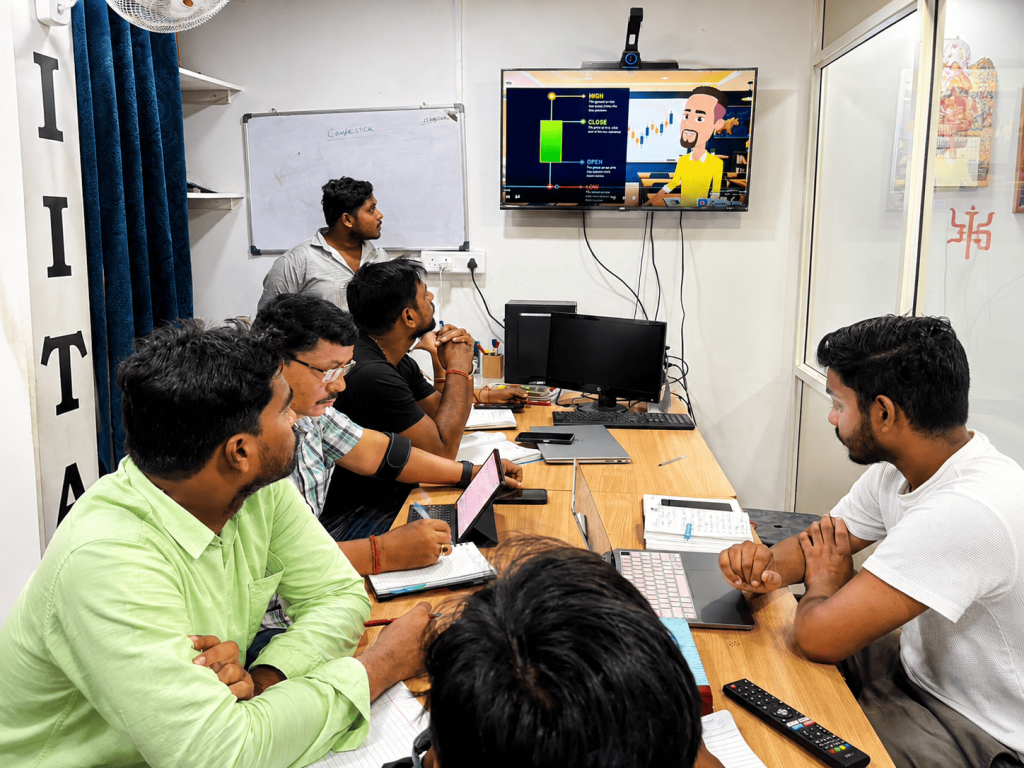
That last point is important. Prices aren’t random. They reflect what thousands of people collectively believe a business is worth at any given moment — based on profits, growth potential, leadership, competition, and even things like interest rates or monsoon forecasts.
Why Do Share Prices Go Up and Down?
This is usually the first question every beginner asks, and it’s a fair one. Share prices fluctuate because of a constant tug-of-war between buyers and sellers.
If a company announces strong quarterly profits, more people want to own a piece of it, so demand rises and the price climbs. If there’s bad news — a scandal, weak sales, or a global slowdown — investors sell, supply increases, and the price drops. Multiply this across thousands of listed companies and millions of investors, and you get the constant motion we call “the market.”
Professionals commuting through BKC every day are surrounded by exactly this kind of decision-making — banks, financial firms, and trading desks that live and breathe these price movements. Understanding the basics puts you in a position to actually participate, instead of just watching from the sidelines.
Who Can Invest in the Stock Market?
Any Indian resident above 18, with a PAN card, a bank account, and a Demat + trading account, can start investing. You don’t need lakhs of rupees to begin — many people start with a few thousand rupees and build their portfolio gradually. What matters far more than your starting capital is understanding how the market works before you put real money on the line.
This is where most beginners go wrong. They open a trading app because a friend told them to, buy a stock because it was “trending,” and lose money simply because they never understood the fundamentals. A structured, beginner-friendly approach avoids this mistake entirely.
Key Terms Every Beginner Should Know
- Demat Account: Holds your shares electronically, similar to how a bank account holds your money.
- Trading Account: Used to actually place buy/sell orders on the exchange.
- Sensex & Nifty: India’s benchmark indices that track the overall performance of top listed companies.
- Broker: The platform or firm through which you buy and sell shares (e.g., Zerodha, Upstox, Groww).
- Portfolio: The collection of stocks and investments you currently hold.
Getting comfortable with these terms is the first real step toward understanding how the stock market works — everything else builds on this foundation.

Is the Stock Market Risky?
Yes, and it’s important to say that honestly. Stock prices can fall, and you can lose money, especially if you invest without research or jump into speculative trading. But risk in the stock market isn’t random chaos — it’s manageable when you understand what you’re doing. Diversification, patience, and proper market education dramatically reduce the chances of making costly beginner mistakes.
This is exactly why structured learning matters more than random YouTube tips or WhatsApp forwarded “hot stock” tips. A proper course teaches you how to read financial statements, understand market cycles, and build a long-term strategy — rather than gambling on guesswork.
Where Should a Beginner Start?
If you’re near BKC and have been putting off learning the market because it feels overwhelming, the good news is that it doesn’t have to be. With the right guidance, most people grasp the basics of how the stock market works within a few structured sessions — no finance degree required.
At IITA, our beginner programs are designed specifically for people starting from zero. We break down real market data, walk through live examples, and help you build the confidence to make your first informed investment decision — not a guess, but a decision backed by understanding.
Final Thoughts
The stock market isn’t a mysterious club reserved for finance experts. It’s simply a system of buying and selling ownership in businesses, driven by information, sentiment, and economic activity. Once you understand the basic mechanics — how shares are priced, why they move, and how to evaluate a company — the market stops feeling intimidating and starts feeling like an opportunity.
Every experienced investor was once a beginner staring at a stock app, unsure what any of it meant. The only difference between where you are now and where they are today is a bit of structured learning and consistent practice.

Frequently Asked Questions (FAQs)
1. How does the stock market work in simple terms? The stock market is a platform where investors buy and sell shares of publicly listed companies. Prices move up or down based on demand, supply, company performance, and broader economic factors.
2. How much money do I need to start investing in the stock market? You don’t need a large amount to begin. Many beginners start with just a few thousand rupees and gradually increase their investment as they gain experience and confidence.
3. What documents do I need to start trading? You’ll need a PAN card, a bank account, and both a Demat and trading account. Most brokers today let you open these online within a day or two.
4. What is the difference between Sensex and Nifty? Sensex tracks the top 30 companies on the BSE, while Nifty tracks the top 50 companies on the NSE. Both are used as benchmarks to gauge overall market performance.
5. Is it safe for a complete beginner to invest in the stock market? Investing always carries some risk, but that risk becomes far more manageable with proper research, diversification, and a long-term mindset. This is exactly why beginner-focused market education matters before you start investing real money.
6. Can I learn the stock market without a finance background? Yes. Most successful investors don’t come from a finance background. With the right structured guidance — like the beginner programs at IITA — anyone can learn how the stock market works, regardless of their educational background.
7. Where can I learn the stock market near BKC or Andheri West? IITA offers both offline classes at our Andheri West office and online classes for those who prefer learning remotely, making it convenient for professionals working near BKC and across Mumbai.
📞 Book Your Free Career & Market Guidance Session Today!
Not sure where to begin? Speak with our academic counselors and discover the right learning path based on your goals.
📍 Office: Andheri West, Mumbai
💻 Training Mode: Both Offline & Online Classes available
📞 Call / WhatsApp: +91 84520 18280, +91 91870 98700
🌐 Website: https://iita.tech/stockmarket-course-in-mumbai/
📸 Follow us on Instagram: @stockmarketcourse_iita
Subscribe to Our YouTube Channels: 🔹 IITA Official: https://www.youtube.com/@iitab 🔹 Sudha Das (Market Learning): https://www.youtube.com/@sudhadas8420 🔹 Subrat Das: https://www.youtube.com/@subratdas2506
Disclaimer: Stock market trading involves financial risk. This article is for educational purposes only and is not investment advice.