
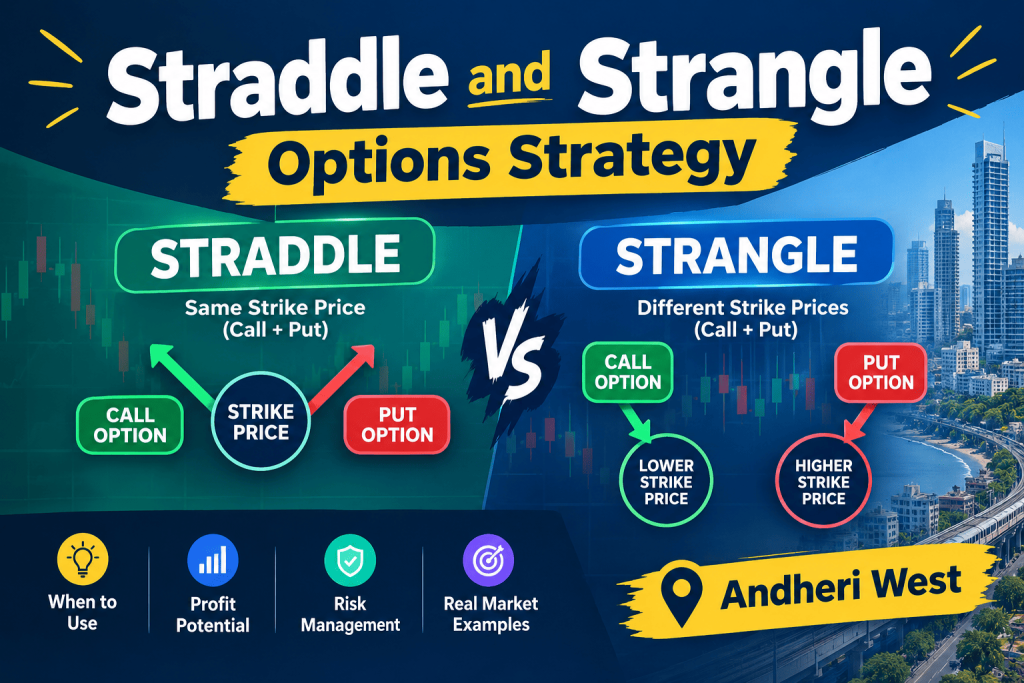
Straddle & Strangle Options Strategy: What to Do When You Don’t Know Which Way the Market Will Move
Learn how the straddle and strangle options strategy works, when to use each, and the risks involved. A practical guide from IITA Andheri West Mumbai.
A student in one of our Andheri West evening batches once asked a question that, honestly, trips up a lot of people who are new to options: “What do I do if I’m sure something big is about to happen, but I have no clue whether it’s going up or down?” That’s a fair question, and it’s exactly the situation the straddle and strangle options strategy was built for.
Most beginners learn options as a directional bet — buy a call if you think the stock will rise, buy a put if you think it’ll fall. But some of the most useful trades don’t care about direction at all. They care about movement. That’s the whole idea behind straddles and strangles.
Two Legs, One Goal
A straddle is simple once you see it laid out: you buy a call and a put on the same stock, same strike price, same expiry, at the same time. If the stock rockets up, the call carries you. If it crashes down, the put does the job instead. Either way, as long as the move is big enough to cover what you paid for both options, you come out ahead.
A strangle works on the same principle but spaces the strikes apart — a call above the current price and a put below it. Because both legs are out-of-the-money, it’s cheaper to set up than a straddle. The catch? The stock now needs to travel further before either leg is worth anything.
Think of it this way: a straddle is betting on a strong reaction, a strangle is betting on an even stronger one, but at a discount.
Where This Actually Gets Used
Earnings season is the classic setup. Budget day is another. So is any RBI policy announcement where the outcome is genuinely up in the air. These are moments when everyone agrees something is coming, but almost nobody agrees on which direction it’ll push the stock or the index.
We’ve had traders in our Andheri West classes run through this exact scenario using past quarterly results — buying a straddle two or three days before a company’s numbers came out, purely on the expectation of a sharp reaction either way.
Long vs Short — and Why the Risk Profile Flips Completely
Here’s where a lot of people get tripped up. You can buy a straddle or strangle (going long), or you can sell one (going short), and the risk changes entirely depending on which side you’re on.
Buying either one caps your maximum loss at the total premium you paid — nothing more, no matter how badly the trade goes against you. Selling either one flips that entirely: your maximum loss is, in theory, unlimited if the underlying makes a violent move you weren’t prepared for.
This is not a small distinction. Selling a naked straddle can look like easy, steady income for weeks — right up until it isn’t.

Doing the Math on Breakeven
For a long straddle, you need the stock to close above the strike plus your total premium, or below the strike minus your total premium, to actually make money. A strangle’s breakeven points sit even further out, since the strikes themselves are already spread apart before you add the premium.
Quick example: say a stock is sitting at ₹1,000 right before its results. You buy a straddle at the ₹1,000 strike for a combined ₹40 in premium. You need the stock above ₹1,040 or below ₹960 to profit. Now try a strangle instead — a ₹980 put and a ₹1,020 call. It might cost less overall, but the stock has to move further past those strikes before you’re actually in the green.
The Piece Everyone Forgets: Implied Volatility
This is the part that separates traders who understand the straddle and strangle options strategy from those who just heard about it once and tried it. Implied volatility drives what you pay for both legs. Buy when implied volatility is already sky-high — which is exactly what happens right before a widely anticipated event — and you’re paying a premium that can collapse the moment the news is out, even if you called the direction correctly. Traders call this volatility crush, and it’s ruined more “obvious” earnings trades than bad direction-calling ever has.
Where People Go Wrong
- Buying right before an event without checking whether implied volatility is already priced sky-high
- Assuming a small move will be “enough” without actually calculating the real breakeven
- Holding on after the event has passed, letting time decay quietly chip away at what’s left
- Selling naked without fully appreciating that the downside isn’t capped

A Reasonable Way to Approach It
If you’re new to this, don’t jump straight to selling. Start by paper-trading a long straddle or strangle around an earnings date you’re already tracking, and watch how the premium behaves before, during, and after the event. You’ll learn more from watching one real cycle play out than from any amount of reading.
Give yourself a hard deadline for the trade too — decide in advance how long you’ll hold it if the anticipated move doesn’t show up, rather than letting time decay make that decision for you.
How This Differs From Just Picking a Direction
New options traders often assume every strategy boils down to “will it go up or down.” A directional call or put buy lives entirely on getting that one call right. A straddle or strangle sidesteps the question altogether — you’re not betting on direction at all, you’re betting that the size of the move will be big enough to outrun what you paid for both legs combined.
This distinction matters practically too. A directional trade can be wrong in two ways: wrong direction, or right direction but not enough movement to cover the premium and time decay. A non-directional position removes the first failure mode entirely — you only need to be right about magnitude, which for a genuinely uncertain, high-conviction event like earnings, is often the easier call to make.
That said, “easier” doesn’t mean “easy.” You’re still exposed to time decay eating both legs simultaneously if the move doesn’t show up when expected, and you’re still exposed to implied volatility contracting sharply the moment the uncertainty resolves — whether that resolution comes as good news, bad news, or a surprisingly quiet non-event.
Sizing the Position Sensibly
Because you’re paying for two legs instead of one, it’s tempting to under-allocate risk thinking and treat the combined cost as “just the premium.” Don’t. Size the entire position — both legs together — against the same risk budget you’d apply to any single directional trade, not double it just because there are two options involved. A useful mental check: if this entire position went to zero, would that loss still sit comfortably within your usual per-trade risk limit? If the answer is no, the position is oversized, regardless of how confident you feel about the upcoming event.
Final Thoughts
The straddle and strangle options strategy is genuinely one of the more elegant tools in options trading — it lets you profit from uncertainty itself rather than requiring you to guess a direction. But “elegant” doesn’t mean “easy.” Getting the timing, the volatility read, and the breakeven math right takes real practice. At IITA, we walk through both live and historical examples in our Andheri West sessions so students actually see how these positions behave in real market conditions, not just on a whiteboard.

📞 Book Your Free Career & Market Guidance Session Today!
Not sure where to begin? Speak with our academic counselors and discover the right learning path based on your goals.
📍 Office: Andheri West, Mumbai
💻 Training Mode: Both Offline & Online Classes available
📞 Call / WhatsApp: +91 84520 18280, +91 91870 98700
🌐 Website: https://iita.tech/stockmarket-course-in-mumbai/
📸 Follow us on Instagram: @stockmarketcourse_iita
Subscribe to Our YouTube Channels: IITA Official: https://www.youtube.com/@iitab 🔹 Sudha Das (Market Learning): https://www.youtube.com/@sudhadas8420 🔹 Subrat Das: https://www.youtube.com/@subratdas2506
Disclaimer: Stock market trading involves financial risk. This article is for educational purposes only and is not investment advice.
IITA – https://iita.tech/best-stock-market-courses-in-mumbai/