
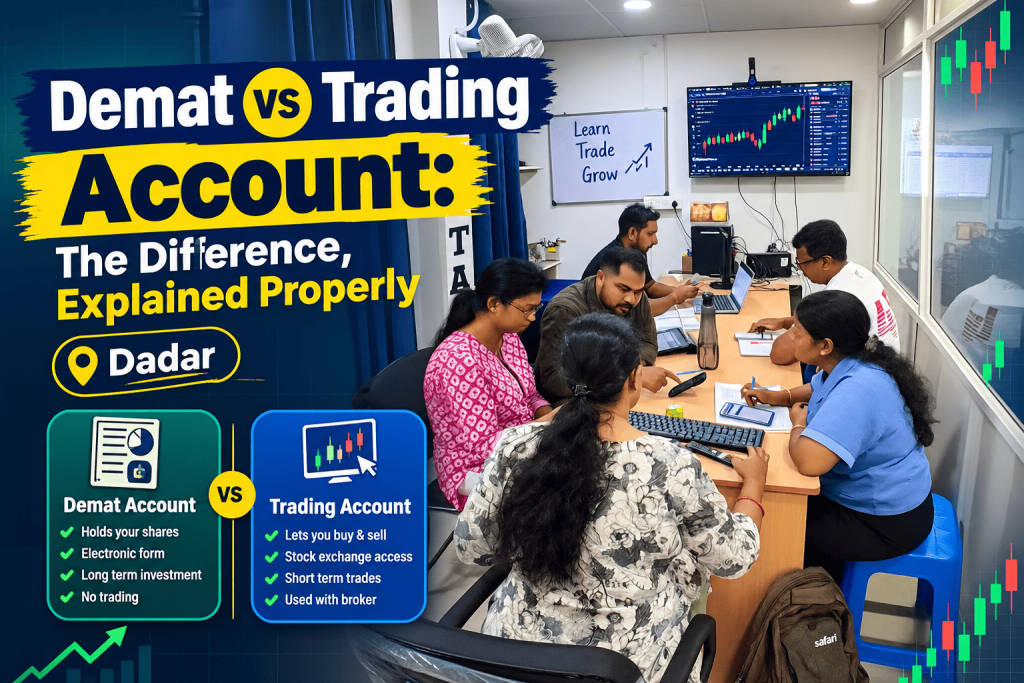
Most beginners think a demat and trading account are the same thing. They aren’t. Here’s what each one actually does, the charges nobody mentions, and what to check before you open one.
Demat vs Trading Account: The Difference Nobody Bothers to Explain
Here’s a question I’ve asked in a lot of first sessions: you’ve opened your account, you’ve bought your first share — where is that share right now?
The answers are all over the place. “In the app.” “With the broker.” “In my bank.” One person said “in the stock market,” which is charmingly close and completely wrong.
Almost nobody gets it right, and it’s not their fault. The whole demat vs trading account distinction gets steamrolled by the account-opening process. You fill one form, upload one PAN, do one video KYC, and out pops something the app calls “your account.” Singular. Except it isn’t one account. It’s two, doing two entirely different jobs.
The Locker and the Counter
The simplest way to hold this in your head:
Your demat account is a locker. It stores things. Your trading account is a counter. It places orders.
That’s genuinely most of it. Everything below is detail.
What the Demat Account Actually Does
Demat is short for “dematerialised” — meaning your shares exist as electronic entries rather than paper certificates.
And paper certificates were a nightmare. Before the late 1990s, buying shares in India meant physical certificates arriving by post, transfer deeds, signatures that had to match exactly, certificates lost in transit, forged certificates, months of waiting. An entire category of fraud existed purely because ownership was recorded on paper.
Your demat account sits with a Depository Participant, which connects to one of two depositories — NSDL or CDSL. Buy a share, it gets credited. Sell it, it gets debited. The account itself doesn’t place any orders and doesn’t hold money. It just holds securities.
What the Trading Account Actually Does
This is the one you interact with. The app, the order window, the buy and sell buttons.
When you tap “buy,” your trading account sends that order to NSE or BSE. The exchange matches it against a seller. Once matched, three things happen almost simultaneously: money leaves your bank account, shares arrive in your demat account, and your trading account shows the position.
The thing people find genuinely surprising: your money does not sit in your trading account. It sits in your bank account, or in the broker’s settlement account if you’ve transferred funds in. The trading account is a pipe, not a container.
Demat vs Trading Account: Side by Side
| Demat Account | Trading Account | |
| Job | Stores your securities | Places buy/sell orders |
| Holds money? | No | No (funds sit in bank/settlement) |
| Holds shares? | Yes | No |
| Connects to | NSDL or CDSL | NSE and BSE |
| Can you invest with only this? | No | No |
Do You Genuinely Need Both?
For buying and selling shares, yes.
There’s one exception worth knowing. You can hold a demat account without an active trading account — say you inherited shares, or you received them through an ESOP, or you rematerialised old physical certificates. Those shares sit there perfectly fine. You just can’t sell them until you link a trading account.
The reverse doesn’t work at all. Buy an equity share with no demat account attached and there’s nowhere for it to land.
The Charges Part — Read This Bit
Broker advertising has trained everyone to compare account opening fees. Which are now mostly zero, so it’s a meaningless comparison.
What actually costs you money:
Annual Maintenance Charge (AMC) sits on the demat account. Typically somewhere between ₹200 and ₹800 a year depending on the broker. Some offer zero-AMC plans with an upfront fee instead. Fine if you’re going to stay for years, bad value if you’re not.
Brokerage sits on the trading account, per trade. Flat-fee brokers charge a fixed amount per executed order; full-service brokers charge a percentage. If you trade rarely, percentage-based might actually be cheaper. If you trade often, flat-fee wins easily.
DP charges hit every time you sell from your demat account — often ₹13 to ₹20 per scrip per day, regardless of quantity. This is the sneaky one. It’s why selling 10 shares of five different companies costs more in DP charges than selling 500 shares of one.
Plus STT, exchange transaction charges, GST and stamp duty, which are broadly similar everywhere because they’re statutory.
The Mistake I See Constantly
Opening accounts with three or four brokers to “try them out.”
Every one of those demat accounts starts accruing AMC. Two years later somebody has ₹2,000 of charges on accounts they used twice. Worse, if the AMC goes unpaid, the account can get frozen and unfreezing it is a tedious paperwork exercise.
Open one. Use it properly for six months. Switch if you must, but close the old one — don’t just abandon it.
What to Check Before You Sign Up
Is the broker a registered member of NSE/BSE and a SEBI-registered DP? Verify on the exchange website, not the broker’s own page.
Does the platform actually work during volatile sessions? Every broker’s app is fast at 2pm on a quiet Wednesday. Ask people who use it what happens on a day the Nifty moves 2%.
How do you reach a human when something goes wrong? Because eventually something will — a stuck order, a corporate action credited incorrectly, a fund transfer that vanishes for a day. A chatbot won’t help you.
Settlement: Why Your Shares Aren’t There Instantly
India runs on T+1 settlement. Buy today, the shares are formally credited to your demat account the next working day.
You’ll usually see them in your holdings immediately in the app, but that’s the broker showing you a pending position. Nothing’s wrong. It’s just how settlement works. This trips people up constantly during their first week.
Where We Start With Students
At our Dadar sessions, the very first practical isn’t charts or strategies. It’s opening the demat and trading account properly, reading the contract note line by line, and reconciling a holdings statement.
Sounds basic. It isn’t. A contract note tells you exactly what you paid in charges — and the number of people who’ve been trading for a year without ever reading one is genuinely higher than you’d expect.
Final Thoughts
The demat vs trading account distinction isn’t trivia. Understanding it means you know where your shares live, where your money sits, why settlement takes a day, and which charges are hitting which account.
Get this right and the rest of market education has something solid to stand on. Skip it, and you’ll spend years slightly confused about your own statements.
Frequently Asked Questions
Can I use one demat account with two different brokers? Usually not directly, though you can transfer holdings between demat accounts. Most people simply maintain separate demat-plus-trading pairs with each broker — just watch the AMC on both.
What happens to my shares if my broker shuts down? Your shares are held with the depository (NSDL or CDSL), not with the broker. The broker is an intermediary. You would need to move to a new DP, but the shares themselves remain yours.
Is a demat account needed for mutual funds? No. Mutual fund units can be held in statement-of-account form directly with the AMC or through an RTA. You only need demat if you specifically want units in demat form or you’re buying ETFs.
Why did I get charged when I sold but not when I bought? That’s the DP charge — levied on debits from your demat account, which happen on selling. Buying credits your account and doesn’t attract it.
Can a minor have a demat account? Yes, operated by a guardian until the minor turns 18, at which point the account has to be converted with fresh KYC.
📞 Book Your Free Career & Market Guidance Session Today!
Not sure where to begin? Speak with our academic counselors and discover the right learning path based on your goals.
📍 Office: Andheri West, Mumbai
💻 Training Mode: Both Offline & Online Classes available
📞 Call / WhatsApp: +91 84520 18280, +91 91870 98700
🌐 Website: https://iita.tech/stockmarket-course-in-mumbai/
📸 Follow us on Instagram: @stockmarketcourse_iita
Subscribe to Our YouTube Channels: 🔹 IITA Official: https://www.youtube.com/@iitab 🔹 Sudha Das (Market Learning): https://www.youtube.com/@sudhadas8420 🔹 Subrat Das: https://www.youtube.com/@subratdas2506
Disclaimer: Stock market trading involves financial risk. This article is for educational purposes only and is not investment advice.