
What Is a Demat Account? How to Open One in India (Step-by-Step)
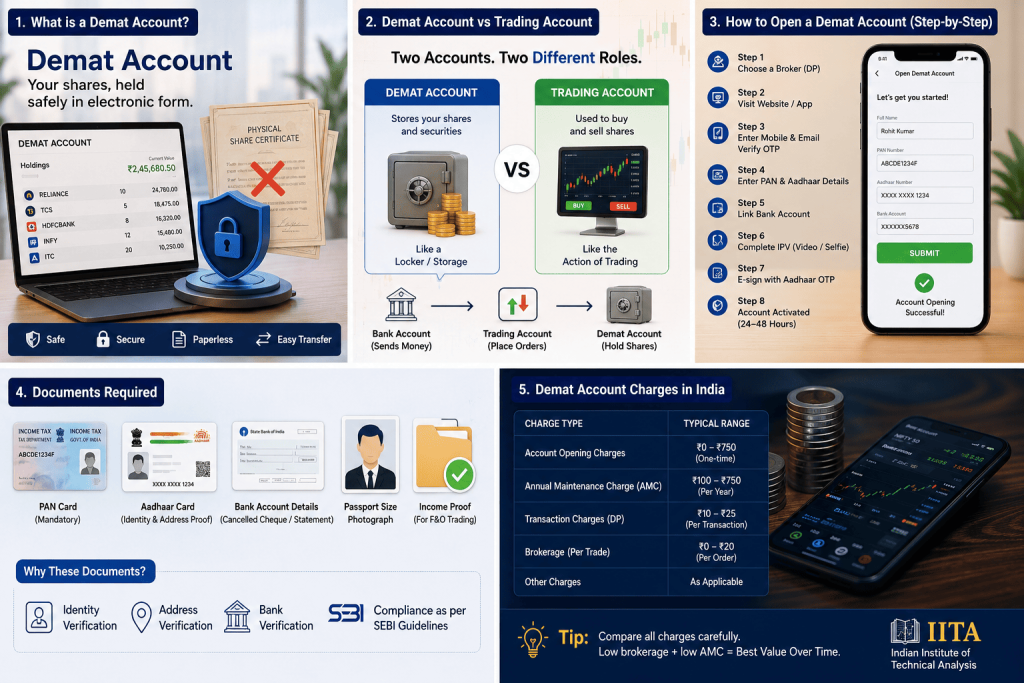
A demat account (short for dematerialised account) is an account that holds your shares and other securities in electronic form, just like a bank account holds your money. Before demat accounts existed, shares were held as physical paper certificates, which were easy to lose, damage, or forge. Today, every share you buy in India is stored safely and electronically in your demat account.
This guide explains what a demat account is, how it differs from a trading account, how to open one, what it costs, and what documents you need, all in simple English.
What Does a Demat Account Do?
A demat account does one main job: it stores your investments electronically. This includes shares, mutual funds, bonds, ETFs, and government securities. When you buy shares, they are credited to your demat account. When you sell, they are debited from it. It works exactly like a bank account, except instead of money, it holds your securities.
Demat Account vs Trading Account: What Is the Difference?
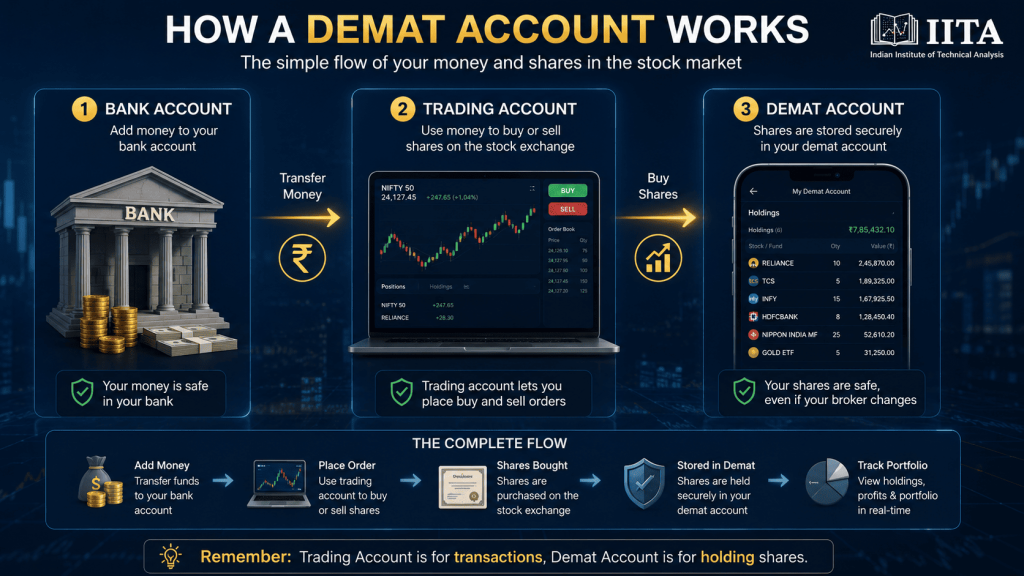
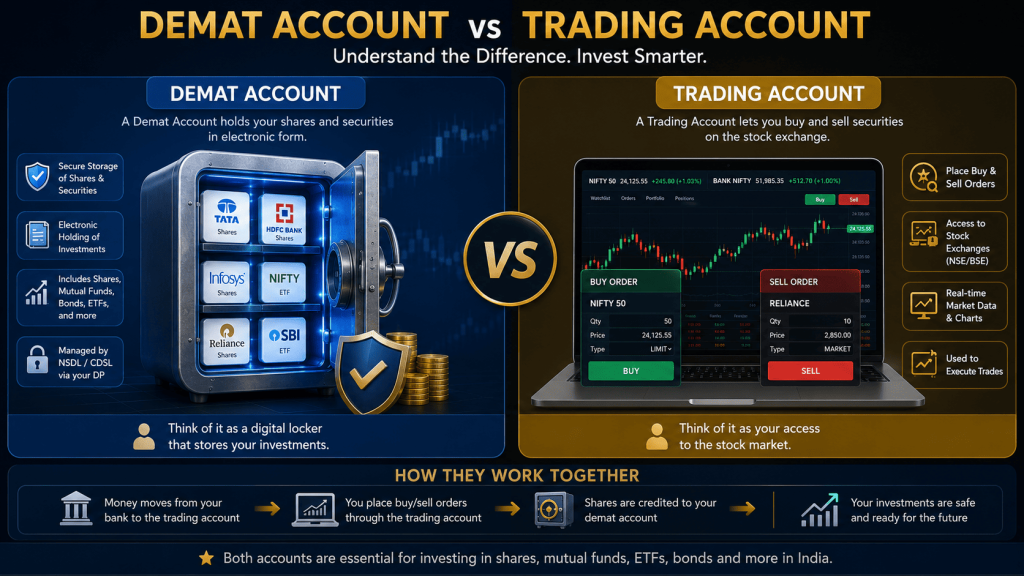
This confuses almost every beginner. You actually need both, and they do different jobs:
- Demat account – stores your shares electronically (like a locker or storage)
- Trading account – lets you place buy and sell orders on the stock exchange (like the action of buying and selling)
Here is a simple way to remember it: the trading account is used to execute the transaction, and the demat account is used to hold what you bought. When you buy shares, money leaves your bank account, the trade happens through your trading account, and the shares land in your demat account.
Most brokers in India offer both accounts together in a single application process, so you do not have to open them separately.
Who Manages Demat Accounts in India?
Demat accounts in India are held with two central depositories:
- NSDL (National Securities Depository Limited)
- CDSL (Central Depository Services Limited)
You do not deal with these depositories directly. Instead, you open your demat account through a Depository Participant (DP), which is usually your stockbroker (like Zerodha, Groww, Angel One, Upstox, or ICICI Direct). The broker acts as the link between you and the depository.
How to Open a Demat Account in India: Step-by-Step
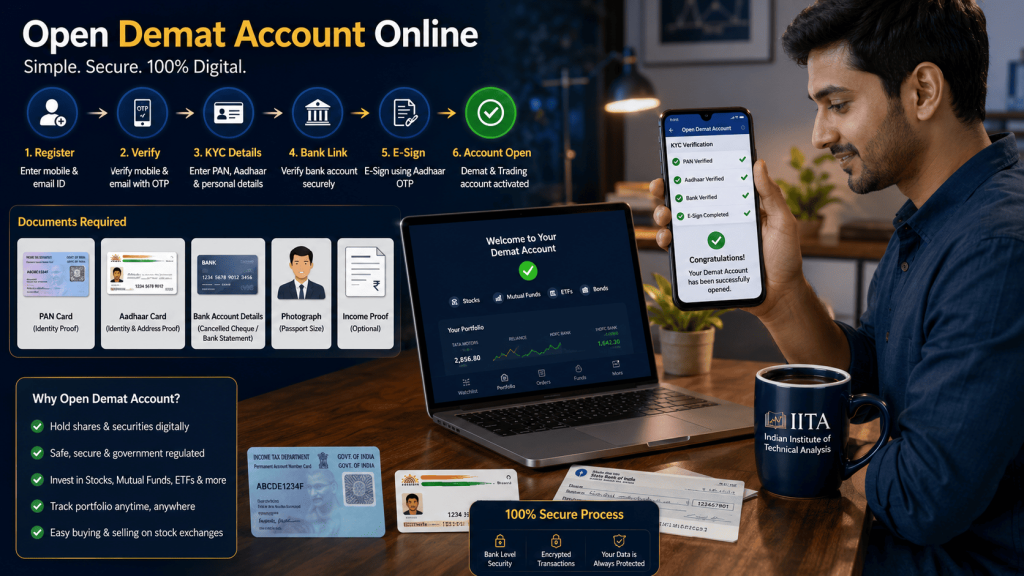
Opening a demat account today is fully online and takes 15–30 minutes. Here is the process:
- Step 1: Choose a broker (Depository Participant). Compare charges, app quality, and service. (See our guide on the best trading apps in India.)
- Step 2: Visit the broker’s website or app and click “Open Demat Account”
- Step 3: Enter your mobile number and email, and verify with OTP
- Step 4: Enter your PAN and Aadhaar details for identity verification
- Step 5: Link your bank account (for adding and withdrawing money)
- Step 6: Complete in-person verification (IPV) via a short video or selfie
- Step 7: E-sign the application using your Aadhaar-linked mobile number
- Step 8: Your account is usually activated within 24–48 hours
Documents Required to Open a Demat Account
- PAN card (mandatory for all stock market activity in India)
- Aadhaar card (for identity and address proof)
- Bank account details (a cancelled cheque or bank statement)
- A passport-size photograph
- Income proof (only required if you want to trade in derivatives like futures and options)

Demat Account Charges You Should Know
Demat accounts are not always free. Here are the common charges to be aware of:
- Account opening charges – many brokers offer this free; some charge a small one-time fee
- Annual Maintenance Charge (AMC) – a yearly fee (typically ₹100–750) to keep the account active. Some brokers offer zero-AMC plans
- Transaction charges – small fees charged by the depository when securities are debited (when you sell)
- Brokerage – charged by the broker per trade (this is a trading account charge, not a demat charge)
Always read the full charge list before choosing a broker. The cheapest opening offer is not always the cheapest over time once AMC and transaction charges are counted.
Things to Check Before Choosing a Demat Account
- Brokerage charges – especially if you plan to trade frequently
- Annual maintenance charges (AMC) – look for low or zero AMC plans
- App and platform quality – a smooth, reliable app matters for active trading
- Customer service – important when something goes wrong
- Additional features – research tools, charting, margin facilities
Frequently Asked Questions About Demat Accounts
What is a demat account in simple words?
A demat account holds your shares and investments in electronic form, similar to how a bank account holds money. When you buy shares, they are stored in your demat account; when you sell, they are removed from it. It is mandatory for stock market investing in India.
Can I open a demat account for free?
Many brokers offer free demat account opening, but most charge an annual maintenance charge (AMC) of around ₹100–750 per year. Some brokers offer zero-AMC plans. Always check the full fee structure, not just the opening offer.
Do I need a demat account and a trading account separately?
You need both, but most brokers open them together in a single process. The demat account stores your shares; the trading account is used to place buy and sell orders. They work together.
What documents do I need to open a demat account?
You need a PAN card, Aadhaar card, bank account details (cancelled cheque or statement), and a photograph. Income proof is required only if you want to trade in derivatives like futures and options.
How long does it take to open a demat account?
The online application takes 15–30 minutes, and most accounts are activated within 24–48 hours after verification is complete.
Open Your Account, Then Learn to Use It Wisely – IITA Bhubaneswar
Opening a demat account is the easy part. Knowing what to buy, when to buy, and how to manage risk is what actually protects and grows your money. That is where most beginners need real guidance.
At IITA Bhubaneswar, we teach you how to use your demat and trading account effectively, from placing your first order to building a complete trading or investing strategy, all with live market practice.
Why Learn with IITA After Opening Your Account
- Practical guidance on placing orders, order types, and platform use
- Complete education from market basics to advanced trading
- Risk management so your first trades do not become costly mistakes
- Live market practice with experienced mentors
- Post-course support during your early trading journey
Visit iita.tech or call us to book a free workshop.
Disclaimer: Stock market trading involves financial risk. This article is for educational purposes only and is not investment advice.
IITA – iita.tech