
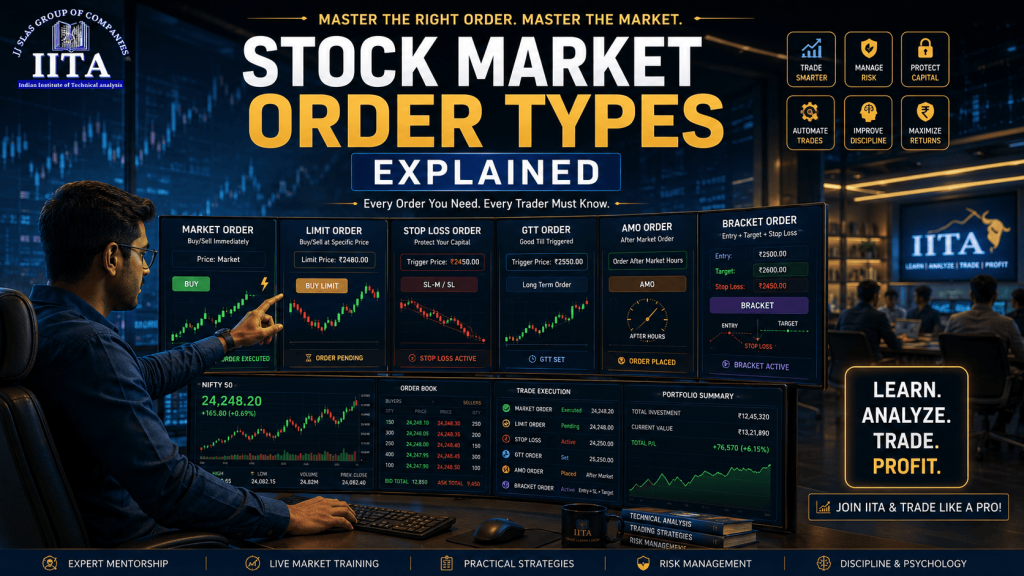
Stock Market Order Types Explained: Every Order a Trader Needs to Know
Knowing what to buy is only half of trading. Knowing how to buy – which order type to use, when, and why – is the mechanical skill that turns your analysis into an actual position. Using the wrong order type can mean getting a worse price than expected, missing an entry entirely, or failing to exit a losing trade when you needed to. Every Indian trading platform offers multiple order types, and understanding each one is essential.
This guide covers every order type available to Indian stock market traders, from the basic ones you will use daily to the advanced ones that automate your risk management.
1. Market Order – Buy or Sell Immediately at the Current Price
A market order executes instantly at the best available price in the order book. You do not specify a price; you accept whatever price the market gives you right now.
- Use when: You need to enter or exit immediately and speed matters more than price precision – fast-moving markets, urgent stop loss exits, or liquid stocks where the bid-ask spread is tiny
- Risk: In illiquid stocks or during volatile moments, the execution price may be significantly different from what you saw on screen. This difference is called slippage
Practical rule: Use market orders for liquid instruments (Nifty options, large-cap stocks) where slippage is minimal. Avoid market orders on illiquid penny stocks where the gap between bid and ask can be large.
2. Limit Order – Buy or Sell Only at Your Specified Price (or Better)
A limit order lets you specify the exact price at which you want to buy or sell. The order only executes if the market reaches your price. If it does not, the order stays pending (and expires at end of day for regular orders).
- Buy limit order: Set below the current market price. Example: Nifty is at 24,050 and you want to buy at 24,000 – you place a buy limit order at 24,000. If Nifty dips to 24,000, your order executes
- Sell limit order: Set above the current market price for taking profit
- Risk: The market may never reach your price, and you miss the trade entirely. In fast-moving markets, limit orders can leave you watching from the sideline
When to use: When you are willing to wait for a better price and missing the trade is acceptable. Swing traders placing orders at support levels commonly use limit orders.
3. Stop Loss Order (SL) – Your Automated Emergency Exit
A stop loss order is a conditional order that becomes active only when the price hits your specified trigger level. It is the most important order type for risk management because it limits your loss automatically without you needing to watch the screen.
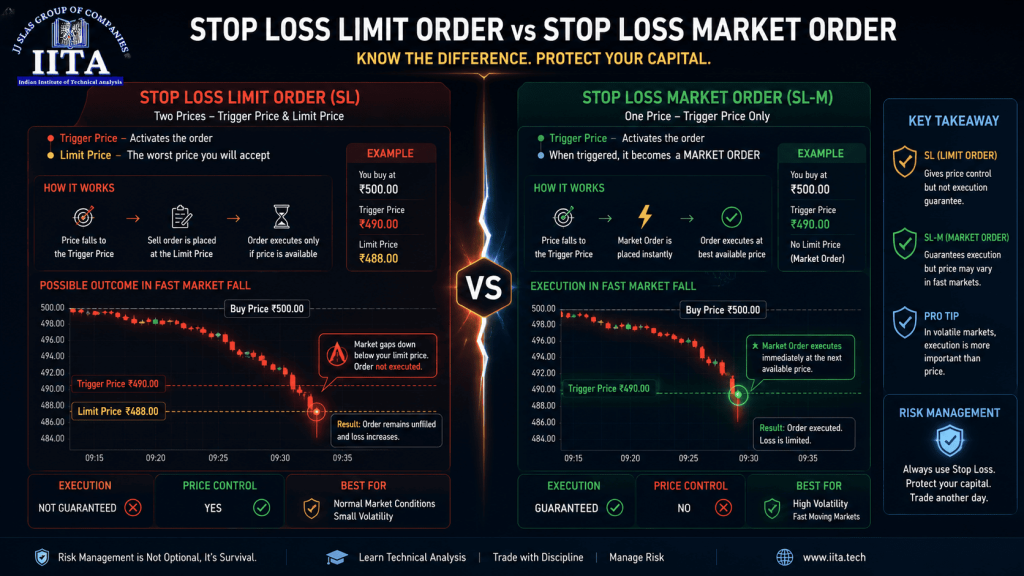
SL Order (Stop Loss Limit)
Has two prices: a trigger price (which activates the order) and a limit price (the worst price you will accept). When the stock hits the trigger, the order enters the order book as a limit order at your specified limit price.
Example: You buy a stock at ₹500. You set a SL order with trigger at ₹490 and limit at ₹488. If the stock falls to ₹490, your sell order is placed at ₹488. If the stock drops below ₹488 too fast (gap down), the order may not fill.
SL-M Order (Stop Loss Market)
Has only a trigger price. When triggered, it becomes a market order and executes at whatever price is available. SL-M guarantees execution but not price. In volatile markets, you may get a worse price than expected. However, it ensures you get out – which is often more important than the exact price.
Practical advice: For most traders, SL-M is safer because it guarantees the exit. SL (limit) can fail to execute in a fast crash, leaving you with an unfilled order and a growing loss.
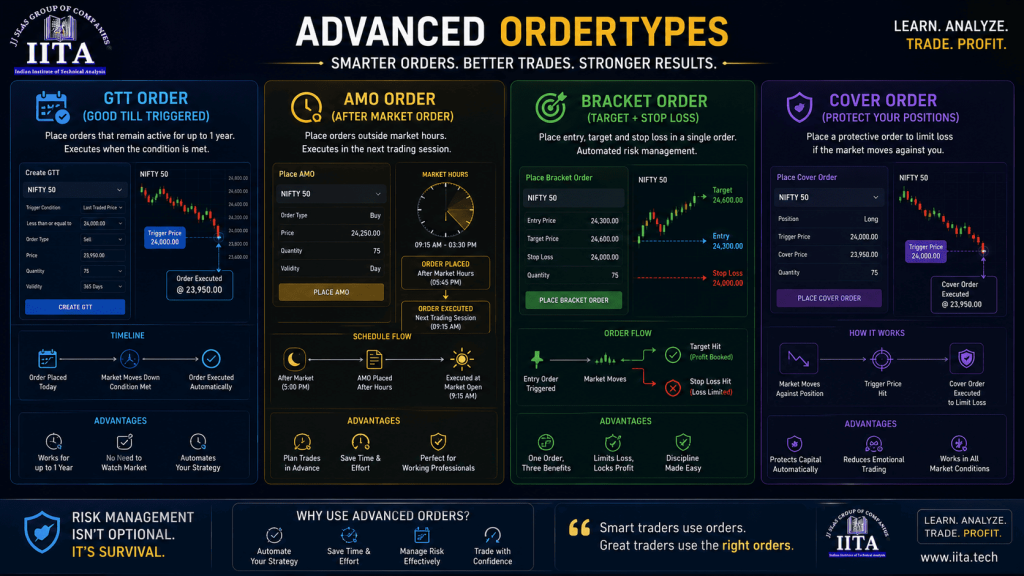
4. GTT (Good Till Triggered) – Long-Term Conditional Orders
A GTT order stays active for up to one year (depending on the broker). You set a condition (price reaching a level), and the order triggers whenever that condition is met, even weeks or months later. It does not expire at the end of the trading day like regular orders.
- Use for long-term stop losses: Set a GTT sell order below your buy price to protect a long-term investment position
- Use for limit entries: Set a GTT buy order at a price you want to buy at, and forget about it until the market reaches that level
GTT is available on Zerodha, Groww, Angel One, and most major Indian brokers. It is extremely useful for investors and swing traders who do not watch the market daily.
5. AMO (After Market Order) – Orders Placed Outside Market Hours
An AMO lets you place orders before the market opens (or after it closes). These orders are queued and sent to the exchange when the pre-open session begins at 9:00 AM. Useful for traders who analyse charts in the evening and want their orders ready for the next morning without needing to be at the screen at 9:15 AM.
6. Bracket Order (BO) – Entry + Target + Stop Loss in One
A bracket order places three orders simultaneously: an entry order, a target (take profit) order, and a stop loss order. When the entry fills, the target and stop loss are automatically placed. When either the target or stop loss is hit, the other is automatically cancelled. It is a complete trade plan in a single order.
Advantage: Enforces discipline by pre-defining your risk and reward before the trade begins. You cannot hold indefinitely or forget to set a stop loss. Limitation: Available mainly for intraday trades on most Indian brokers.
7. Cover Order (CO) – Market Order + Compulsory Stop Loss
A cover order is a market order with a mandatory stop loss attached. Because the stop loss is guaranteed, brokers offer higher leverage on cover orders compared to regular market orders. Useful for intraday traders who want leverage and are disciplined about stop losses.
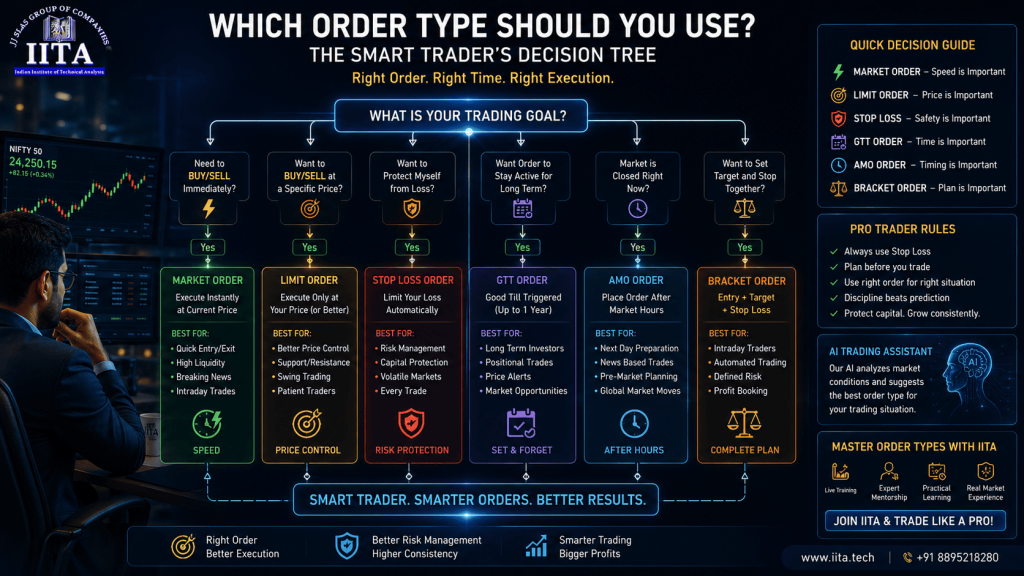
Which Order Type Should You Use?
- Quick entry/exit in liquid instruments → Market order
- Precise entry at a specific price → Limit order
- Automated loss protection → SL-M order (guaranteed exit) or SL order (price control)
- Long-term positions without daily monitoring → GTT order
- Evening analysis, morning execution → AMO order
- Complete trade plan in one click → Bracket order
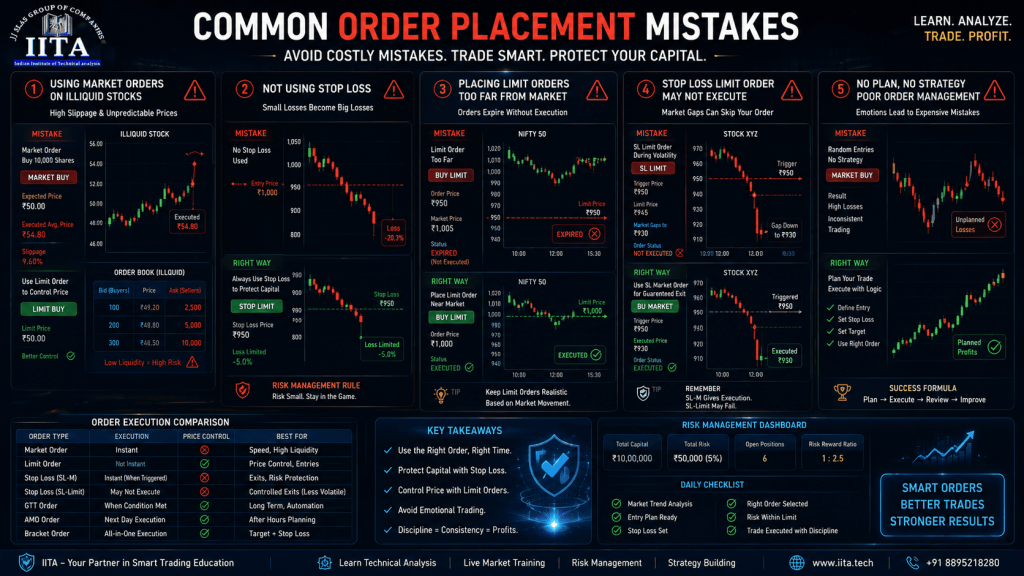
Common Mistakes with Order Types
- Using market orders on illiquid stocks and getting terrible execution prices
- Setting limit orders too aggressively and missing good trades repeatedly
- Not setting any stop loss order – the most dangerous and most common mistake
- Using SL (limit) instead of SL-M during volatile sessions, resulting in unfilled stop losses during crashes
- Forgetting that regular orders expire end of day – use GTT for multi-day conditions
Frequently Asked Questions
What is the difference between market order and limit order?
A market order executes immediately at the current best price – guaranteed fill but not guaranteed price. A limit order executes only at your specified price or better – price controlled but fill not guaranteed if the market does not reach your price.
Which stop loss order should I use: SL or SL-M?
SL-M (Stop Loss Market) guarantees execution – you will definitely exit, though possibly at a slightly worse price. SL (Stop Loss Limit) gives price control but may not fill during fast moves. For most traders, SL-M is the safer choice because the priority is exiting, not optimising the exit price.
What is a GTT order in simple words?
A Good Till Triggered order stays active for up to a year. You set a price condition, and the order automatically triggers when that price is reached, even months later. It is used for long-term stop losses and patient limit entries without needing to monitor the market daily.
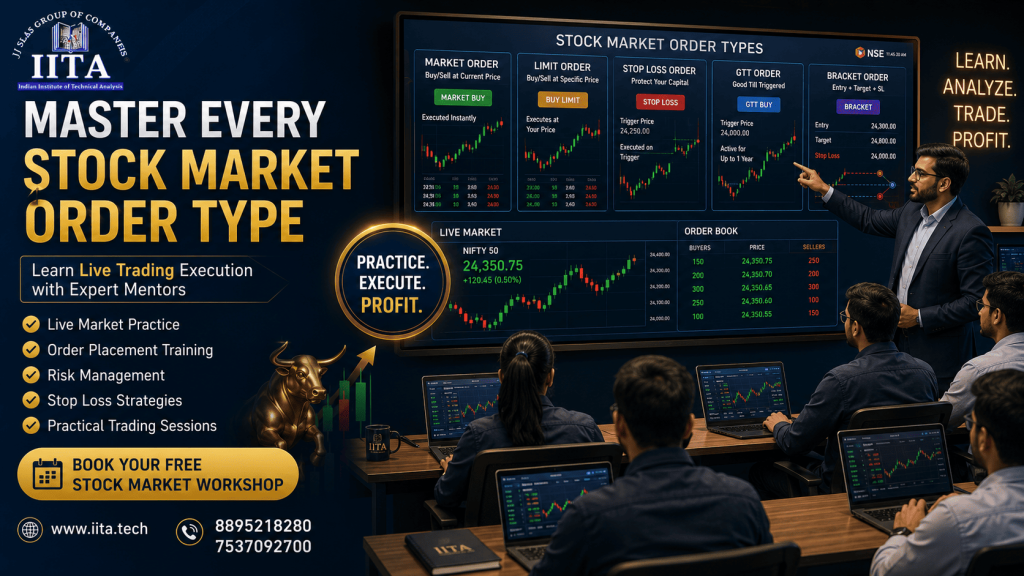
Learn Order Types, Platform Skills, and Trading Execution with IITA Bhubaneswar
At IITA (Indian Institute of Technical Analysis), Bhubaneswar, concepts like these are not taught from slides alone. Our trainers demonstrate on live market charts, letting you practise in real conditions with mentor guidance.
- Live market sessions – learn by doing, not just watching
- Experienced traders as trainers who practise what they teach
- Small batches for personal attention and doubt-clearing
- Post-course mentorship so support continues after class ends
- Classroom and online options available across Odisha
Visit iita.tech or call us to book a free introductory workshop.
Disclaimer: Stock market trading involves financial risk. This article is for educational purposes only and is not investment advice.IITA – iita.tech