
Mutual Funds vs Stock Market: Which One Is Right for You?

This is one of the most common dilemmas for anyone looking to grow their money in India: should I invest through mutual funds, where a professional manages the portfolio, or should I invest directly in stocks, where I pick and manage my own positions? The honest answer is that both have a place, and the right choice depends on your time, knowledge, risk tolerance, and goals – not on which one the internet tells you is “better.”
This guide compares both options across every dimension that actually matters, without bias toward either.

What Are Mutual Funds?
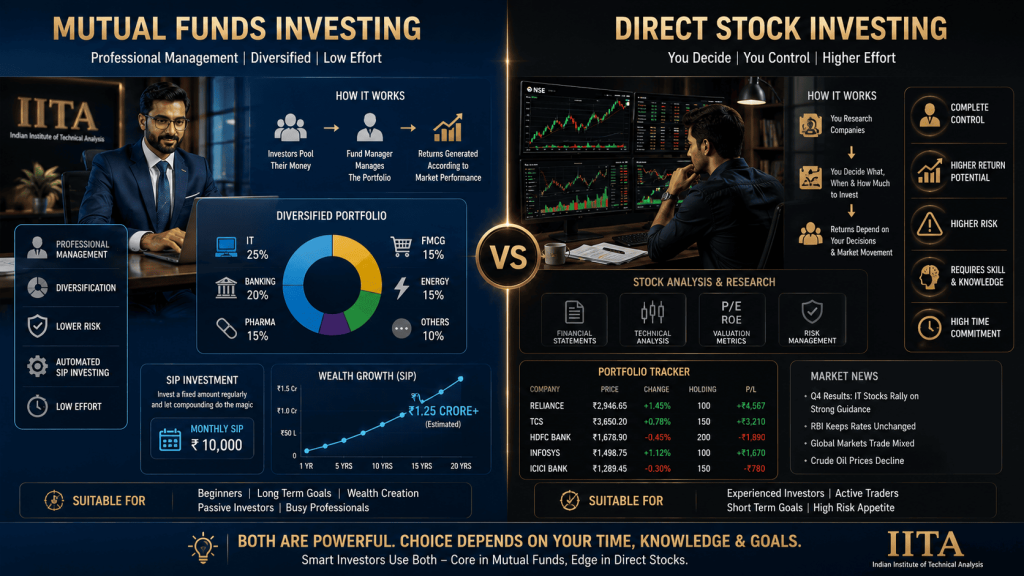
A mutual fund is a pool of money collected from thousands of investors and managed by a professional fund manager who invests it in stocks, bonds, or other assets according to the fund’s stated objective. You do not pick individual stocks; the fund manager does. You own “units” of the fund, and the value of your units rises or falls with the portfolio’s performance.
- Equity mutual funds invest primarily in stocks
- Debt mutual funds invest in bonds and fixed-income instruments
- Index funds passively track an index like Nifty 50 with minimal management
- SIP (Systematic Investment Plan) lets you invest a fixed amount monthly, automating discipline
What Is Direct Stock Investing?
Direct stock investing means you open a demat and trading account, research companies yourself, buy and sell individual shares, and manage your own portfolio. You make every decision: what to buy, when to buy, how much, and when to sell. The outcome depends entirely on your own skill, research, and discipline.
The Comparison: 7 Dimensions That Matter
1. Knowledge Required
Mutual funds: Low. You need to understand fund categories and choose a fund with a good track record. The fund manager handles stock selection. Stocks: High. You need fundamental analysis (to pick good companies), technical analysis (to time entries and exits), and ongoing monitoring. Without knowledge, direct stock picking is educated gambling.
2. Time Commitment
Mutual funds: Minutes per month. Set up an SIP and review performance quarterly. Stocks: Hours per week minimum. Research, monitoring, portfolio rebalancing, reading earnings reports, and tracking market conditions. Active trading requires daily screen time.
3. Diversification
Mutual funds: Built-in. A single equity mutual fund typically holds 30–80 stocks across sectors. Stocks: You must build diversification yourself, which requires more capital and more research. Many beginners put all their money in 2–3 stocks, creating dangerous concentration risk.
4. Returns Potential
Mutual funds: Returns match the market average (index funds) or slightly above/below (active funds). Very few active funds consistently beat the index after fees. Stocks: Theoretically unlimited if you pick well. The top stock pickers dramatically outperform the market. However, most individuals underperform the market average, especially beginners. The potential is higher; the probability of achieving it is lower.
5. Risk
Mutual funds: Lower due to diversification and professional management. A single stock’s crash does not destroy the portfolio. Stocks: Higher, especially with concentrated portfolios. A single bad pick can cause significant losses. Risk management is entirely your responsibility.
6. Cost
Mutual funds: Annual expense ratio (typically 0.5–2% for active funds, 0.1–0.5% for index funds) deducted from the fund’s returns automatically. Stocks: Brokerage per trade (very low with discount brokers like Zerodha), plus taxes (STT, capital gains tax). No ongoing management fee. Over long periods, mutual fund expense ratios can add up significantly.
7. Control
Mutual funds: No control over which stocks the fund holds or when it buys/sells. Stocks: Complete control. You decide everything. This is an advantage if you are skilled and a disadvantage if you are not.
Tax Efficiency: A Factor Most Guides Ignore
Mutual fund taxation and direct stock taxation differ in ways that affect your net returns. Equity mutual funds held over one year qualify for LTCG at 10% above ₹1 lakh, same as direct stocks. However, frequent direct stock trading (especially intraday) is taxed as business income at your slab rate – potentially 30% plus surcharge. SIP into equity mutual funds, held long-term, is among the most tax-efficient investment methods for salaried Indians. Active traders should factor in the higher tax rate on trading income when comparing returns; a 20% gross return taxed at 30% nets less than a 15% mutual fund return taxed at 10%.
Who Should Choose Mutual Funds?
- People with limited time for market research and monitoring
- Complete beginners with no technical or fundamental analysis knowledge
- Anyone who wants a disciplined, automated investment process (SIP)
- Investors seeking long-term wealth creation without active involvement
- People who find stock picking stressful or are prone to emotional decisions

Who Should Choose Direct Stocks?
- People willing to invest significant time in learning analysis and research
- Traders who want to actively manage entries, exits, and risk
- Investors with enough knowledge to evaluate company fundamentals
- Anyone who wants complete control over their portfolio
- People who have already learned the basics and practised (via paper trading or education)
The Practical Middle Ground
Many successful investors use both: the bulk of their portfolio in mutual funds (typically index funds for low-cost, broad exposure) and a smaller allocation for direct stock picks where they apply their growing knowledge. This gives diversified stability from the mutual fund core and the learning opportunity and upside potential from the direct stock allocation.
As your knowledge and experience grow, you can adjust the allocation – shifting more toward direct stocks if your track record justifies it, or staying majority mutual funds if passive investing serves your goals better.

Frequently Asked Questions
Which gives better returns: mutual funds or stocks?
Stocks have higher return POTENTIAL but lower PROBABILITY of achieving it for average investors. Most individual stock pickers underperform index funds over long periods. Skilled stock pickers outperform significantly. The answer depends on your skill level, not on the instrument itself.
Can I invest in both mutual funds and stocks?
Yes, and this is often the smartest approach. Mutual funds for the core portfolio (stability, diversification) and direct stocks for a smaller allocation (learning, higher potential). Many financial advisors recommend this hybrid approach.
Is SIP better than buying stocks?
SIP is an investment METHOD (investing fixed amounts at regular intervals), not a product. You can SIP into mutual funds or even buy stocks periodically. SIP’s advantage is discipline and rupee cost averaging – it removes the timing problem. For most salaried investors, SIP into index funds is the lowest-effort, highest-probability path to long-term wealth.
Should beginners start with mutual funds or stocks?
Start with mutual funds (specifically index funds) for your core savings. Simultaneously, begin learning stock market analysis and practice through paper trading. Move a small portion into direct stocks only when you have built genuine knowledge and a tested approach. This protects your capital while building your skills.
Learn Both Investing and Trading Skills with IITA Bhubaneswar
At IITA (Indian Institute of Technical Analysis), Bhubaneswar, concepts like these are not taught from slides alone. Our trainers demonstrate on live market charts, letting you practise in real conditions with mentor guidance.
- Live market sessions – learn by doing, not just watching
- Experienced traders as trainers who practise what they teach
- Small batches for personal attention and doubt-clearing
- Post-course mentorship so support continues after class ends
- Classroom and online options available across Odisha
Visit iita.tech or call us to book a free introductory workshop.
Disclaimer: Stock market trading involves financial risk. This article is for educational purposes only and is not investment advice.