

IPO Investing in India: Everything a Beginner Needs to Know
When a company that has been private – owned by founders, investors, and private equity – decides to sell its shares to the general public for the first time, that event is called an IPO (Initial Public Offering). IPOs generate enormous excitement in India: long subscription queues, grey market premiums discussed on every trading group, and listing day celebrations or disappointments that make headlines.
But beneath the excitement, IPO investing requires the same rigour as any other investment decision. This guide explains how IPOs work in India, how to apply, how to evaluate them, and the mistakes that cost beginners money.
How an IPO Works in India
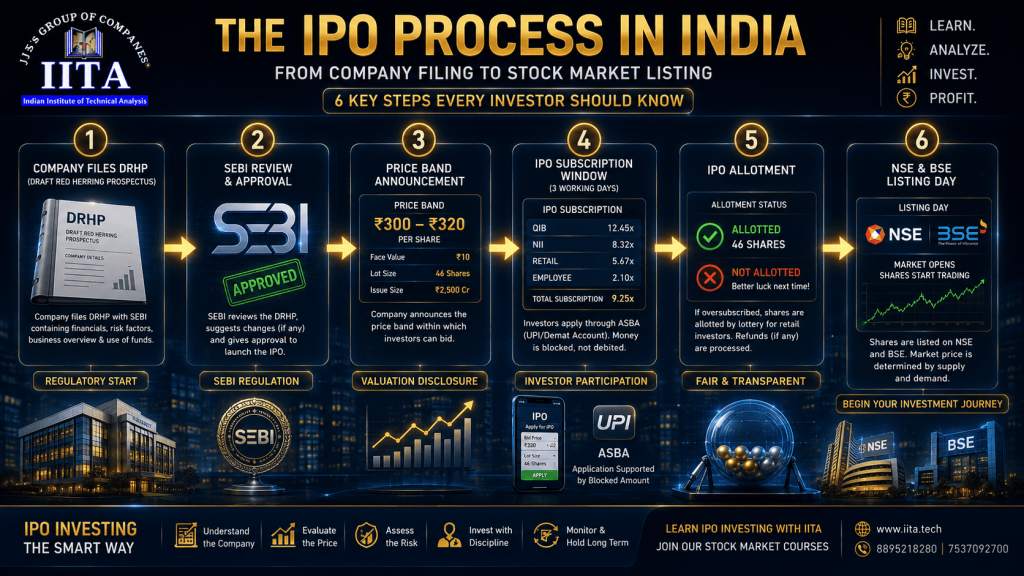
The IPO process follows a regulated sequence:
- Company files DRHP (Draft Red Herring Prospectus) with SEBI, disclosing financials, risks, and use of funds
- SEBI reviews and approves (or requires changes to) the prospectus
- Price band announced – a range (e.g., ₹300–320) within which investors can bid
- Subscription window opens – typically 3 working days during which investors apply
- Allotment – if oversubscribed (more demand than shares available), shares are allotted by lottery for retail investors. If undersubscribed, everyone gets shares
- Listing day – shares begin trading on NSE/BSE, and the market price is determined by supply and demand
How to Apply for an IPO
Applying for an IPO in India is straightforward through your demat account:
- Through your broker’s app: Zerodha, Groww, Angel One, and other brokers have an IPO section where you can bid directly
- Through UPI: Most retail applications use the ASBA (Application Supported by Blocked Amount) method via UPI. Your money is blocked in your bank account (not debited) until allotment. If you do not get shares, the block is released automatically
- Bid at the cut-off price for the highest chance of allotment. Retail investors (applying for up to ₹2 lakh) are allocated shares at the final issue price regardless of their bid, so bidding at cut-off simply means you accept whatever the final price is
The process takes 5 minutes on a phone app. The waiting takes 5–7 days until allotment results are announced.
How to Evaluate an IPO (Before the Excitement Clouds Your Judgement)
1. Read the Prospectus – At Least the Key Sections
The Red Herring Prospectus (RHP) contains everything: the company’s financials, growth history, risk factors, how the money will be used, and the promoters’ background. At minimum, read the financial summary (revenue, profit, debt trends over 3–5 years), the risk factors (the company is legally required to list everything that could go wrong), and the objects of the issue (what the money will be used for – growth investment is good; paying off promoter debt is a red flag).
2. Check the Financials
- Revenue growth: Is revenue growing consistently or erratically?
- Profitability: Is the company profitable? Companies that are burning cash and have no path to profit are higher risk
- Debt levels: High debt relative to equity is a warning sign
- Compare with listed peers: If similar companies trade at 20x earnings and this IPO is priced at 50x, you are paying a premium that needs strong justification
3. Understand the Valuation
The IPO price is set by the company and its investment bankers, not by the market. They have an incentive to price it as high as investors will accept. Compare the IPO’s Price-to-Earnings (P/E) ratio with comparable listed companies. If the IPO is priced significantly higher, ask why – and “future growth potential” without concrete evidence is not a sufficient answer.
4. Check Promoter Track Record
Who are the promoters and what is their history? Have they built successful businesses before? Are they retaining a significant stake post-IPO (a good sign – they believe in the company’s future) or selling most of their shares (a warning sign – they may be cashing out)?
Grey Market Premium (GMP) – What It Really Tells You
The grey market premium is the unofficial premium at which IPO shares trade before listing, in an unregulated market. A GMP of ₹50 on a ₹300 IPO suggests the market expects a listing around ₹350. Many investors use GMP as their primary decision tool.
The honest assessment: GMP is a sentiment indicator, not a guarantee. It is based on small, unregulated trades and can be manipulated. IPOs with high GMP have listed flat or negative, and IPOs with low GMP have surprised positively. Use GMP as one data point, never as the only one.
Listing Day: The Reality
Listing day is when IPO shares start trading on the exchange. The opening price is determined by market demand. Three outcomes are possible:
- Premium listing: Opens above IPO price (what everyone hopes for). Many retail investors sell immediately to book the listing gain
- Flat listing: Opens near the IPO price. No quick profit, but not a loss either
- Discount listing: Opens below IPO price. Immediate loss for all allottees. This happens more often than the hype suggests
Strategy consideration: If you plan to sell on listing day, you are not investing – you are playing a one-day allocation lottery. If you plan to hold long-term, the listing price matters much less than the company’s fundamentals and growth over years.

Common IPO Investing Mistakes
- Applying for every IPO without reading the prospectus – not all IPOs are good investments
- Relying solely on GMP – it is a sentiment gauge, not a valuation tool
- Borrowing money to invest in IPOs expecting guaranteed listing gains – listing losses are real and common
- Ignoring the lock-in period for anchor investors – when the lock-in expires, large selling pressure can push the price down
- Not comparing IPO valuation with listed peers – paying a premium without justification
- FOMO-driven applications – oversubscription does not mean the company is good; it means many people applied, possibly for the same uninformed reasons

Frequently Asked Questions
What is an IPO in simple words?
An IPO is when a private company sells shares to the public for the first time. After the IPO, the shares trade on stock exchanges (NSE/BSE) where anyone can buy and sell them. The IPO is the company’s entry into the public market.
Is IPO investing safe?
IPO investing carries the same risks as any stock investment, plus additional uncertainty because the company has no public trading history to analyse. Some IPOs deliver excellent returns; others list below the issue price and decline further. Due diligence (reading the prospectus, checking financials, comparing valuations) is essential.
How much money do I need to apply for an IPO?
The minimum application is one lot, which varies by IPO but is designed to stay within ₹15,000. Under current SEBI rules, retail investors can apply for up to ₹2 lakh per IPO. The money is blocked (not debited) via UPI until allotment.
What happens if I do not get allotment?
The blocked amount in your bank account is released within 1–2 working days. You lose nothing. There is no charge for applying and not receiving allotment.
Learn Fundamental Analysis and Investment Skills with IITA Bhubaneswar
At IITA (Indian Institute of Technical Analysis), Bhubaneswar, concepts like these are not taught from slides alone. Our trainers demonstrate on live market charts, letting you practise in real conditions with mentor guidance.
- Live market sessions – learn by doing, not just watching
- Experienced traders as trainers who practise what they teach
- Small batches for personal attention and doubt-clearing
- Post-course mentorship so support continues after class ends
- Classroom and online options available across Odisha
Visit iita.tech or call us to book a free introductory workshop.
Disclaimer: Stock market trading involves financial risk. This article is for educational purposes only and is not investment advice.
IITA – iita.tech