
What Is Legal Forex Trading in India?
Indian residents can legally trade the following currency pairs as exchange-traded derivatives on NSE/BSE/MSE:
- USD/INR — US Dollar versus Indian Rupee. Highest liquidity, tightest spreads. Most actively traded currency derivative in India.
- EUR/INR — Euro versus Indian Rupee. Moderate liquidity.
- GBP/INR — British Pound versus Indian Rupee.
- JPY/INR — Japanese Yen versus Indian Rupee.
- Cross-currency pairs (since 2015): EUR/USD, GBP/USD, and USD/JPY were added as cross-currency futures and options on NSE. These do not involve INR directly but are exchange-traded and therefore legal.
That is the full list. You cannot legally trade EUR/GBP, AUD/USD, NZD/USD, or any exotic pairs as an Indian retail trader on regulated exchanges. Anyone offering you those products through an ‘India office’ of a foreign broker is operating in a legal grey area at minimum, and outright violation of FEMA in most cases.
Forex Trading India: What Is Legal, What Is Not, and How to Trade Currency Derivatives on NSE
Let us start with the most important fact that most online forex content in India conveniently skips: trading forex on international brokers like MetaTrader, OANDA, IG, or any foreign platform is illegal for Indian residents under the Foreign Exchange Management Act (FEMA) 1999. The Reserve Bank of India (RBI) and SEBI have been absolutely clear on this. If you are using a foreign forex broker from India, you are violating FEMA — regardless of how easy the sign-up is or how many YouTube videos promote it.
What IS legal is trading INR-paired currency derivatives on Indian regulated exchanges — NSE, BSE, and Metropolitan Stock Exchange (MSE). This is genuine, regulated forex trading that Indian traders can access through any SEBI-registered broker. This guide covers how it works, what you can trade, and how to apply technical analysis to the USD/INR and other currency pairs.
How USD/INR Currency Futures Work on NSE
USD/INR futures on NSE are exchange-traded contracts where each lot represents 1,000 US Dollars. The contract is cash-settled — you do not actually exchange dollars. Instead, the profit or loss on your position is settled in Indian rupees based on the RBI reference rate on expiry. Contracts expire on the last business day of every month, with up to 12 monthly contracts available at any time.
Contract specifications (verify current details with NSE as these can change): Lot size 1,000 USD, margin requirement approximately 2 to 3 percent of contract value (check with your broker for current SEBI-mandated margin requirements), trading hours 9:00 AM to 5:00 PM (Monday to Friday), price quoted in rupees per USD with a tick size of 0.25 paise.
USD/INR Technical Analysis: Key Factors That Drive the Rate
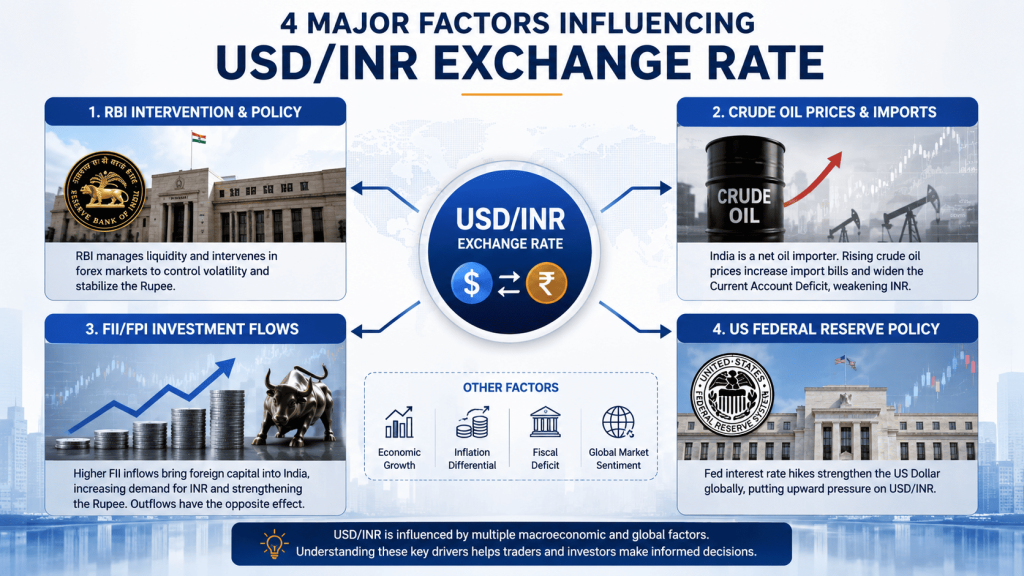
USD/INR is not purely a technical chart — it is heavily influenced by macroeconomic and policy factors that every Indian forex trader must understand before relying only on chart patterns.
- RBI intervention: The RBI actively manages the rupee and intervenes in the forex market when volatility becomes extreme. This is a fundamental reality that can invalidate technical levels instantly. A strong support level in USD/INR can break or hold based on RBI’s willingness to sell dollars — something no technical indicator can predict.
- Current Account Deficit (CAD): India is a net oil importer. When oil prices rise, India’s import bill increases, widening the CAD, which weakens the rupee (USD/INR goes up). This is why crude oil prices and USD/INR historically show positive correlation.
- FII/FPI flows: When foreign institutional investors buy Indian stocks and bonds, they bring dollars into India, which strengthens the rupee (USD/INR falls). When they sell and repatriate, the rupee weakens.
- US Federal Reserve policy: When the US Fed raises interest rates, the dollar strengthens globally, including against the INR. The 2022-2023 Fed rate hiking cycle saw USD/INR move from approximately 74 to 83 — a massive move driven by fundamental forces, not chart patterns.
Technical Analysis Applied to USD/INR
Despite fundamental dominance, USD/INR does respond to technical levels, particularly for short-term intraday and swing trading.
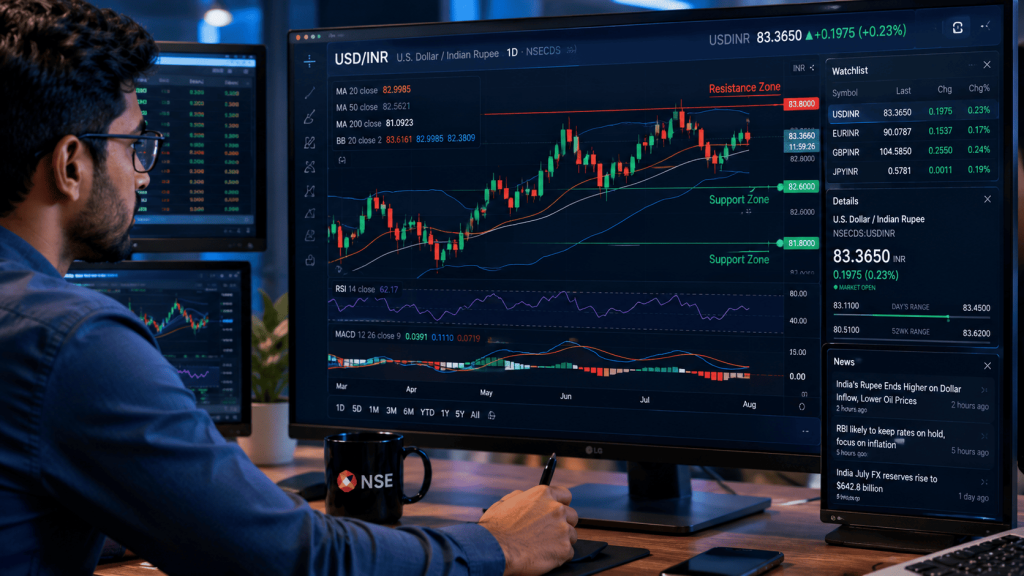
Support and Resistance on USD/INR: Round numbers (80.00, 83.00, 84.00) act as strong psychological levels. The RBI is also known to defend specific levels, making certain support zones particularly strong. When USD/INR approaches multi-year highs, the RBI tends to intervene, creating artificially strengthened resistance.
Moving Averages: The 20-day and 200-day EMAs are widely tracked by institutional traders in USD/INR. The trend in the 200-day EMA direction is generally the safest directional bias for swing positions.
Bollinger Bands on USD/INR: Because the RBI manages volatility, USD/INR often trades within a tighter Bollinger Band range than pure market-driven pairs. Mean reversion strategies — selling when price touches the upper band and buying lower band touches — have historically worked well during stable RBI intervention phases.
Currency Options on NSE India
NSE also offers USD/INR options — European-style, cash-settled, with the same contract specifications as futures. Currency options India are used by: exporters who want to protect against rupee appreciation (buy USD put options), importers hedging against rupee depreciation (buy USD call options), and traders speculating on or hedging volatility around events like RBI monetary policy decisions, Union Budget, and US Fed meetings.
Currency options have lower capital requirements than futures because you pay only the premium — but the premium is non-refundable if you are wrong about direction. For beginners, USD/INR futures are typically simpler to learn with before moving to options strategies.

Frequently Asked Questions
Can I use MetaTrader or foreign forex brokers from India?
No. Legally, you cannot. Trading forex on foreign platforms is a violation of FEMA 1999. The RBI and SEBI have repeatedly issued warnings about illegal forex trading through unauthorized platforms. The legal route is NSE/BSE/MSE currency derivatives through a SEBI-registered broker. Many Indian traders do it illegally — that does not make it legal or safe.
Is currency derivatives trading taxable in India?
Yes. Profits from currency derivatives in India are treated as business income (non-speculative) and taxed at your applicable income tax slab rate. They are not taxed as capital gains. Losses from currency derivatives can be set off against other business income and carried forward for 8 years.
What is the minimum amount needed to trade USD/INR futures in India?
A single USD/INR futures lot represents 1,000 USD (approximately 83,000 to 85,000 rupees at current rates). The margin requirement is approximately 2 to 3 percent, meaning you need approximately 2,000 to 2,500 rupees per lot in margin. However, trading single lots without adequate risk capital to absorb losses is inadvisable. IITA recommends having at minimum 5 to 10 times the margin requirement as trading capital.
Why Choose IITA?
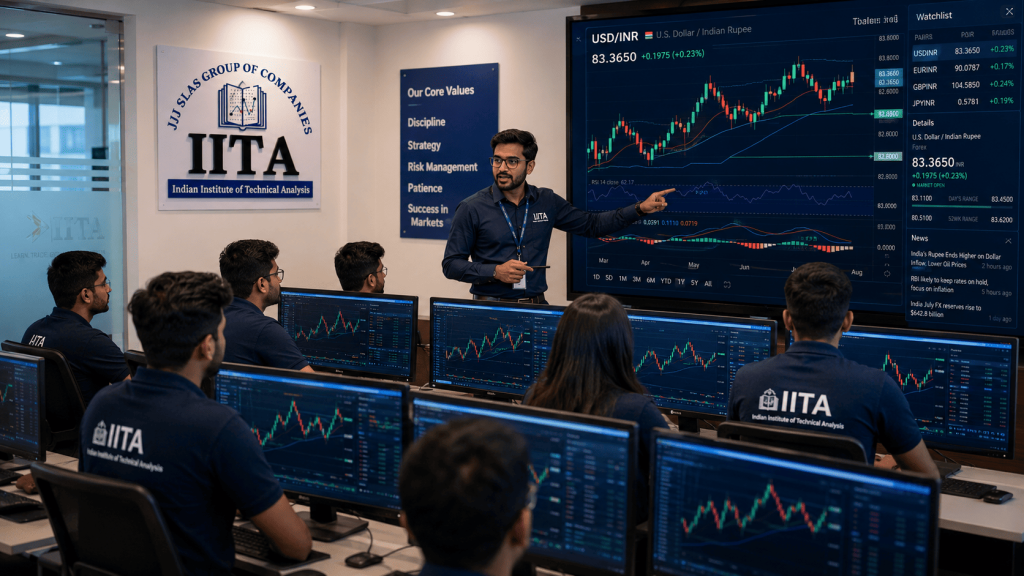
We do not just teach from a book. At IITA, you learn by doing. Our trainers are experienced and guide you step by step, whether you are a complete beginner or already know the basics. Our strong record of happy students and positive reviews speaks for itself.
What IITA Gives You
- Clear, simple teaching that anyone can follow, even with no finance background
- Real practice on live markets, not just classroom theory
- Personal attention and doubt-clearing from experienced mentors
- Support and guidance even after your course ends
- Both classroom and online learning options to suit your needs
Our USP – What Makes Us Different
- Live Market Training: we teach you on real, live markets so you learn how trading actually works
- Success Guaranteed Courses: our courses are designed to give you real skills and confidence
- Both Indian and Forex Market Live Training: learn to trade in both Indian markets and the global forex market with live practice
If you want to learn the stock market the right way in Bhubaneswar, IITA is ready to guide you. Visit iita.tech or call us to book a free workshop and see the difference for yourself.
Disclaimer: Stock market trading involves financial risk. This article is for educational purposes only and is not investment advice.