

Confused between free vs paid stock market courses? Compare both honestly and learn what beginners in India should actually choose in 2026.
Free vs Paid Stock Market Courses in India: What Beginners Should Actually Choose
Every beginner faces the same dilemma at some point — “Why should I pay for a stock market course when there are thousands of free videos and blogs available online?” It’s a fair question. But the honest answer isn’t as simple as “free is always enough” or “paid is always better.” Let’s break down free vs paid stock market courses properly, so you can make a decision based on facts, not assumptions.
What Free Stock Market Learning Actually Offers
Free resources — YouTube videos, blogs, social media pages, and forums — are genuinely useful for building initial awareness. They can help you understand basic terms like shares, Sensex, Nifty, or what a demat account is, at zero cost and your own pace.
Where free resources work well:
- Understanding basic definitions and terminology
- Getting a general sense of how the market moves
- Exploring different topics before committing to a specific learning path
- Building initial curiosity and motivation
Where free resources fall short:
- Content is scattered and unstructured — you jump between videos without a clear progression
- No one to clear your doubts in real time
- Quality varies wildly; some free content is outdated, incorrect, or overly simplified
- No practical exposure, mentorship, or accountability to actually apply what you learn
What a Paid Stock Market Course Actually Offers
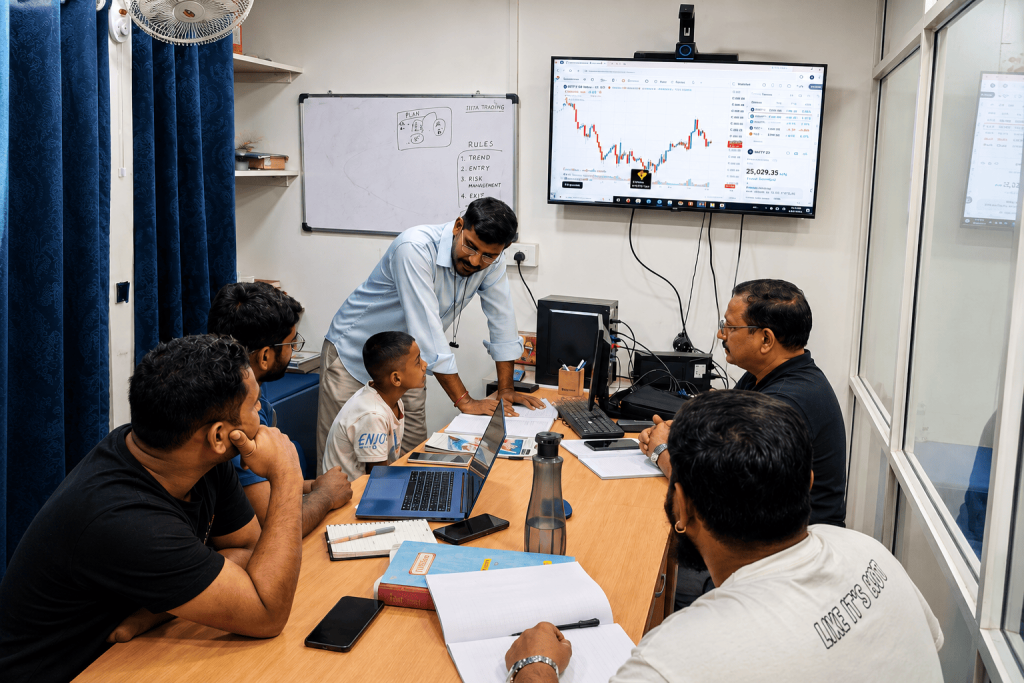
A well-structured, paid stock market course in Mumbai typically follows a curriculum that builds knowledge step by step — from basics to technical analysis to risk management — rather than leaving you to piece it together randomly. This is really the heart of the free vs paid stock market courses debate: structure versus scattered self-learning.
Where paid courses add real value:
- Structured curriculum that builds concepts in the right order
- Live doubt-clearing sessions with experienced mentors
- Practical exposure through live market examples, not just theory
- Peer learning through batch-based classes
- Certification or credibility that can matter for career opportunities
- Accountability — you’re more likely to complete a course you’ve invested in
Where paid courses can fall short:
- Not every paid course is well-structured; some are overpriced with generic content
- Course quality depends heavily on the institute’s actual teaching approach, not just marketing claims
Free vs Paid Stock Market Courses: Is It Even the Right Comparison?
The more useful question isn’t “free or paid,” but “what does structured, mentored learning save me compared to trial-and-error self-learning?” Many beginners who rely purely on free content end up making costly mistakes in the actual market — jumping into trades without understanding risk management, or misreading chart patterns because no one corrected their understanding early on.
A paid stock market course isn’t about replacing free learning entirely — it’s about adding structure, mentorship, and accountability to a process that free content alone often can’t provide. Framed this way, free vs paid stock market courses stops being an either-or decision and becomes a question of sequencing.
How to Decide What’s Right for You
Choose primarily free learning if:
- You’re just exploring whether the stock market interests you at all
- You have significant time to self-study and cross-verify information from multiple sources
- You’re comfortable learning without direct mentorship or doubt-clearing support
Consider a paid course if:
- You want a structured path from beginner to confident investor or trader
- You’ve tried free resources but still feel confused about how concepts connect
- You value live mentorship, practical exposure, and faster progress
- You’re serious about eventually trading or investing with real capital and want to reduce costly beginner mistakes
What to Check Before Paying for Any Stock Market Course
If you do decide to invest in a paid course, don’t choose based on advertisements alone. Check:
- Curriculum structure — does it progress logically from basics to advanced topics?
- Faculty experience — are mentors actively involved in the market, not just teaching theory?
- Live interaction — does the course offer real doubt-clearing sessions, not just recorded videos?
- Practical exposure — is there live market practice, paper trading, or case studies included?
- Fees transparency — are share market course fees in Mumbai clearly explained, without hidden charges?
A Balanced Approach Many Successful Investors Use
Many experienced investors actually use both — free content to explore topics casually, and a structured paid course to build a serious, disciplined foundation. This combination often works better than relying entirely on one or the other, which is really the most honest answer to the free vs paid stock market courses question. Free resources can supplement your learning after a course, helping you stay updated with market news and trends, while the paid course gives you the structured base to interpret that information correctly.

Why Beginners in Mumbai Often Choose Structured Courses
Given how much misinformation circulates on social media about “quick trading tips” and unrealistic profit claims, many beginners in Mumbai prefer joining a proper stock market training institute where the curriculum is verified, mentors are experienced, and the learning path is designed specifically for people starting from zero. This reduces the risk of picking up bad habits early — something that’s much harder to unlearn later.
For working professionals, weekend share market classes in Mumbai offer a practical middle ground — structured, mentored learning without disrupting weekday schedules.
Frequently Asked Questions
Can I become a successful investor using only free resources? It’s possible, but it typically takes much longer and involves more trial-and-error mistakes compared to structured, mentored learning.
Is a paid stock market course worth it for someone with almost no knowledge? For complete beginners, a paid course can significantly reduce the confusion and scattered learning that often comes from relying purely on free resources.
How to learn share market from zero in Hindi, whether free or paid? Yes, this is possible. Many institutes in Mumbai now offer content in Hindi and English both, whether through free introductory sessions or full paid courses.
Share market seekhne me kitna time lagta hai using free resources alone? It can take significantly longer with free resources alone, since the learning isn’t structured — often several months longer than a guided course covering the same ground.
Final Thoughts: Free vs Paid Stock Market Courses
Free and paid stock market learning both have their place — the key is understanding what each format actually offers and being honest about which one fits your current stage and goals. If you’re serious about building real, structured knowledge and reducing costly early mistakes, a well-chosen paid course at IITA Mumbai can be a genuinely worthwhile investment in your financial future.
📞 Book Your Free Career & Market Guidance Session Today!
Not sure where to begin? Speak with our academic counselors and discover the right learning path based on your goals.
📍 Mumbai Office: Crystal Plaza, Opposite Infinity Mall, Andheri West, Mumbai
💻 Training Mode: 100% Live Online Classes
📞 Call / WhatsApp: +91 84520 18280 , +91 91870 98700
🌐Website: https://iita.tech/stockmarket-course-in-mumbai/
📸 Follow us on Instagram: @stockmarketcourse_iita
Subscribe to Our YouTube Channels: 🔹 IITA Official: www.youtube.com/@iitab 🔹 Sudha Das (Market Learning): www.youtube.com/@sudhadas8420 🔹 www.youtube.com/@subratdas2506
Disclaimer: Stock market trading involves financial risk. This article is for educational purposes only and is not investment advice.
IITA – https://iita.tech/stockmarket-course-in-mumbai/