
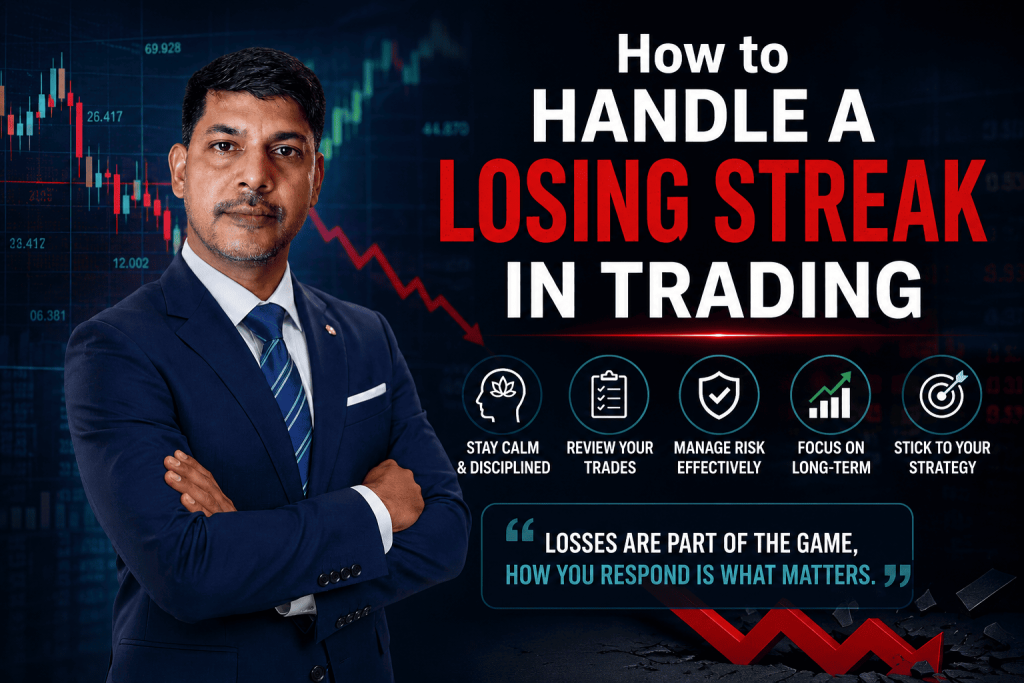
Every trader faces Losing Streaks in Trading. Learn practical steps to recover, reflect, and rebuild through a stock market training institute in Mumbai.
How to Handle a Losing Streak in Trading
Every trader, no matter how experienced, eventually faces a stretch of consecutive losses. It’s one of the least talked-about realities of trading — most content online celebrates winning trades, but rarely addresses what to do when nothing seems to work. This guide focuses on exactly that: how to handle a losing streak without letting it derail your progress or your confidence.

First, Understand That Losing Streaks Are Normal
Even the most disciplined, statistically sound trading strategies go through losing streaks. A strategy with a genuinely good win rate can still produce five, six, or more consecutive losses purely due to normal statistical variation — this doesn’t necessarily mean the strategy is broken. Understanding this distinction is one of the first lessons taught at any serious stock market training institute in Mumbai, because without it, traders often abandon perfectly good strategies at exactly the wrong moment.
Step 1: Stop Trading Temporarily and Assess
The instinctive reaction after a losing streak is often to trade more aggressively, trying to “win back” what was lost quickly. This is almost always the wrong move. The first, most important step is to pause — even just for a day or two — and assess what’s actually happening, rather than reacting emotionally in the middle of the market session.
Step 2: Review Your Trading Journal Honestly
If you’ve been keeping a trading journal (and if you haven’t, this is the moment to start), go back through your recent trades and ask honestly:
- Did I follow my planned strategy, or did I deviate from my rules?
- Were my losses due to a genuine strategy weakness, or poor execution?
- Was my risk management — position sizing, stop-loss placement — consistent across trades?
- Were external factors (unusual market volatility, news events) affecting normal price behaviour?
This kind of structured self-review is exactly what students are trained to do in a disciplined share market classes in Mumbai program, using their own trade history as the primary learning material.
Step 3: Separate Strategy Problems From Execution Problems
This is one of the most important distinctions in recovering from a losing streak. A strategy problem means your approach itself has a genuine flaw — perhaps it doesn’t account for certain market conditions, or the risk-reward ratio isn’t favourable enough over time. An execution problem means your strategy is sound, but you’re not following it correctly — entering too early, exiting too late, or letting emotions override your rules.
Most losing streaks among beginners are execution problems, not strategy problems. Fixing this requires discipline and structured practice, not necessarily a completely new approach — something reinforced repeatedly in a good technical analysis course.
Step 4: Reduce Position Size While Rebuilding Confidence
Rather than stopping entirely or continuing at full size, many experienced traders reduce their position size significantly during a losing streak. This allows you to keep trading, testing whether adjustments are working, without risking meaningful capital while you rebuild both your process and your confidence.
Step 5: Revisit Your Risk Management Rules
A losing streak is also a good moment to double-check that your risk management is genuinely protecting you. Are you risking a small, consistent percentage of your capital per trade? Are your stop-losses placed based on logical chart levels, or arbitrary numbers? Sound risk management doesn’t prevent losing streaks, but it ensures a losing streak never threatens your overall trading capital.
Step 6: Address the Emotional and Psychological Side
Losing streaks affect confidence and decision-making far more than most beginners expect. Traders sometimes swing between two extremes — becoming overly cautious and missing good opportunities, or becoming reckless in an attempt to recover losses quickly. Recognising these emotional patterns in yourself, and having a structured plan to manage them, is just as important as any technical adjustment.
If you find a losing streak is significantly affecting your mood, sleep, or decisions outside of trading, it’s worth stepping back further and reassessing your overall approach, position sizing, and whether trading capital and psychological readiness are properly aligned — this is a normal, sensible response, not a sign of failure.
Step 7: Get an Outside Perspective
It’s genuinely difficult to review your own trades objectively when you’re emotionally invested in them. This is where mentorship becomes valuable — an experienced trainer or mentor can often spot patterns in your trades that you’ve missed, simply because they’re not emotionally attached to the outcome. This kind of guided review is one of the most underrated benefits of learning through a structured stock market course in Mumbai, rather than trading in complete isolation.

When to Consider Structured Retraining
If losing streaks become a recurring pattern rather than an occasional stretch, it’s often a sign that foundational concepts — risk management, technical reading, or trade planning — need to be revisited and strengthened. Returning to structured learning isn’t a step backward; many experienced traders periodically revisit fundamentals precisely because markets, and their own trading psychology, keep evolving.
At IITA, based at Andheri West, our mentors work with students not just on entry and exit strategies, but on building the discipline and review habits needed to handle inevitable losing periods without losing confidence or capital unnecessarily.
Frequently Asked Questions
Q: How many consecutive losses should trigger a full pause in trading? There’s no fixed number, but many traders pause after 3-5 consecutive losses to reassess objectively.
Q: Should I change my strategy immediately after a losing streak? Not immediately — first distinguish between an execution problem and a genuine strategy flaw before changing anything.
Q: Is it normal to feel anxious after a losing streak? Yes, this is a common experience; structured risk management and mentorship help manage it constructively.
📞 Book Your Free Career & Market Guidance Session Today!
Not sure where to begin? Speak with our academic counselors and discover the right learning path based on your goals.
📍 Office: Andheri West, Mumbai
💻 Training Mode: 100% Live Online Classes
📞 Call / WhatsApp: +91 84520 18280 , +91 91870 98700
🌐 Website: https://iita.tech/stockmarket-course-in-mumbai/
📸 Follow us on Instagram: @stockmarketcourse_iita
Subscribe to Our YouTube Channels: 🔹 IITA Official: www.youtube.com/@iitab 🔹 Sudha Das (Market Learning): www.youtube.com/@sudhadas8420 🔹 www.youtube.com/@subratdas2506
Disclaimer: Stock market trading involves financial risk. This article is for educational purposes only and is not investment advice.
IITA – https://iita.tech/stockmarket-course-in-mumbai/