

Pre-Market Analysis Routine: How Professional Traders Prepare Before 9:15 AM
The best traders in the market have already done their most important work before the opening bell rings at 9:15 AM. They do not stare at the screen waiting for inspiration. They arrive with levels marked, scenarios planned, and trades defined – so that when the market opens, they execute a plan instead of reacting to chaos. This morning routine is called pre-market analysis, and it takes 15–30 minutes.
This guide gives you the exact checklist and process, in order, that you can follow every trading morning to start prepared rather than panicked.
Step 1: Check GIFT Nifty / SGX Nifty (2 Minutes)
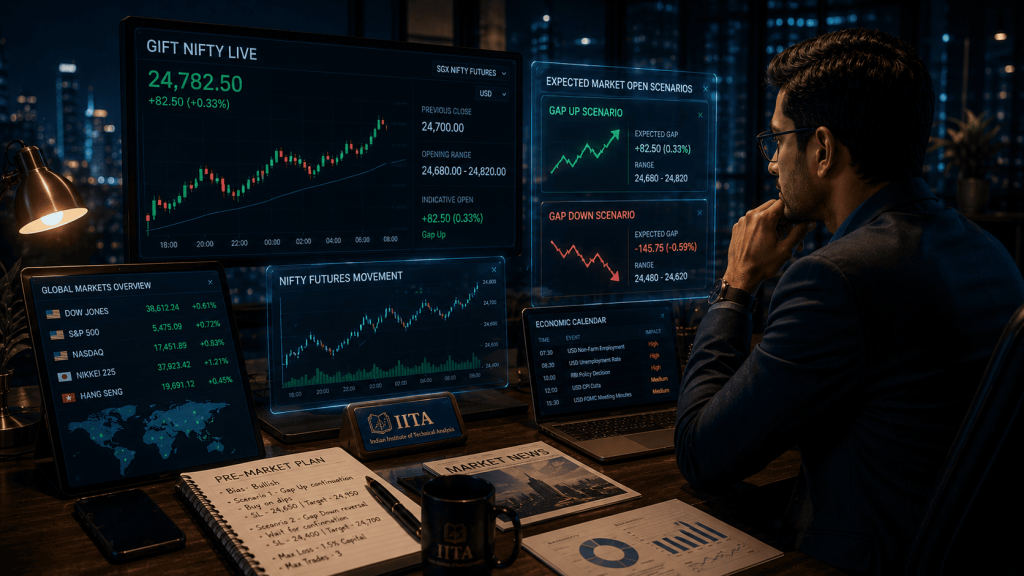
GIFT Nifty (formerly SGX Nifty) is a Nifty futures contract traded internationally, even when Indian markets are closed. Its current level at 8:45–9:00 AM gives you the best estimate of where Nifty will open. If GIFT Nifty is 100 points above yesterday’s close, expect a gap-up open of roughly that magnitude. If it is 150 points below, expect a significant gap down.
This single data point tells you whether to prepare for a gap-up strategy, a gap-down strategy, or a flat open – before you look at anything else.
Step 2: Review Overnight Global Markets (3 Minutes)
What happened while India slept directly affects where India opens:
- US markets (Dow, S&P 500, Nasdaq): How did they close? A 2% US rally usually means a strong Indian open. A US selloff usually means a weak one. Check whether the move was driven by something India-specific or purely US domestic
- Asian markets (Japan’s Nikkei, Hong Kong’s Hang Seng): Already open before India. Their morning direction confirms or contradicts the GIFT Nifty signal
- US futures (pre-market): If US futures are sharply different from last night’s close, that can shift sentiment further
You do not need to analyse these markets deeply. A quick glance at the closing numbers and the direction is enough. The question you are answering: is global sentiment bullish, bearish, or neutral this morning?
Step 3: Scan for News and Data Releases (3 Minutes)
Check for events that could drive unusual volatility today:
- Corporate earnings: Any major company reporting results before or after today’s market session
- RBI announcements: Monetary policy decisions, interest rate changes
- Government policy: Budget-related news, regulatory changes, tax announcements
- Global data: US jobs report (first Friday), US CPI (inflation), Federal Reserve statements – these affect global sentiment and commodity prices
- FII/DII data: Foreign institutional investor buying or selling from the previous day – persistent FII selling is bearish; persistent buying is supportive
If there is a major event today, plan for higher volatility and consider smaller position sizes. If the calendar is empty, expect a normal session.
Step 4: Mark Key Levels on Your Charts (5–10 Minutes)
Open your main charts (Nifty, Bank Nifty, and your watchlist stocks) and mark:
- Previous day’s high, low, and close – these are the day’s most immediate reference levels
- Key support and resistance levels from the daily chart – where has price reversed before?
- VWAP from the previous session (if your platform carries it over) – a reference for fair value
- Moving averages – especially the 20 EMA and 50 EMA on the 15-minute and daily charts
- Any open gap levels – unfilled gaps from previous sessions that may act as magnets
These levels are your trading map for the day. Without them, you are trading in the dark. With them, you know in advance where the important decisions happen.
Step 5: Define Today’s Trade Plan (5 Minutes)
Based on steps 1–4, write down (yes, physically write) your plan for the day:
- Directional bias: Bullish, bearish, or neutral based on GIFT Nifty + global cues + chart levels
- Scenario A (primary): If Nifty opens here and does this, I will look for entries here, with stop loss here and target here
- Scenario B (alternate): If the market does the opposite, I will do this instead (or stay out)
- Risk limits: Maximum loss for the day. Maximum number of trades. Position sizing per trade
This takes 5 minutes and is the most valuable 5 minutes of your trading day. A trader with a written plan will outperform a better analyst without one, because execution discipline beats analytical brilliance when real money is at stake.
Step 6: The First 15 Minutes – Observe, Do Not Trade
The first 15 minutes after market open (9:15–9:30 AM) are the most volatile and chaotic of the day. Prices swing wildly, spreads are wide, and emotional reactions to the gap drive irrational moves. Professional traders observe this period and let it establish the day’s range. They mark the 15-minute opening range (first candle’s high and low) and use it as a reference for the rest of the session.
The 15-minute rule: Wait for the first 15-minute candle to complete. Then trade based on your plan and the information that candle provides: bullish (strong close near high), bearish (strong close near low), or indecisive (doji-like, small body). Patience in the first 15 minutes prevents the majority of impulsive morning losses.
The Complete Pre-Market Checklist (Print This)
- GIFT Nifty level and expected gap ✓
- US market close (Dow, S&P, Nasdaq) ✓
- Asian market direction ✓
- Today’s news/events/data calendar ✓
- FII/DII data from yesterday ✓
- Key levels marked on charts (PDH, PDL, PDC, S&R, MAs) ✓
- Written trade plan with scenarios A and B ✓
- Risk limits defined (max loss, max trades) ✓
Common Mistakes in Pre-Market Preparation
- Skipping preparation entirely and trading reactively – the #1 source of avoidable losses
- Overanalysing and creating 10 scenarios instead of 2 – keep it simple
- Not writing the plan down – a plan in your head changes with your emotions; a written plan holds you accountable
- Trading in the first 5 minutes because of excitement or FOMO
- Ignoring global cues and being surprised by a gap that was entirely predictable

Frequently Asked Questions
How early should I start pre-market analysis?
30 minutes before market open is sufficient for most traders: 8:45–9:15 AM. With practice, you can complete the routine in 15 minutes. The key is consistency – doing it every single trading day, not just when you feel like it.
Do I need paid tools for pre-market analysis?
No. GIFT Nifty is available on TradingView and multiple free apps. Global market data is on Google Finance, Investing.com, or Moneycontrol. News is on any financial news site. Charts and levels are on your broker’s free platform. The routine requires discipline, not subscriptions.
What if the market opens opposite to my pre-market bias?
Execute Scenario B from your plan. If you did not prepare an alternate scenario, do not trade until the market gives you a clear setup that matches your analytical framework. The willingness to NOT trade when conditions do not match is one of the most profitable skills in trading.
Learn Pre-Market Routines and Intraday Trading Systems with IITA Bhubaneswar
At IITA (Indian Institute of Technical Analysis), Bhubaneswar, concepts like these are not taught from slides alone. Our trainers demonstrate on live market charts, letting you practise in real conditions with mentor guidance.
- Live market sessions – learn by doing, not just watching
- Experienced traders as trainers who practise what they teach
- Small batches for personal attention and doubt-clearing
- Post-course mentorship so support continues after class ends
- Classroom and online options available across Odisha
Visit iita.tech or call us to book a free introductory workshop.
Disclaimer: Stock market trading involves financial risk. This article is for educational purposes only and is not investment advice.