
Starting out in the stock market can feel overwhelming. You open a trading screen for the first time and see strange words, flashing numbers and charts that make no sense. A lot of people in Odisha assume the market is only for experts or people with finance degrees. That isn’t true. Students, working professionals and business owners all learn to trade. But learning comes first, and this guide covers how to start stock market trading in Bhubaneswar, step by step, without skipping the parts that protect your money.

One honest point before we begin. Trading is risky, and most beginners lose money at first. SEBI’s study of individual intraday traders in the equity cash segment found that about 7 in 10 of them made a net loss (you can read it on SEBI’s website). Nothing in this guide can promise you a different result. What it can do is help you start with your eyes open. If you want to start stock market trading with a small amount, the six steps below are the order we’d suggest.
Step 1: Open a demat and a trading account
You need two accounts. A trading account is where you place buy and sell orders on exchanges like NSE and BSE. A demat account is where your shares are held electronically, a bit like a locker. Most brokers open both together. Pick a broker that is registered with SEBI, whose app works properly when the market is busy, and whose charges you understand before you sign up. Our guides on demat vs trading accounts and how to open a demat account walk through it.
Step 2: Learn to read charts
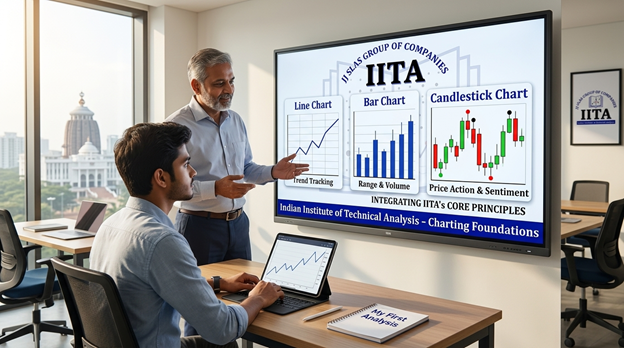
Many beginners buy because of a rumour, a hot tip in a chat group, or a news headline. That’s gambling with extra steps. Technical analysis gives you a more structured way to look at prices. You learn how candlesticks show the push and pull between buyers and sellers, where prices have paused before, and how volume fits in. It’s a skill, so it takes practice, and it doesn’t let you predict the market. A chart shows you what has happened and what might be likely, never what will. Start with our guide to technical analysis.
Step 3: Decide your risk rules before you trade
Decide this before you start stock market trading with real money. The traders who last aren’t the ones who win the most. They’re the ones who don’t lose too much when they’re wrong. That starts with position sizing, which means working out how many shares to buy so that one bad trade can’t do much damage.
Here’s a made-up example. You have ₹1,00,000 and you decide you’ll risk no more than 1% on one trade, which is ₹1,000. You want to buy a share at ₹250 and you’ll exit if it falls to ₹240. That’s ₹10 of risk per share, so you can buy 100 shares (₹1,000 ÷ ₹10). Your position is worth ₹25,000.
Now the part most guides skip. A stop-loss isn’t a guarantee. If the stock opens at ₹235 the next morning after bad news, your stop can only fill at around ₹235, and your loss is 15 × 100 = ₹1,500, not ₹1,000. And a stop-limit order might not fill at all. Charges and taxes are extra on top. So a risk limit is a plan, not a promise. For more, read about risk management in trading.
Step 4: Practise before you use real money
Reading about a strategy is easy. Following it when numbers are jumping around is different, because fear and greed kick in fast. Practise first with paper trading, which lets you place trades with pretend money. You can practise drawing support levels, spotting breakouts and placing exits until the routine feels natural. Our guide to paper trading in India shows how. Keep a journal of every practice trade and why you took it.
Step 5: Start small, and start with cash shares
There are two broad ways to trade. In the cash market, you buy shares of a company and hold them for as long as you like. In the derivatives market, which people call F&O, you trade futures and options on indices like Nifty or on single stocks. F&O uses leverage, so a small move can cost you a lot more than you put in. That’s why most people who start stock market trading are better off learning in the cash market first.
But let’s be clear about the cash market too. It isn’t “very safe”. Say you buy 100 shares at ₹250 and the price falls 20% to ₹200. You’ve lost ₹5,000, which is 5% of a ₹1,00,000 account, and the price can fall further or stay down for a long time. Starting small just means that kind of day doesn’t hurt you too much while you learn.
Step 6: Review your trades and keep learning
After every trade, write down what you expected, what happened and what you’d change. Once a week, read through the losing trades first. Most beginners learn more from those than from their wins.
Gambler or system trader?
It helps to know which habits to copy and which to drop.
| The gambler | The system trader |
|---|---|
| Buys on rumours, tips or headlines | Trades only when a setup matches written rules |
| Puts a big chunk of money in one stock | Sizes each position so one loss stays small |
| Removes the exit when a stock falls and hopes | Keeps the exit and accepts the loss |
| Trades angrily to win back a loss | Treats a loss as a normal cost and moves on |
Even a system trader loses trades. The difference is that the losses are planned.
How to choose where to learn
You’ll probably look at a few institutes in Bhubaneswar before you decide, and that’s sensible. Visit the centre, sit in a free workshop, and ask these questions. Can you see the full syllabus in writing? Is the total fee clear, and what does it include? How much of the course is practice, and how is it done? Do they promise profits or guaranteed results? If the answer to that last one is yes, walk away. Our guides on choosing a stock market institute and teaching languages can help you compare.
If you’d like proper training when you start stock market trading, here is what IITA offers. The courses cover technical analysis, risk management and an introduction to exchange-traded markets. We use live market examples, simulated practice and doubt-clearing sessions, and we run classroom and online batches in Hindi, Odia and English. We can’t promise results, because nobody can. For current fees and batch details, contact our IITA experts or visit our Bhubaneswar course page.
Start stock market trading: questions beginners ask
Do I need to be good at maths to start?
No. Chart reading is mostly visual, and the sums you need, like position sizing, are simple. It does take practice, though.
How much money do I need?
There’s no fixed amount. You can practise with free charting tools and paper trading, which cost nothing. For real trades, start with an amount you can afford to lose, and check your broker’s charges first. For current fees at IITA, contact our experts.
Can I start stock market trading alongside a full-time job?
Many people do. Some trading styles, such as swing trading, need less screen time than intraday trading. But how much time you need depends on your approach, and nobody should expect steady income from it.
Does a stop-loss protect me completely?
No. It can fill at a worse price after a gap, and some types of stop orders may not fill at all. It helps you manage risk, but it doesn’t remove it.
Final thoughts
You don’t need to be an expert to start stock market trading well. You need patience, small positions and the habit of reviewing every trade. Take your time with the early steps, because they matter more than any single trade.
Book Your Free Career & Market Guidance Session Today!
Not sure where to begin? Speak with our academic counselors and discover the right learning path based on your goals.
Office: Esplanade Mall, Rasulgarh, BBSR
Training Mode: Both Offline & Online Classes available
Call / WhatsApp: +91 8895218280, +91 8328955452
Website: https://iita.tech/best-stock-market-course-in-bhubaneswar/
Follow us on Instagram: @stockmarketcourse_iita
Subscribe to Our YouTube Channels: IITA Official: https://www.youtube.com/@iitab | Sudha Das (Market Learning): https://www.youtube.com/@sudhadas8420 | Subrat Das: https://www.youtube.com/@subratdas2506
Disclaimer: Stock market trading involves financial risk. This article is for educational purposes only and is not investment advice or a recommendation to buy or sell any security. It encourages readers to learn before they trade. Figures, rules and rates mentioned may change as per SEBI and other regulators. Check the latest figures on the official SEBI, exchange or other regulator websites, or consult experts.
IITA – https://iita.tech/