
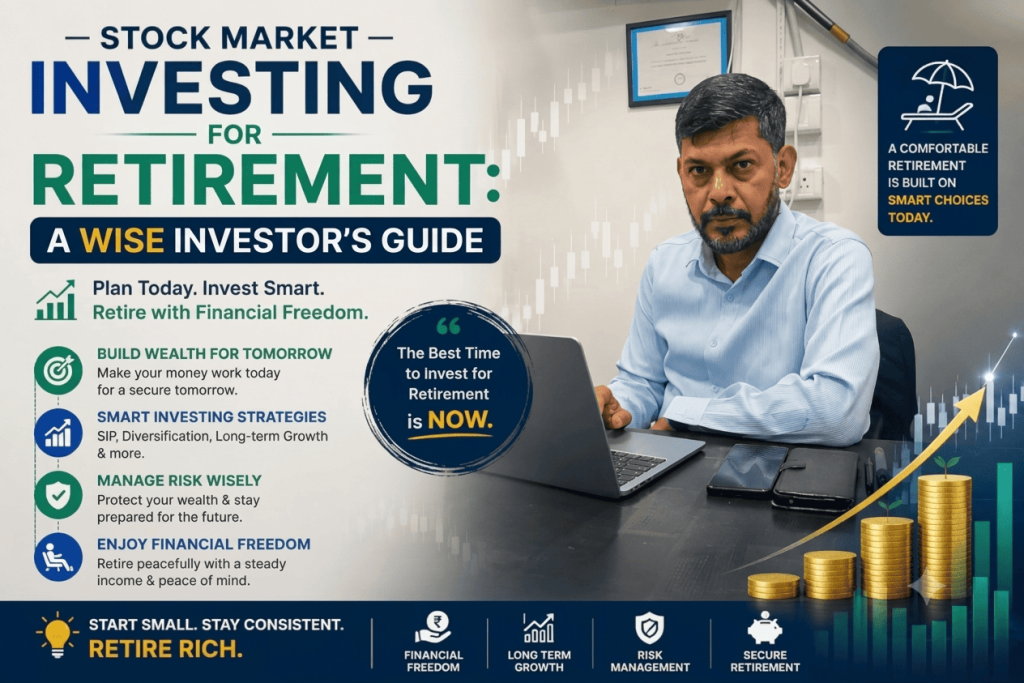
Planning your future? Learn how stock market investing for retirement works, key strategies, and mistakes to avoid, through a practical investor’s guide.
Stock Market Investing for Retirement: A Investor’s Guide
Mumbai , with its mix of long-established residents and newer high-rise communities, is home to many professionals thinking seriously about long-term financial planning — and for a growing number of them, stock market investing for retirement has become a central part of that plan. Unlike short-term trading, retirement-focused investing requires a completely different mindset — one built on patience, discipline, and time rather than quick gains. This guide walks through how to approach it thoughtfully.
Why Stock Market Investing for Retirement Matters
Traditional retirement savings instruments like fixed deposits and provident funds offer safety, but often struggle to outpace inflation significantly over long periods. Stock market investing for retirement, when approached correctly, offers the potential for wealth growth that can meaningfully compound over decades — something fixed-income instruments alone often cannot achieve at the same scale.
The Power of Time and Compounding
The single biggest advantage in stock market investing for retirement is time. Someone who starts investing in their late 20s or early 30s benefits enormously from compounding compared to someone who starts in their 40s or 50s, even with smaller monthly contributions. This is why many financial advisors emphasize starting early, regardless of how modest the initial investment amount might be.

Building a Retirement-Focused Investment Strategy
1. Define Your Retirement Timeline
Your investment approach should differ significantly based on how many years remain until retirement. Someone 25-30 years away from retirement can typically afford a more equity-heavy portfolio, while someone closer to retirement may need to gradually shift toward more conservative allocations.
2. Diversify Across Sectors and Market Caps
Stock market investing for retirement shouldn’t rely on a handful of stocks. A well-diversified portfolio across sectors, and a mix of large-cap, mid-cap, and select small-cap companies, helps balance growth potential with risk management over the long term.
3. Consider Systematic Investment Plans (SIPs)
For those investing through mutual funds rather than picking individual stocks directly, SIPs allow disciplined, regular investing regardless of market conditions, smoothing out the impact of volatility through rupee-cost averaging over time.
4. Focus on Quality, Fundamentally Strong Companies
For those choosing individual stocks as part of their stock market investing for retirement strategy, prioritizing companies with strong fundamentals — consistent earnings growth, manageable debt, and durable competitive advantages — tends to serve long-term investors better than chasing short-term momentum stocks.
5. Rebalance Periodically
As retirement approaches, periodically reviewing and rebalancing your portfolio — gradually shifting from higher-risk equity toward more stable instruments — helps protect accumulated wealth from significant market downturns closer to your retirement date.
Common Approaches Used by Mumbai Investors Planning for Retirement
The Core-and-Satellite Approach
Many investors build a “core” portfolio of stable, blue-chip stocks or index funds, supplemented by a smaller “satellite” portion allocated to higher-growth opportunities, balancing stability with growth potential.
The Dividend-Focused Approach
Some retirement-focused investors prioritize companies with a strong history of consistent dividend payments, creating a potential income stream that can supplement other retirement resources over time.
The Index Fund Approach
For those who prefer a more hands-off strategy, investing in broad market index funds offers diversified exposure to overall market growth without the need for constant individual stock analysis.

Mistakes to Avoid in Stock Market Investing for Retirement
- Starting too late: Delaying investment reduces the benefit of compounding significantly over time
- Chasing short-term trends: Retirement investing is a long-term game; reacting to short-term market noise often hurts more than it helps
- Lack of diversification: Concentrating too heavily in one sector or a few stocks increases unnecessary risk
- Ignoring inflation: Being overly conservative with retirement savings can result in returns that fail to keep pace with rising living costs over decades
- Panic-selling during downturns: Market corrections are a normal part of long-term investing; exiting positions during temporary declines often locks in losses unnecessarily
Balancing Risk as Retirement Approaches
A common principle in stock market investing for retirement is gradually reducing equity exposure as the retirement date nears, shifting a larger portion of the portfolio toward more stable instruments like bonds or fixed-income options. This helps protect accumulated wealth from being significantly impacted by a market downturn occurring right before retirement.
The Role of Financial Discipline
Successful retirement-focused investing depends less on perfectly timing the market and more on consistent, disciplined contributions over an extended period. Automating monthly investments, resisting the urge to withdraw during market dips, and reviewing your portfolio periodically rather than obsessively are all habits that support long-term success.
Why Education Matters for Retirement Investors
Many Worli residents approaching stock market investing for retirement benefit significantly from structured financial education — understanding fundamental analysis, portfolio diversification principles, and risk management before committing significant long-term capital. This knowledge helps investors make informed decisions rather than relying solely on advisor recommendations or market trends.
Final Thoughts
Stock market investing for retirement isn’t about chasing quick wins — it’s a patient, disciplined process built on starting early, diversifying wisely, and staying consistent through market ups and downs. Whether you’re just beginning your career or already well into it, the earlier you build a thoughtful, structured approach to retirement investing, the more time your money has to work in your favor.

Frequently Asked Questions
1. At what age should I start stock market investing for retirement? The earlier, the better. Starting in your 20s or 30s allows significantly more time for compounding compared to starting later, though it’s never too late to begin building a retirement-focused portfolio.
2. Is stock market investing for retirement riskier than fixed deposits? Equity investing carries more short-term volatility than fixed deposits, but over long time horizons, it has historically offered better potential to outpace inflation, which is important for long-term retirement planning.
3. Should I invest directly in stocks or through mutual funds for retirement? Both approaches work, depending on your knowledge and time availability. Mutual funds and SIPs offer built-in diversification and professional management, while direct stock investing requires more personal research and monitoring.
4. How should my retirement portfolio change as I get older? Most financial approaches suggest gradually shifting from equity-heavy allocations toward more conservative, stable instruments as retirement approaches, to protect accumulated wealth from market volatility.
5. Can I start stock market investing for retirement with a small amount? Yes, many investors start with modest monthly contributions through SIPs, gradually increasing their investment amount as income grows, making it accessible regardless of starting capital.
📞 Book Your Free Career & Market Guidance Session Today!
Not sure where to begin? Speak with our academic counselors and discover the right learning path based on your goals.
📍 Office: Andheri West, Mumbai
💻 Training Mode: Both Offline & Online Classes available
📞 Call / WhatsApp: +91 84520 18280, +91 91870 98700
🌐 Website: https://iita.tech/stockmarket-course-in-mumbai/
📸 Follow us on Instagram: @stockmarketcourse_iita
Subscribe to Our YouTube Channels: 🔹 IITA Official: https://www.youtube.com/@iitab 🔹 Sudha Das (Market Learning): https://www.youtube.com/@sudhadas8420 🔹 Subrat Das: https://www.youtube.com/@subratdas2506
Disclaimer: Stock market trading involves financial risk. This article is for educational purposes only and is not investment advice.
IITA – https://iita.tech/stockmarket-course-in-mumbai/