
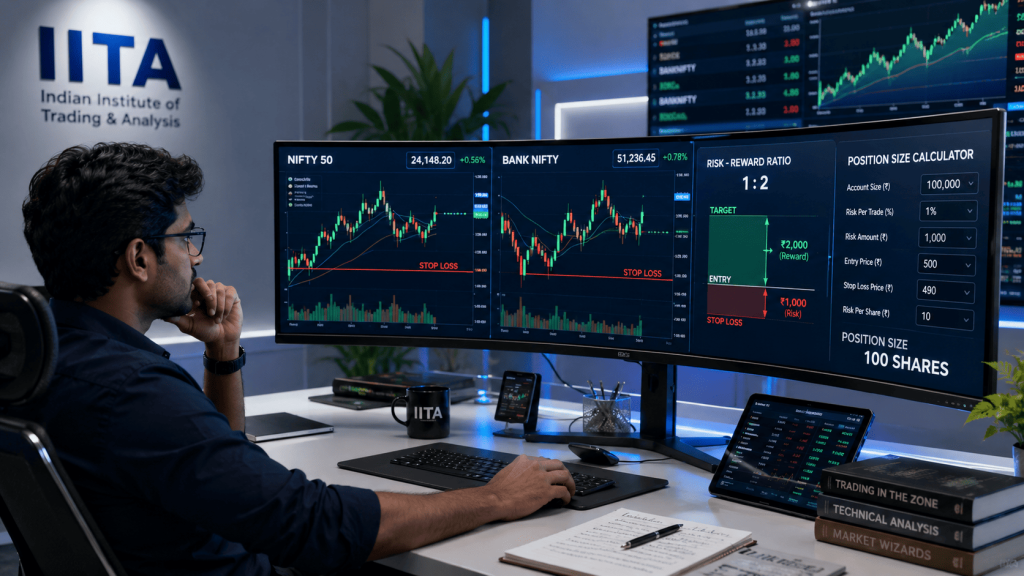
Risk Management in Trading: How to Protect Your Capital
Risk management is the single most important skill in trading, more important than any indicator, chart pattern, or strategy. It is the practice of controlling how much money you can lose on each trade so that no single bad trade (or even a series of bad trades) can destroy your account. Professional traders do not survive because they never lose. They survive because they control how much they lose.
This guide covers every risk management concept a beginner needs: stop losses, position sizing, risk-reward ratios, and capital protection rules, all in simple English with practical examples.
Why Risk Management Matters More Than Picking Winners
Here is a fact that surprises most beginners: even the best traders in the world are wrong on 40–50% of their trades. They are profitable not because they win every time, but because their winning trades are larger than their losing trades, and they never let a single loss grow out of control. That is risk management.
Without risk management, you could have the best strategy in the world and still blow up your account, because one or two unchecked losses can wipe out dozens of small wins. Risk management is the reason some traders last decades while others are out in months.
1. The Stop Loss: Your Most Important Tool
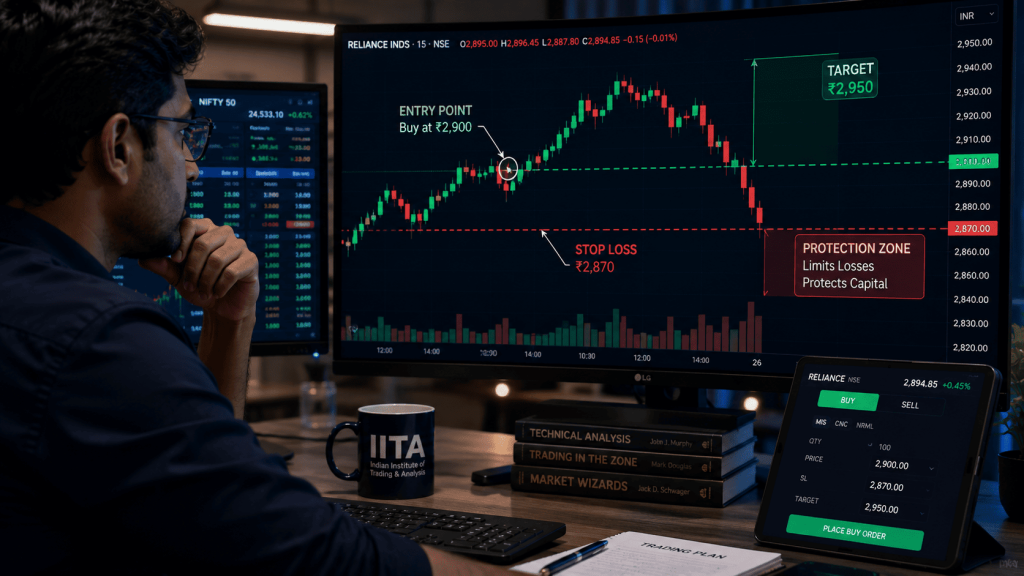
A stop loss is a pre-set price level at which your trade automatically closes to prevent further loss. You decide this level before you enter the trade, and you do not move it once the trade is live.
Example: You buy Reliance at ₹2,800 and set a stop loss at ₹2,760. If the price falls to ₹2,760, your position is automatically sold, limiting your loss to ₹40 per share. Without a stop loss, that same trade could fall to ₹2,600 or lower, turning a small loss into a disaster.
Rules for Stop Loss
- Set it before entering every trade – never trade without knowing your exit
- Place it at a logical level – just below support for buy trades, just above resistance for sell trades
- Never move it further away – moving your stop to “give it more room” defeats the purpose
- Accept that stop losses will get triggered – they are a feature, not a bug. Getting stopped out keeps you alive.
2. Position Sizing: How Much to Risk Per Trade
Position sizing answers the question: how many shares (or lots) should I trade? The answer is determined by how much of your capital you are willing to risk on a single trade.
The most widely used rule among professional traders is the 1–2% rule: never risk more than 1–2% of your total trading capital on any single trade.
How to Calculate Position Size
The formula is simple:
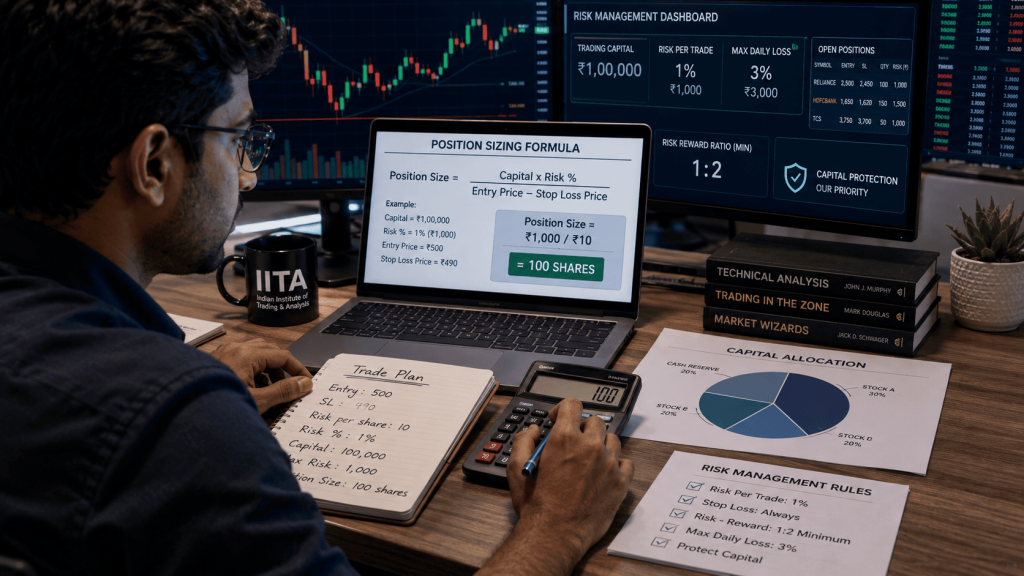
Position Size = (Capital × Risk %) / (Entry Price – Stop Loss Price)
Example: Your trading capital is ₹1,00,000. You want to risk 1% (= ₹1,000). You plan to buy a stock at ₹500 with a stop loss at ₹490 (risk per share = ₹10). Position size = ₹1,000 / ₹10 = 100 shares. You should buy exactly 100 shares, no more.
This ensures that even if the trade hits your stop loss, you only lose ₹1,000 (1% of your capital), which is completely recoverable. Losing 1% ten times in a row only costs you 10% of your capital. Losing 20% on a single trade can take months to recover from.
3. Risk-Reward Ratio: Only Take Trades That Are Worth It
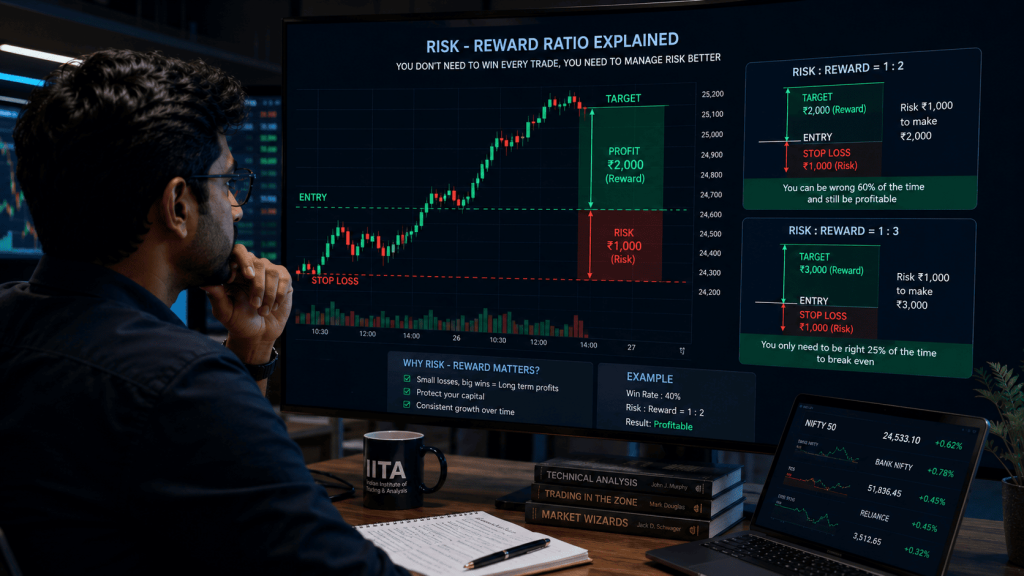
The risk-reward ratio compares how much you stand to lose versus how much you stand to gain on a trade. A good rule of thumb is to only take trades where the potential reward is at least 2 times the potential risk – a 1:2 risk-reward ratio.
Example: If your stop loss risks ₹10 per share (your risk), your target should be at least ₹20 per share above your entry (your reward). This means even if you win only 50% of your trades, you still make money overall.
- 1:1 risk-reward – you need to win more than 50% of trades just to break even
- 1:2 risk-reward – you can be wrong 60% of the time and still be profitable
- 1:3 risk-reward – you only need to win 25% of trades to break even
The math is clear: a good risk-reward ratio lets you be wrong often and still succeed. This is why professional traders are obsessed with it.
4. Capital Allocation: Never Put All Your Money in One Place
- Never put more than 5–10% of your total capital in a single stock or trade – diversification protects you from stock-specific disasters
- Keep a cash reserve – do not deploy 100% of your capital. Having cash allows you to take new opportunities and survive drawdown periods
- Separate trading money from personal money – never trade with rent money, EMI money, or emergency funds
- Define a daily loss limit – if you lose a set amount in a day (e.g., 3% of capital), stop trading for the day. This prevents revenge trading spirals
5. The Risk Management Checklist (Use Before Every Trade)
- What is my entry price?
- Where is my stop loss? (Is it at a logical level?)
- How much am I risking in rupees? (Is it within 1–2% of my capital?)
- What is my target? (Is the risk-reward ratio at least 1:2?)
- If this trade fails, can I take the next trade without emotional damage?
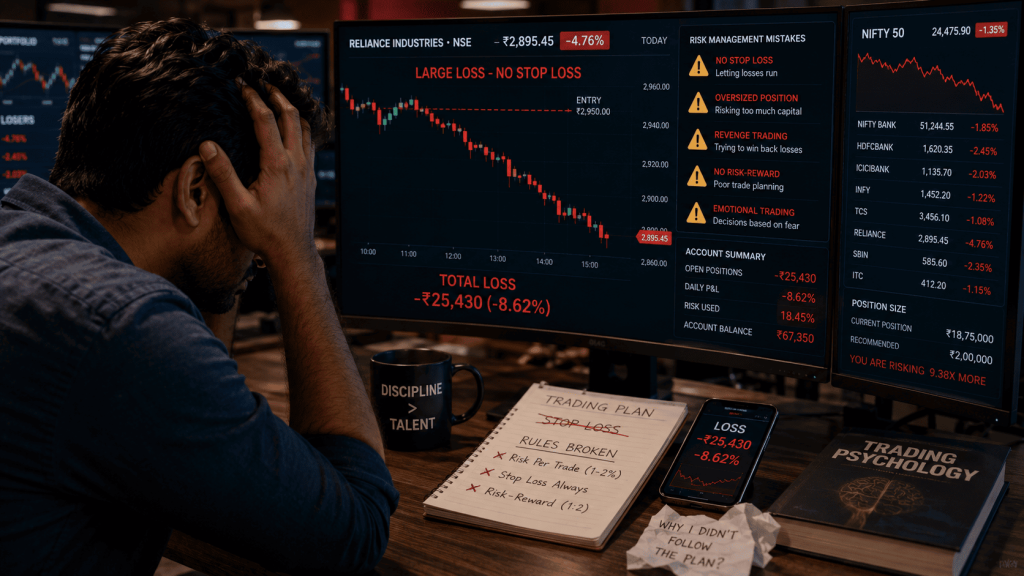
If you cannot answer all five questions clearly, do not take the trade.
Common Risk Management Mistakes
- Trading without a stop loss and hoping a losing trade will recover
- Risking 10–20% of capital on a single “sure” trade (no trade is sure)
- Moving the stop loss further away to avoid getting stopped out
- Increasing position size after a loss to try to win it back quickly (revenge trading)
- Not having a daily loss limit and trading all day after a bad start
- Ignoring the risk-reward ratio and taking trades with more downside than upside
Frequently Asked Questions About Risk Management
What is risk management in trading in simple words?
Risk management is the practice of controlling how much money you can lose on each trade. It involves using stop losses to limit losses, position sizing to control how much capital is at risk, and risk-reward ratios to ensure your potential gains outweigh your potential losses. It is the skill that keeps traders in the game long-term.
How much should I risk per trade?
Most professional traders risk 1–2% of their total trading capital per trade. This means if you have ₹1,00,000 in your trading account, you should not lose more than ₹1,000–2,000 on any single trade. This ensures that even a string of losses does not seriously damage your account.
What is the best risk-reward ratio?
A minimum of 1:2 is recommended. This means for every rupee you risk, you aim to make at least two rupees. Some traders aim for 1:3 or higher. The higher the ratio, the fewer winning trades you need to be profitable overall.
Can I trade without a stop loss?
You can, but you should not. Trading without a stop loss means a single bad trade can cause unlimited damage to your account. Every professional trader uses stop losses. It is a non-negotiable rule of survival.
Learn to Trade with Discipline at IITA Bhubaneswar
Most trading courses spend 90% of the time on entries and 10% on risk management. At IITA, we flip that emphasis, because we know from experience that risk management is what separates traders who last from those who quit.
Every trade setup we teach comes with a built-in risk management framework: where to enter, where to place the stop loss, how to size the position, and where to take profit. You leave IITA not just knowing what to trade, but knowing how to survive trading.
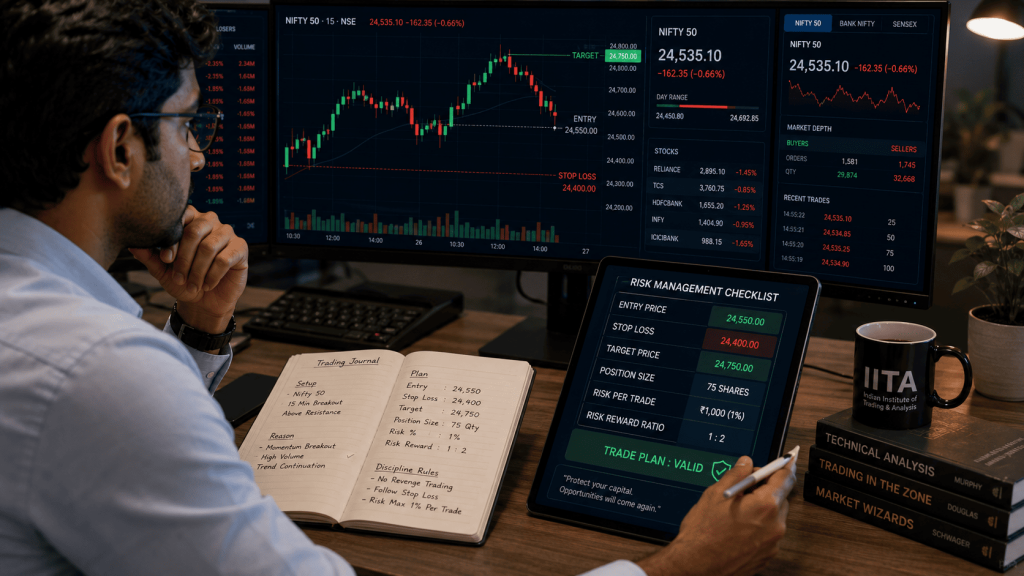
Why IITA Teaches Risk Management First
- Every strategy taught includes stop loss placement and position sizing – not as an afterthought
- Live examples of risk management on real Nifty and Bank Nifty trades
- Capital protection drills – practice managing losing trades, not just winning ones
- Emotional discipline training – how to stay calm after losses
- Post-course risk reviews with mentors
Protect your capital first. Visit iita.tech or call us to book a free workshop.
Disclaimer: Stock market trading involves financial risk. This article is for educational purposes only and is not investment advice.