
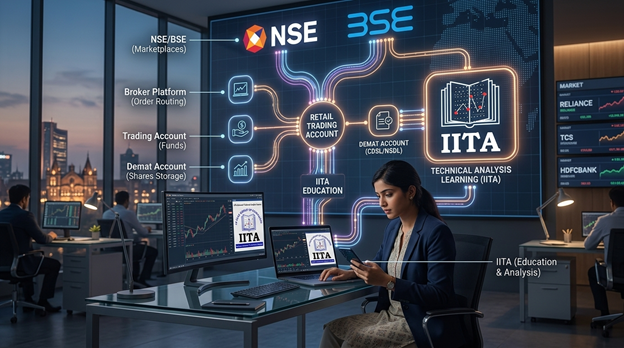
How Does the Indian Stock Market Work? A Complete Beginner’s Guide
The Indian stock market is where shares of publicly listed companies are bought and sold. It operates through two main stock exchanges: the National Stock Exchange (NSE) and the Bombay Stock Exchange (BSE). When you buy a share, you own a tiny piece of that company. When the company does well, your share’s value tends to go up. When it does poorly, the value tends to go down.
This guide explains how the entire system works, from stock exchanges and brokers to accounts and market timings, in plain, simple words. No finance degree required.
What Is a Stock Exchange?
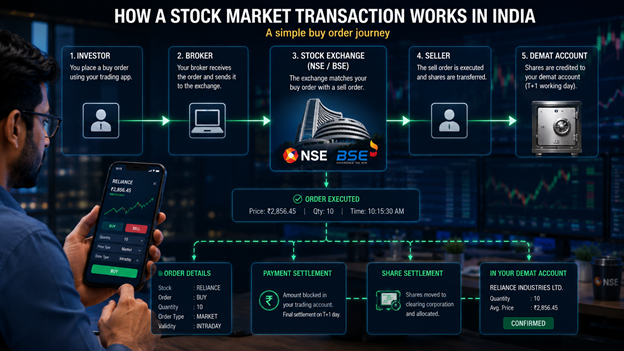
- NSE (National Stock Exchange) – the largest stock exchange in India by trading volume. Most active traders use NSE. Nifty 50 is the main index of NSE.
- BSE (Bombay Stock Exchange) – the oldest stock exchange in Asia, established in 1875. Sensex (BSE 30) is its main index. BSE has more listed companies but lower daily trading volume compared to NSE.
Both exchanges are regulated by SEBI (Securities and Exchange Board of India), the government body that ensures fair and transparent trading.
How Does Buying and Selling Work?
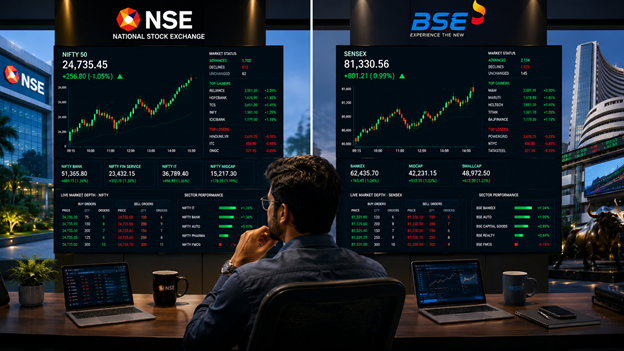
Here is a simplified version of what happens when you place a trade:
Your broker sends this order to the stock exchange (NSE or BSE)
The exchange matches your buy order with someone else’s sell order at the same price
The trade is executed and confirmed within milliseconds
The process is fully electronic. No physical share certificates, no paperwork. Everything happens through your phone or computer.
What Accounts Do You Need?
To participate in the Indian stock market, you need two accounts:
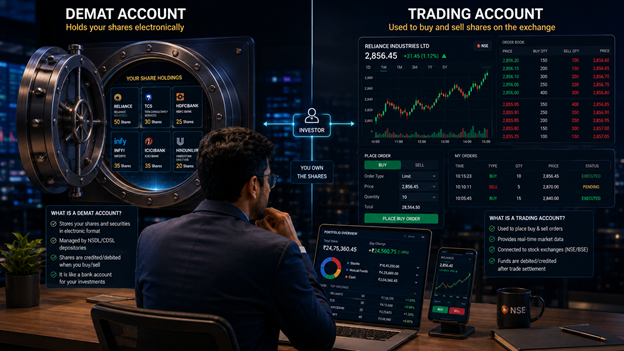
1. Demat Account (Dematerialised Account)
A demat account holds your shares electronically, just like a bank account holds your money. When you buy shares, they are credited to your demat account. When you sell, they are debited. In India, demat accounts are managed by two depositories: NSDL and CDSL.
2. Trading Account
A trading account is the interface through which you place buy and sell orders on the stock exchange. Your broker provides this. Most brokers in India (like Zerodha, Groww, Angel One, Upstox) offer both demat and trading accounts together as a combined package, opened through a single online process.
Opening both accounts is free or costs a nominal fee with most brokers. You need your Aadhaar, PAN card, and bank account details. The process is fully online and takes 15–30 minutes.
Indian Stock Market Timings
Pre-open session: 9:00 AM – 9:15 AM IST (order matching for the opening price)
Regular trading hours: 9:15 AM – 3:30 PM IST
Post-closing session: 3:40 PM – 4:00 PM (closing price calculation)
Trading days: Monday to Friday (closed on weekends and stock exchange holidays)
All times are Indian Standard Time (IST). The market is closed on national holidays and a few exchange-specific holidays announced at the beginning of each year by NSE and BSE.
What Can You Trade in the Indian Stock Market?
Equity (Shares) – buying and selling shares of individual companies like Reliance, TCS, Infosys
Equity Derivatives – futures and options contracts on individual stocks and indices like Nifty and Bank Nifty
Commodities – gold, silver, crude oil through MCX (Multi Commodity Exchange)
Currency – currency futures and options (USD/INR, EUR/INR) on NSE
ETFs and Mutual Funds – exchange-traded funds and mutual fund units that can be bought/sold on the exchange
Different Ways to Participate: Investing vs Trading
Not everyone in the stock market does the same thing. There are broadly two approaches:
Investing (Long-Term)
Investors buy shares or mutual funds and hold them for months or years, aiming for long-term wealth creation through price appreciation and dividends. Investing requires patience, fundamental analysis (studying a company’s financials), and a long time horizon.
Trading (Short-Term)
Traders buy and sell over shorter periods – from minutes (intraday trading) to weeks (swing trading) – aiming to profit from price movements. Trading requires technical analysis (reading charts and indicators), quick decision-making, and strict risk management. (See our guides on how to read stock charts and best indicators for intraday trading.)
Key Regulators and Institutions
SEBI – the primary regulator ensuring market integrity and investor protection
NSE and BSE – the stock exchanges where trading happens
NSDL and CDSL – the depositories that hold shares electronically
Stockbrokers – registered intermediaries through whom you trade (Zerodha, Angel One, Groww, ICICI Direct, etc.)
Clearing corporations – ensure that trades are settled and both buyer and seller honour the transaction.
Common Beginner Mistakes When Entering the Stock Market
Trading without any education, treating it as gambling rather than a skill
Investing based on tips from friends or social media without understanding the company
Ignoring risk management and putting all your money into one stock
Confusing investing with trading – each requires a different mindset, strategy, and time commitment
Not using a stop loss when trading, letting small losses become large ones
Frequently Asked Questions About the Indian Stock Market
How does the stock market work in India for beginners?
The Indian stock market allows you to buy and sell shares of publicly listed companies through the NSE and BSE stock exchanges. You need a demat account to hold shares and a trading account to place orders, both provided by a registered stockbroker. When you buy a share, you own a small part of the company. Market hours are 9:15 AM to 3:30 PM IST, Monday to Friday.
What is the minimum age to start trading in India?
You must be at least 18 years old to open a demat and trading account in India. Minors can have demat accounts operated by a guardian, but active trading typically requires you to be an adult.
Is the stock market safe for beginners?
The stock market is regulated by SEBI, so the infrastructure is safe and transparent. However, trading and investing carry financial risk. Beginners should educate themselves, start with small amounts, and never invest money they cannot afford to lose.
Can I start with just ₹500 or ₹1,000?
Yes. There is no minimum amount required. You can buy a single share of a company priced at ₹100 or even less. However, futures and options trading requires significantly more capital due to margin requirements. For beginners, starting with a small amount in equity delivery is the safest way to learn.
From Understanding to Action – Learn with IITA Bhubaneswar
Knowing how the stock market works is the first step. The next step is learning how to actually make informed decisions, whether you want to invest for the long term or trade actively. IITA Bhubaneswar provides structured, hands-on training that takes you from “I have no idea” to “I have a system.”
Our courses start with the fundamentals of how markets work and build up to chart reading, technical analysis, indicators, options trading, and risk management – all with live market practice, not just slides.
Why Begin Your Journey at IITA
Starts from zero – no prior knowledge assumed, perfect for complete beginners
Live market exposure from the very first week of training
Step-by-step curriculum covering everything from demat accounts to advanced trading
Experienced mentors who trade themselves and teach from real experience
Post-course support including doubt-clearing and market discussion groups
Both in-person and online training available
Take the first step. Visit iita.tech or call us to book a free workshop.
Disclaimer: Stock market trading involves financial risk. This article is for educational purposes only and is not investment advice.
IITA – iita.tech