
How Much Money Do You Need to Start Trading in India?
One of the most common questions every beginner asks is: how much money do I need to start trading in India? The answer depends on what type of trading you want to do. You can technically buy a share for ₹10, but that is very different from having enough capital to trade intraday or options effectively and safely.
This guide gives you honest, realistic numbers for every type of trading, including the amounts nobody talks about, like how much you actually need to trade without blowing up your account in the first month.
The Short Answer
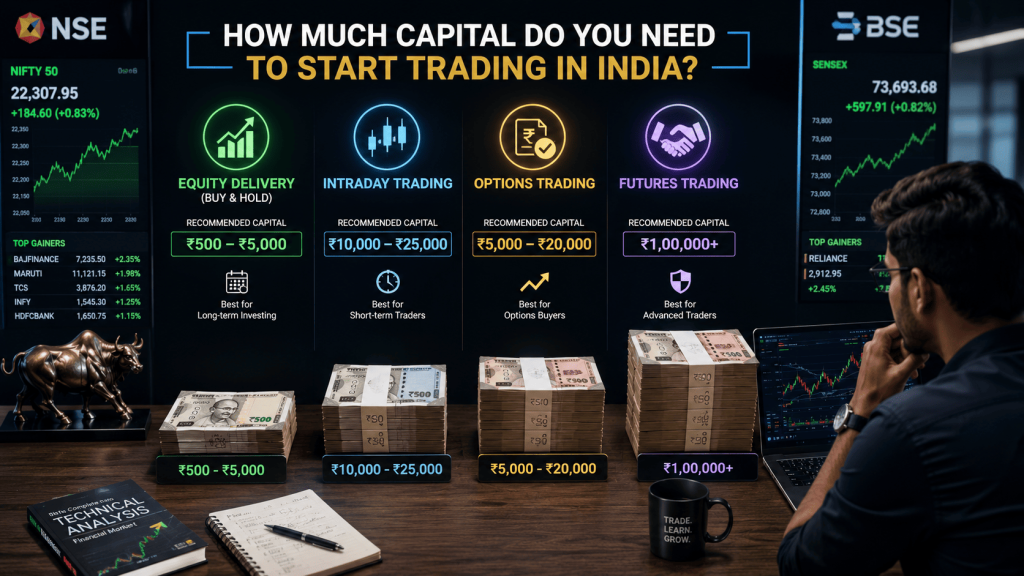
Here is a quick overview of the minimum practical capital needed for each type of trading in India:
- Equity Delivery (Buy and Hold): ₹500 – ₹5,000 is enough to start
- Intraday Trading: ₹10,000 – ₹25,000 to be practical with leverage
- Options Buying: ₹5,000 – ₹20,000 for premiums
- Futures Trading: ₹1,00,000 – ₹1,50,000 minimum (margin requirement)
- Options Selling: ₹1,00,000+ (high margin requirement)
Now let’s break each one down honestly.
1. Equity Delivery Trading (Buying and Holding Shares)
This is the simplest form: you buy shares and hold them for days, weeks, months, or years. There is no leverage involved, meaning you pay the full price of the shares.
Minimum needed: There is no official minimum. If a share costs ₹100, you can buy 1 share for ₹100. Many quality stocks are available below ₹500. So ₹1,000–5,000 is enough to get started and learn the mechanics of buying and selling.
The catch: With very small amounts, your profits will be tiny in rupee terms, even if the percentage return is good. That is fine. The goal at this stage is to learn, not to earn.
2. Intraday Trading
Intraday traders buy and sell within the same day, using margin (leverage) provided by the broker. Most brokers offer 5x to 20x leverage for intraday, meaning with ₹10,000, you can take positions worth ₹50,000 to ₹2,00,000.
Minimum practical amount: ₹10,000 to ₹25,000. Technically you can start with less, but after accounting for brokerage, taxes, and the need for proper position sizing with stop losses, ₹10,000 is the realistic floor to trade meaningfully without being wiped out by transaction costs.
Warning: Leverage amplifies losses just as much as profits. With 10x leverage, a 1% move against you is a 10% loss on your capital. This is why risk management is absolutely critical for intraday traders.
3. Options Buying
Options buying means purchasing call or put options by paying a premium. The premium is your maximum loss. Nifty and Bank Nifty option premiums can range from ₹5 to ₹500+ per unit, and one lot of Nifty is 25 units, meaning one option contract can cost between ₹125 and ₹12,500+.
Minimum practical amount: ₹5,000 to ₹20,000. This allows you to take a few positions, absorb some losses while learning, and practise proper trade management. Trading options with just ₹1,000–2,000 means one or two losing trades can wipe you out before you learn anything.
Reality check: Options are the most popular instrument among beginners because they are “cheap.” But SEBI data consistently shows that over 90% of individual options traders lose money. The low entry cost attracts people who then lose it all through lack of knowledge. (Read our guide on options trading for beginners.)
4. Futures Trading
Futures require a margin deposit set by the exchange. For Nifty futures, the margin is approximately ₹1,00,000–1,50,000 per lot (varies with volatility). For Bank Nifty futures, it is similar or higher. Individual stock futures vary by stock.
Minimum practical amount: ₹1,50,000 to ₹2,50,000. This gives you margin for one lot plus buffer for daily mark-to-market losses. Trading futures with exactly the minimum margin means one bad day can trigger a margin call (your broker forces you to add money or closes your position).
5. Options Selling
Options selling (also called option writing) requires significantly higher margins because the potential loss is theoretically much larger than with buying. Margins for selling a single Nifty option can be ₹70,000–1,00,000+.
Minimum practical amount: ₹2,00,000+. This is not a beginner’s activity. It requires deep understanding of options pricing, volatility, and Greeks.
The Number Nobody Talks About: How Much You Can Afford to Lose
The real question is not “how much do I need?” but “how much can I afford to lose while learning?” Because you will lose money as a beginner. Every trader does. The learning period typically lasts 6–12 months.
If you start with ₹20,000 in intraday trading and your learning losses are ₹15,000, can you handle that? If that ₹15,000 was money you needed for rent or an EMI, you have made a catastrophic mistake. Only trade with money that, if completely lost, would not affect your life.
A Sensible Starting Plan
- Step 1: Open a demat + trading account (free with most brokers)
- Step 2: Start with ₹2,000–5,000 in equity delivery to learn how buying and selling works
- Step 3: Paper trade (practice without real money) for intraday and options for 2–3 months
- Step 4: Move to intraday or options with ₹10,000–20,000 only after you are consistently profitable on paper
- Step 5: Scale up gradually as your skills and confidence grow
This approach protects your capital during the learning curve and ensures you are building skill before risking serious money.
Frequently Asked Questions
Can I start trading with just ₹1,000?
You can buy a few shares in equity delivery with ₹1,000. For intraday or options, ₹1,000 is too small to trade meaningfully after accounting for brokerage and the risk of loss. Start with at least ₹10,000 for active trading.
Is ₹10,000 enough for intraday trading?
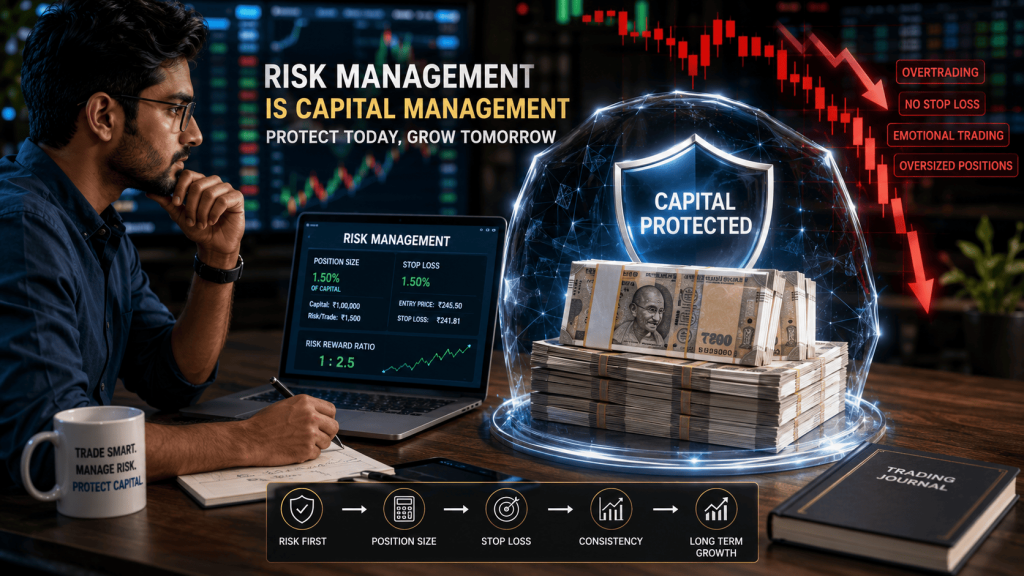
It is the minimum practical amount. With leverage, you can take meaningful positions. But with only ₹10,000, proper risk management (1–2% risk per trade) means your risk per trade is just ₹100–200. This keeps losses small but also limits returns. Scale up only as you gain skill.
Why do most new traders lose money?
Not because of insufficient capital. Most losses come from lack of education, no risk management, emotional trading, and unrealistic expectations. A trader with ₹10,000 and a solid plan will outlast a trader with ₹1,00,000 who trades recklessly.
Should I take a loan to start trading?
Absolutely not. Never trade with borrowed money. The pressure of repaying a loan while absorbing learning losses is a recipe for disaster. Trade only with surplus money you can afford to lose.

Learn to Trade Before You Fund Your Account – IITA Bhubaneswar
The smartest investment you can make before putting money into the market is investing in your own education. A ₹10,000 trading course that teaches you proper risk management can save you ₹1,00,000 in avoidable losses. That is not a metaphor – it is the experience of most successful traders.
At IITA Bhubaneswar, we teach you to trade profitably with whatever capital you have. Our training focuses on risk management, position sizing, and discipline so that you protect your money while building real skill.
Why Train Before You Trade
- Learn position sizing for your exact capital amount – whether ₹10,000 or ₹1,00,000
- Paper trading practice included in the course
- Risk management as a core module, not an afterthought
- Realistic expectations set from day one – no false promises of quick riches
- Live market practice so you face real conditions before risking your own money
Invest in skill first, capital second. Visit iita.tech or call us for a free workshop.
Disclaimer: Stock market trading involves financial risk. This article is for educational purposes only and is not investment advice.