
What Is Futures Trading? A Beginner’s Guide to F&O in India
Futures trading involves buying or selling a contract that commits you to buy or sell an asset (like a stock or index) at a fixed price on a specific future date. Along with options, futures make up the world of derivatives, often called F&O (Futures and Options) in India. Futures are powerful tools that allow traders to take large positions with relatively small capital, but that same power makes them risky for the unprepared.
This guide explains futures trading in simple words, how it differs from options, and what every beginner must understand before trading F&O.
What Is a Futures Contract?
A futures contract is an agreement to buy or sell an asset at a predetermined price on a fixed future date. Unlike an option (which gives you the right but not the obligation), a futures contract is a firm commitment: both the buyer and seller must honour the contract on the expiry date.
In India, you can trade futures on indices like Nifty and Bank Nifty, and on hundreds of individual stocks. Futures contracts expire on the last Thursday of every month (monthly expiry).

Key Terms Every Futures Beginner Must Know
Lot Size
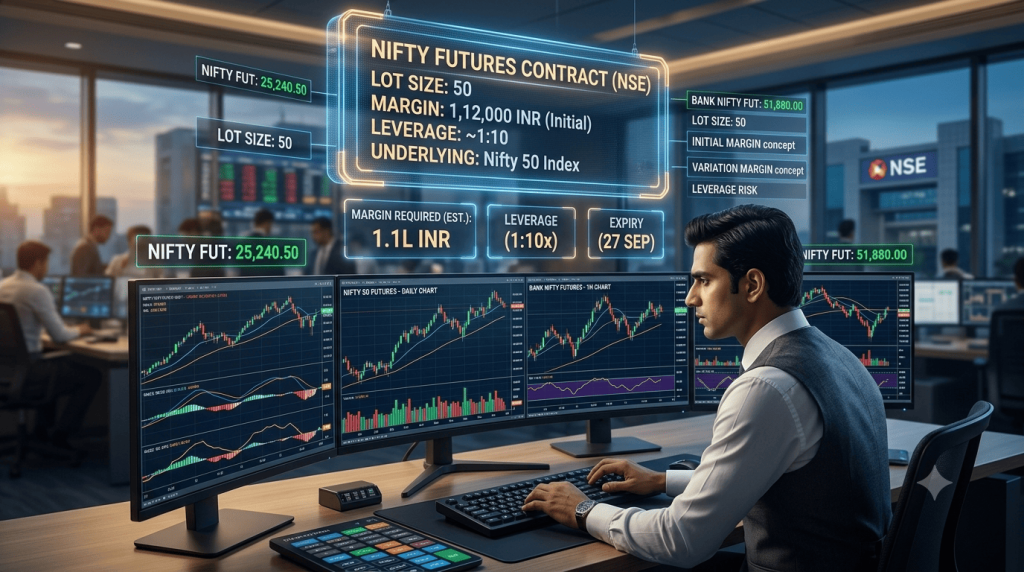
Futures are not traded in single units. They are traded in fixed quantities called lots. For example, one lot of Nifty futures is 25 units (this changes periodically as decided by the exchange). You cannot buy half a lot; you trade in whole lots only.
Margin
You do not pay the full value of a futures contract. Instead, you deposit a margin, a fraction of the total contract value (typically 10–20%). This is what creates leverage: with a small amount, you control a much larger position. For example, with ₹1.2 lakh margin, you might control a Nifty futures position worth ₹6 lakh.
Expiry
Every futures contract has an expiry date. In India, stock and index futures expire on the last Thursday of each month. Before expiry, you can either close your position or let it settle.
Mark-to-Market (MTM)
Futures positions are settled daily. At the end of each trading day, profits or losses are calculated and credited or debited from your account. This is called mark-to-market. If losses pile up, your broker may issue a margin call asking you to add funds.

Futures vs Options: What Is the Difference?
Both are derivatives, but they work very differently:
- Futures are a firm obligation. Both buyer and seller must honour the contract. Profit and loss are both potentially unlimited.
- Options give the buyer a right, not an obligation. An option buyer’s maximum loss is limited to the premium paid, while the upside can be large. (See our guide on options trading for beginners.)
In simple terms: futures have symmetrical risk (you can win big or lose big), while buying options has asymmetrical risk (limited loss, larger potential gain). This is why many beginners start with buying options rather than trading futures, though both require proper education.
Why Do Traders Use Futures?
- Leverage – control a large position with small capital, amplifying potential returns
- Hedging – investors use futures to protect their portfolio against price drops
- Speculation – traders bet on the direction of an index or stock for profit
- Liquidity – Nifty and Bank Nifty futures are extremely liquid, making entry and exit easy
The Big Risk: Leverage Cuts Both Ways
Leverage is the most attractive and most dangerous feature of futures. The same leverage that can multiply your profits can also multiply your losses. Because futures losses are not limited (unlike buying options), a sharp move against your position can wipe out your entire margin and even leave you owing more money.
Example: If you control a ₹6 lakh Nifty futures position with ₹1.2 lakh margin, a 5% move against you (₹30,000 loss) is 25% of your margin gone, from a move that would be minor for a regular investor. This is why risk management is absolutely essential in futures trading. (See our guide on risk management in trading.)
Should Beginners Trade Futures?
The honest answer: not immediately. Futures require a solid foundation in:
- Chart reading and technical analysis
- Understanding leverage and margin
- Strict risk management and position sizing
- Emotional discipline to handle fast-moving, leveraged positions
A sensible path is to first learn the stock market basics, practise with equity, understand options, and only then approach futures with proper training and small position sizes.
Common Mistakes in Futures Trading
- Trading futures without understanding leverage and margin requirements
- Taking positions too large for the account size
- Trading without a stop loss, exposing the account to unlimited losses
- Ignoring mark-to-market and getting hit by a margin call
- Treating futures like a lottery instead of a skill-based activity

Frequently Asked Questions About Futures Trading
What is futures trading in simple words?
Futures trading means buying or selling a contract that commits you to buy or sell an asset at a fixed price on a future date. In India, you can trade futures on indices like Nifty and Bank Nifty and on individual stocks. Futures use leverage, meaning you control a large position with a small margin deposit.
What is the difference between futures and options?
Futures are a firm obligation for both buyer and seller, with potentially unlimited profit and loss. Options give the buyer a right (not an obligation), with the buyer’s loss limited to the premium paid. Futures have symmetrical risk; buying options has limited downside.
How much money is needed for futures trading?
Futures require a margin deposit, typically ₹1–1.5 lakh per lot for Nifty futures (varies with volatility). You also need a buffer for daily mark-to-market losses, so a practical minimum is around ₹1.5–2.5 lakh.
Is futures trading riskier than buying stocks?
Yes. Futures use leverage, which amplifies both profits and losses. Unlike buying stocks (where your maximum loss is your investment), futures losses can exceed your initial margin. Futures require strong risk management and experience.

Learn F&O the Right Way at IITA Bhubaneswar
Futures and options are powerful but unforgiving. Most beginners who jump into F&O without training lose money quickly because they underestimate leverage. IITA gives you the structured education to trade derivatives with skill and discipline.
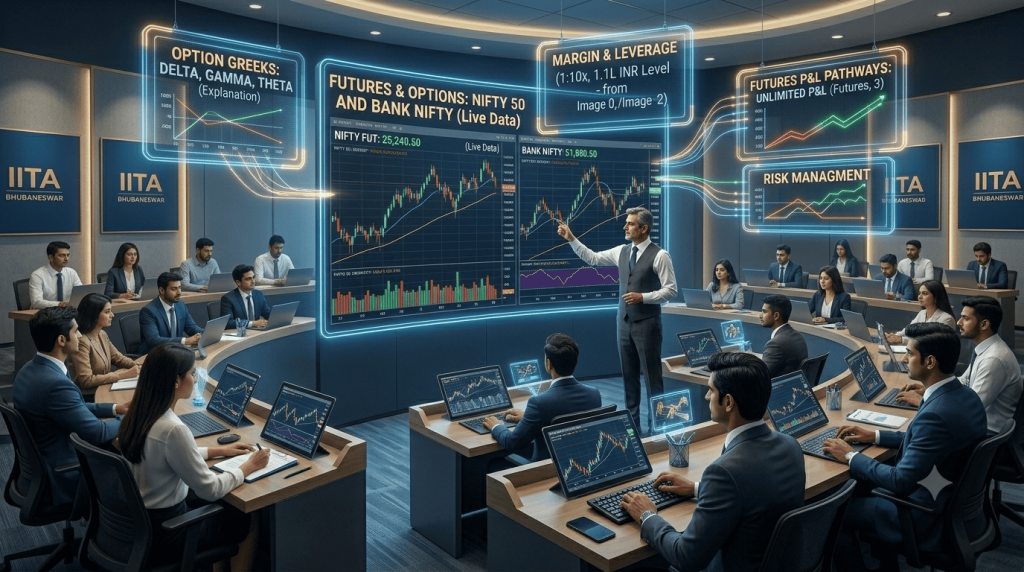
Our F&O training covers futures, options, lot sizes, margins, leverage, and risk management, all explained on live Nifty and Bank Nifty charts during market hours.
Why IITA for Futures and Options Training
- Complete F&O curriculum from basics to advanced strategies
- Live derivatives trading sessions during market hours
- Leverage and margin explained with real examples
- Risk management as a core part of every lesson
- Gradual progression from paper trading to live F&O
Visit iita.tech or call us to book a free workshop.
Disclaimer: Stock market trading involves financial risk. This article is for educational purposes only and is not investment advice.