
What Is Swing Trading? A Complete Beginner’s Guide
Swing trading is a trading style where you hold positions for several days to a few weeks, aiming to capture medium-term price moves (the “swings” in the market). Unlike day trading, where positions are closed within the same day, swing traders hold overnight and let trades develop over days. This makes swing trading especially popular among working professionals and students who cannot watch the market all day.
This guide explains how swing trading works, the best timeframes and strategies, and what every beginner needs to know to get started.
How Does Swing Trading Work?
Swing traders aim to catch a portion of a larger price move. Instead of chasing small intraday moves or holding for years like investors, they target moves that play out over days to weeks. A swing trader might buy a stock showing a bullish breakout and hold it for a week or two as it climbs, then exit when momentum fades.
Because trades develop over days, swing traders do not need to stare at screens constantly. They typically analyse charts in the evening after market hours, place their orders, set stop losses, and check on positions once or twice a day. This is the key advantage that makes swing trading practical for people with jobs.
Swing Trading vs Day Trading
Here is how the two styles compare:
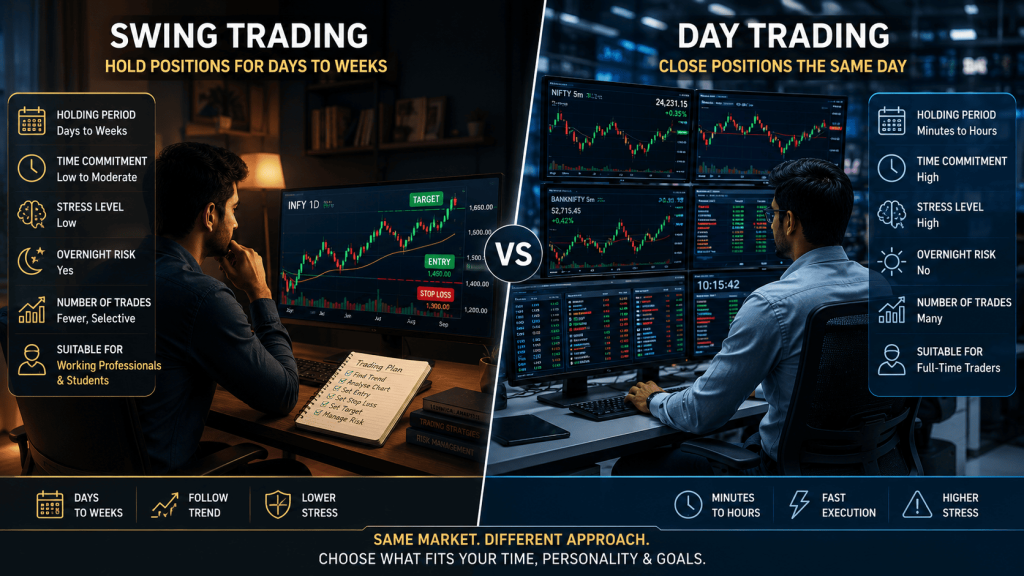
- Time commitment: Day trading needs constant attention during market hours; swing trading fits around a full-time job
- Holding period: Day traders close positions the same day; swing traders hold for days to weeks
- Pace and stress: Day trading is fast and high-pressure; swing trading is slower and calmer
- Overnight risk: Day traders have none; swing traders carry the risk of overnight price gaps
- Number of trades: Day traders take many trades; swing traders take fewer, more selective ones
(For a full comparison, see our guide on intraday trading vs swing trading.)
Best Timeframes for Swing Trading
Swing traders primarily use:
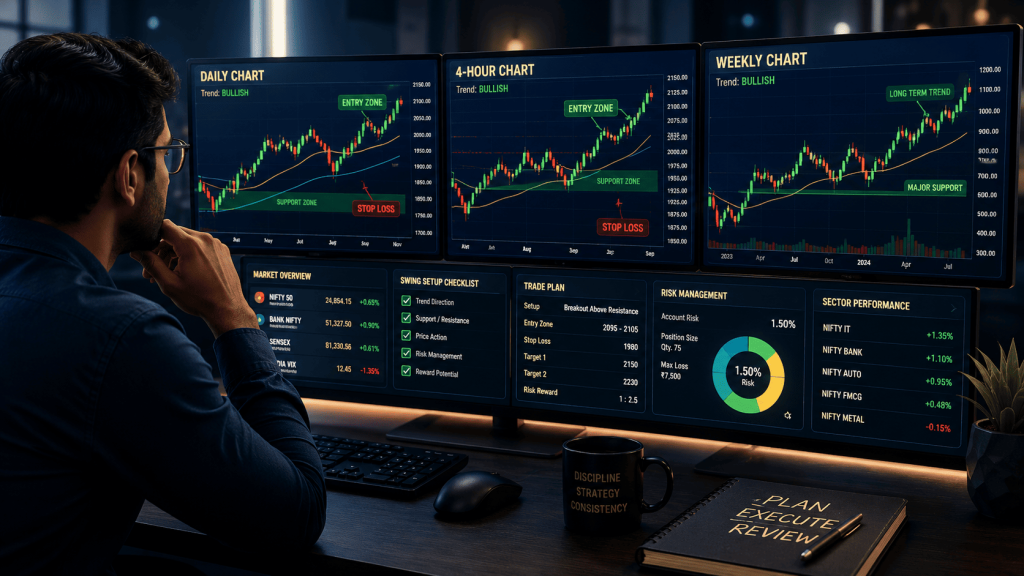
- Daily chart – the main timeframe for identifying the trend and planning trades
- Hourly or 4-hour chart – for fine-tuning entry and exit points
- Weekly chart – for understanding the bigger-picture trend
The daily chart is the backbone of swing trading. It filters out intraday noise while still showing clear, tradeable moves.
Popular Swing Trading Strategies
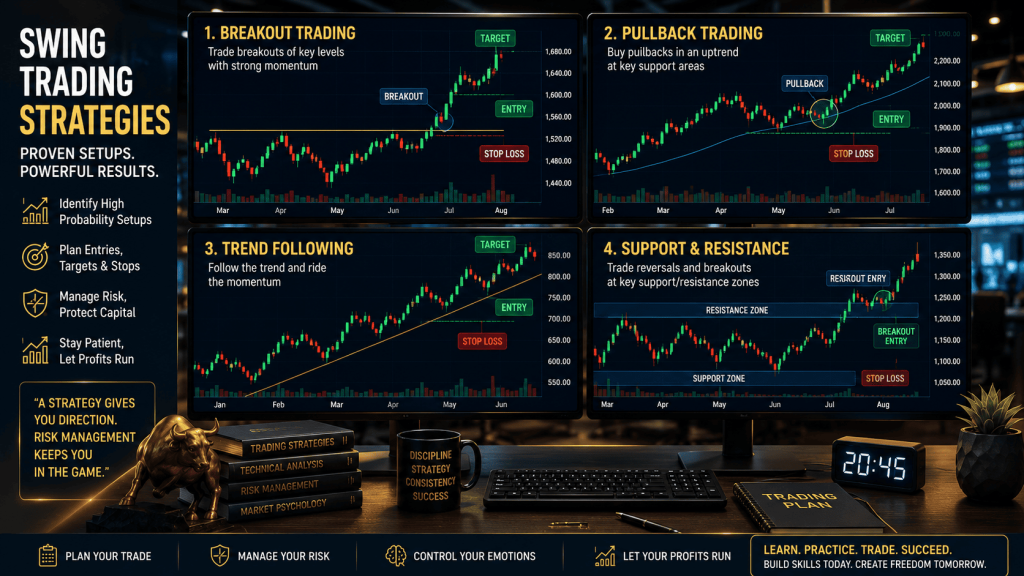
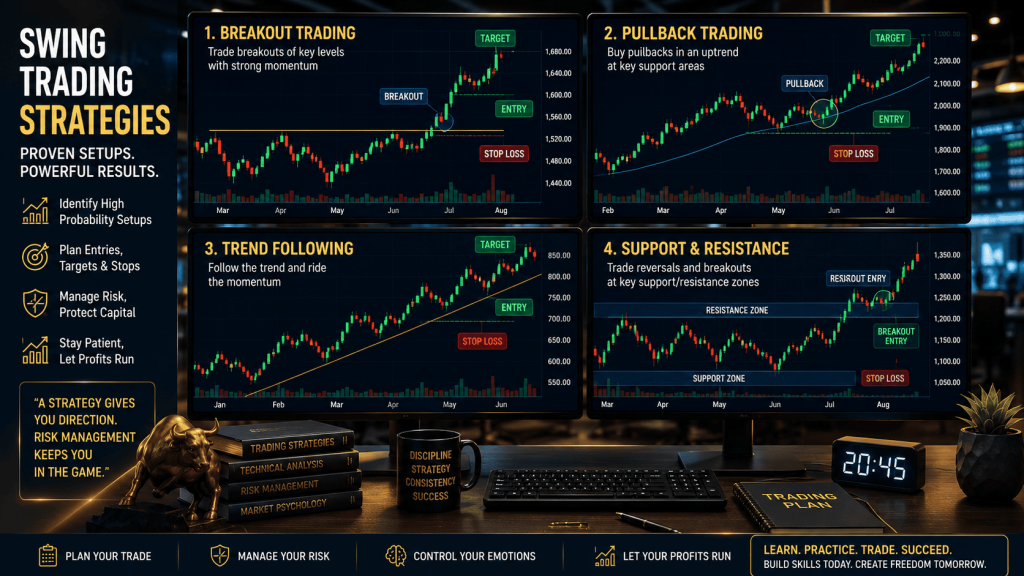
1. Breakout Trading
Buy when price breaks above a key resistance level or chart pattern (like a triangle or flag) with strong volume. The breakout often leads to a multi-day move. (See our guide on chart patterns in trading.)
2. Pullback Trading
In an uptrend, wait for price to pull back to a support level, a moving average (like the 20 or 50-day), or a Fibonacci level, then enter when it bounces. This lets you join a trend at a better price.
3. Trend Following
Identify a strong trend and take trades in the direction of that trend, holding as long as the trend continues. “The trend is your friend” is the core principle here.
4. Support and Resistance Trading
Buy near support, sell near resistance within a range, or trade the breakout when price escapes the range. (See our guide on support and resistance in trading.)

How to Manage Risk in Swing Trading
Swing trading carries overnight gap risk, the chance that a stock opens significantly higher or lower the next day due to news. This makes risk management critical:
- Always use a stop loss – place it below support for long trades
- Size positions properly – risk only 1–2% of capital per trade
- Avoid holding through major events – earnings announcements and big news can cause large gaps
- Diversify – do not put all your capital into one swing trade
(See our complete guide on risk management in trading.)
What Makes a Good Swing Trading Stock?
- Good liquidity – enough trading volume for easy entry and exit
- Clear trends – stocks that trend well rather than chop sideways
- Reasonable volatility – enough movement to produce profits, but not wild unpredictability
- Strong sectors – stocks in sectors that are currently performing well
Common Swing Trading Mistakes
- Holding losing trades too long, hoping they recover instead of respecting the stop loss
- Ignoring overnight gap risk by holding through earnings or major news
- Taking too many trades instead of waiting for high-quality setups
- Exiting winners too early out of fear and cutting profits short
- Trading against the broader market trend
Frequently Asked Questions About Swing Trading
What is swing trading in simple words?
Swing trading is a style where you hold trades for several days to a few weeks to capture medium-term price moves. You do not close positions the same day like day trading, and you do not hold for years like investing. It suits people who cannot watch the market all day.
Is swing trading good for beginners?
Swing trading is often considered more beginner-friendly than day trading because it is slower-paced, less stressful, and fits around a job. However, it still requires learning chart analysis, risk management, and discipline, and it carries overnight gap risk.
What is the best timeframe for swing trading?
The daily chart is the primary timeframe for swing trading, used to identify trends and plan trades. Hourly or 4-hour charts help fine-tune entries and exits, while the weekly chart provides bigger-picture context.
Can I do swing trading with a full-time job?
Yes. Swing trading is well-suited to working people because it does not require constant monitoring. You can analyse charts in the evening, place orders with stop losses, and check positions once or twice a day.
Master Swing Trading at IITA Bhubaneswar
Swing trading is one of the most practical styles for working people, but it still requires real skill in chart reading, pattern recognition, and risk management. IITA teaches you a complete swing trading system you can apply around your job or studies.
Our trainers teach swing trading setups on live Indian stock charts, showing you how to find trades, manage them over days, and handle overnight risk with proper stop losses.
Why IITA for Swing Trading
- Practical swing trading strategies taught on live charts
- Chart pattern and trend analysis for finding quality setups
- Risk management including overnight gap protection
- Evening-friendly approach suited to working professionals
- Post-course mentorship to support your trades
Visit iita.tech or call us to book a free workshop.
Disclaimer: Stock market trading involves financial risk. This article is for educational purposes only and is not investment advice.