Commodity Trading in India: How to Trade Gold, Silver, and Crude Oil
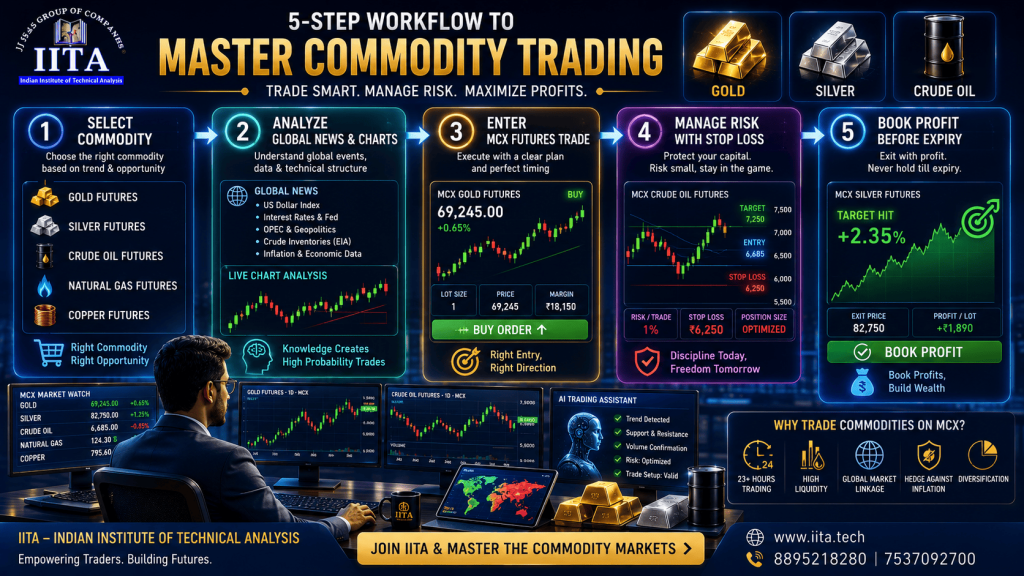
Beyond stocks and indices, there is an entire parallel market where traders buy and sell commodities – gold, silver, crude oil, natural gas, copper, and more. Commodity trading in India happens on the MCX (Multi Commodity Exchange), and it attracts traders for a compelling reason: commodity markets trade for longer hours, are driven by global forces, and offer volatility that creates opportunities distinct from the equity market.
This guide explains how commodity trading works in India, what instruments are available, and what beginners need to know before entering this market.
What Is Commodity Trading?
Commodity trading is buying and selling standardised contracts (futures) based on physical commodities. You are not buying actual gold bars or oil barrels; you are trading futures contracts whose value moves with the commodity’s price. When gold’s price rises, gold futures rise. When crude oil’s price falls, crude futures fall. The settlement is in cash, not physical delivery (for most retail traders).
In India, commodity trading is regulated by SEBI (the same regulator as the stock market) and happens primarily on MCX, with some commodities also tradeable on NCDEX (for agricultural commodities) and NSE (commodity derivatives segment).
The Most Traded Commodities on MCX
Gold
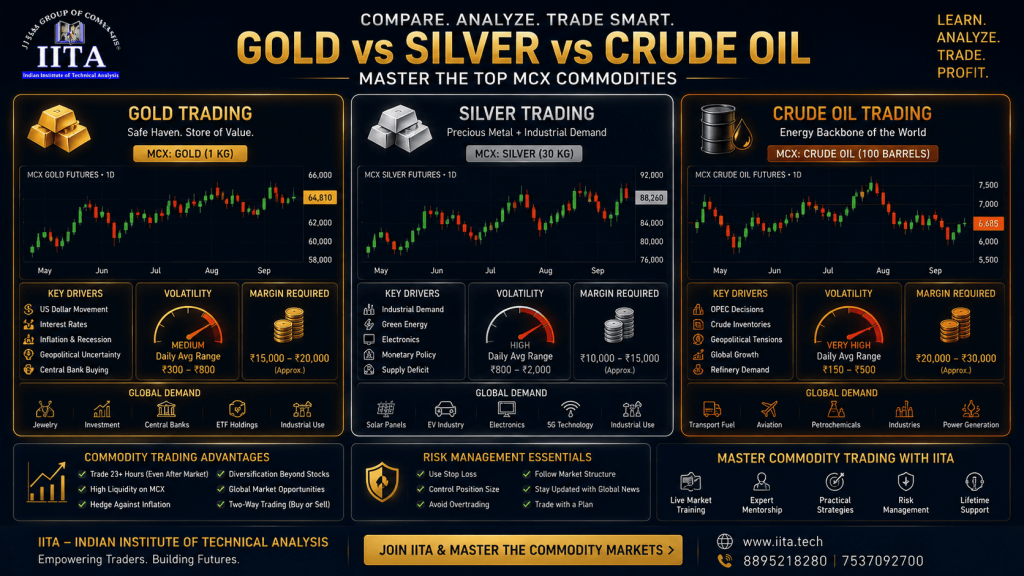
The most popular commodity among Indian traders and investors. Gold prices are driven by global factors: US dollar strength, Federal Reserve interest rate decisions, inflation expectations, and geopolitical uncertainty. When uncertainty rises, gold typically rises (“safe haven”). MCX offers Gold (1 kg lot), Gold Mini (100g), and Gold Petal (1g) contracts for different capital levels.
Silver
Silver is more volatile than gold because it has both precious metal and industrial demand. Silver moves in the same general direction as gold but with larger percentage swings, making it attractive for traders seeking volatility. MCX offers Silver (30 kg) and Silver Mini (5 kg) contracts.
Crude Oil
Crude oil is the most volatile mainstream commodity. Prices swing on OPEC production decisions, US inventory data (released weekly), geopolitical tensions in oil-producing regions, and global economic growth expectations. MCX crude oil tracks Brent and WTI international benchmarks. One lot is 100 barrels. Crude requires careful risk management because large daily swings are normal.
Natural Gas
Highly volatile and weather-sensitive. US weather patterns, storage data, and seasonal heating/cooling demand drive prices. Natural gas is for experienced traders only – the volatility can produce very large gains and very large losses in a single session.
How Commodity Futures Trading Works
- Margin-based: You deposit a margin (typically 5–15% of the contract value) to take a position. This means leverage – a small price move creates a proportionally larger gain or loss on your capital
- Expiry dates: Each futures contract has a monthly expiry. You can hold until expiry or exit anytime before. Most retail traders close before expiry to avoid delivery obligations
- Mark-to-market: Profits and losses are settled daily. If your position loses money, the loss is debited from your account each day
- Two-way trading: You can go long (buy expecting price to rise) or short (sell expecting price to fall) with equal ease
Commodity Market Trading Hours (MCX)
One of the biggest advantages of commodity trading: extended hours.
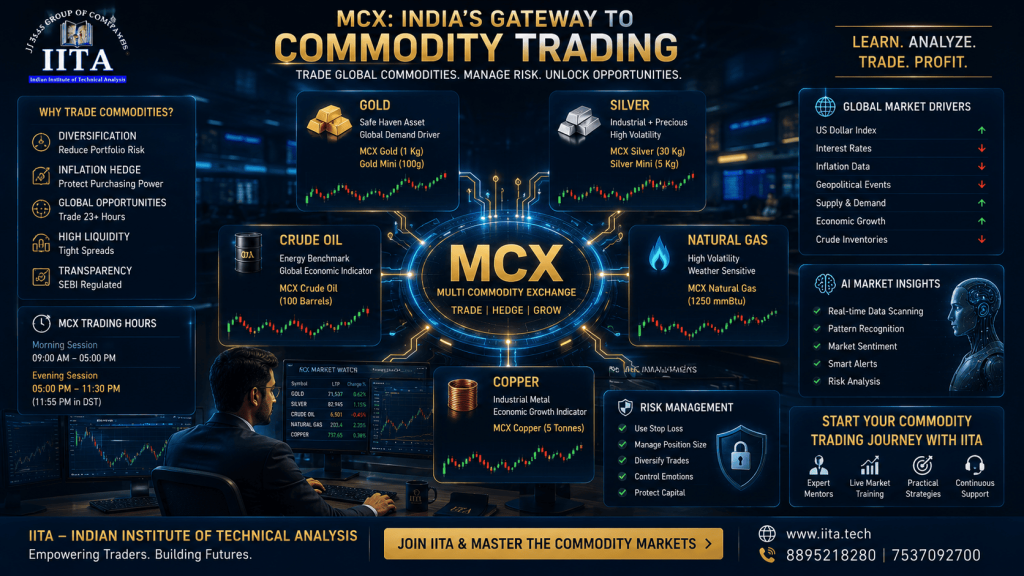
- Morning session: 9:00 AM – 5:00 PM IST
- Evening session: 5:00 PM – 11:30 PM IST (11:55 PM during US daylight saving time)
This means you can trade commodities after the stock market closes, reacting to US market movements, international data releases, and evening news in real time. Many traders treat commodity trading as their evening session after a day in equities.
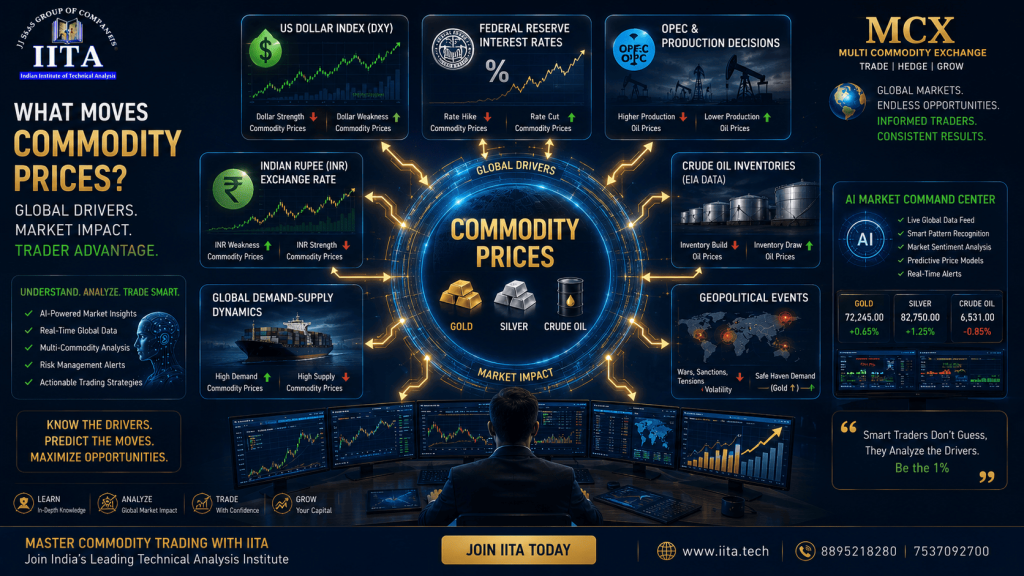
What Drives Commodity Prices?
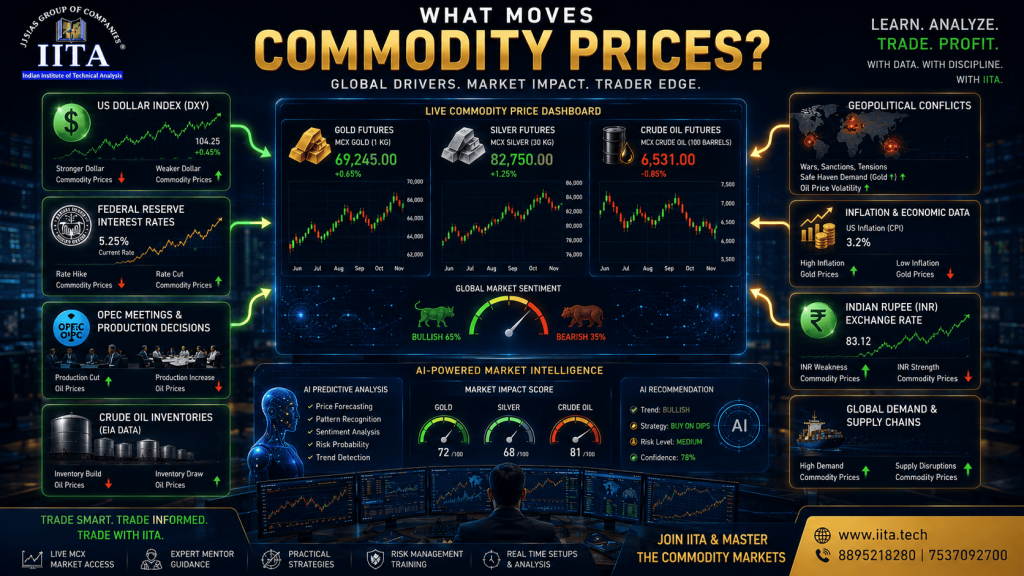
- US Dollar Index (DXY): Most commodities are priced in dollars globally. When the dollar strengthens, commodities tend to fall (and vice versa). This inverse relationship is one of the most important drivers
- Global interest rates: Higher rates strengthen the dollar and reduce gold’s appeal (gold pays no interest); lower rates are bullish for gold
- Supply and demand data: Crude oil inventories (EIA weekly report), OPEC production decisions, mining output for gold and silver
- Geopolitics: Wars, sanctions, trade disputes – uncertainty drives gold up and can spike or crash oil depending on the region affected
- Indian rupee: MCX prices are in rupees. Even if dollar gold is flat, a weakening rupee pushes MCX gold higher (and vice versa)
Commodity Trading vs Stock Market Trading
- Hours: Commodities trade until 11:30 PM; stocks close at 3:30 PM
- Drivers: Commodities are driven by global macro factors; stocks are driven by company and domestic factors
- Volatility: Crude oil and natural gas are significantly more volatile than most stocks
- Correlation: Gold often moves opposite to equity markets, providing diversification
- Technical analysis: Works identically on commodity charts – same candlestick patterns, same indicators, same support and resistance logic
Getting Started with Commodity Trading
- Same demat + trading account – most Indian brokers (Zerodha, Angel One, etc.) offer commodity trading through the same account you use for equities
- Enable commodity segment – you may need to activate the commodity segment separately in your broker account (one-time activation)
- Start with Gold Mini or Silver Mini – smaller lot sizes require less margin and are more manageable for beginners
- Learn the global calendar – US jobs data (first Friday of the month), Fed announcements, EIA crude data (every Wednesday) – these events move commodities significantly
Common Mistakes in Commodity Trading
- Ignoring global news and data calendars – commodities react to international events, not just Indian ones
- Underestimating leverage – 5–10% margin means 10–20x leverage; a 1% move is a 10–20% capital impact
- Trading natural gas or crude oil without experience – their volatility can overwhelm beginners
- Not adjusting position sizes for the higher volatility compared to equities
- Holding positions overnight near expiry without understanding delivery obligations
Frequently Asked Questions
What is commodity trading in simple words?
Commodity trading is buying and selling futures contracts based on physical goods like gold, silver, crude oil, and natural gas. In India, it happens on MCX. You trade price movements, not the physical commodity itself. Profits and losses are settled in cash.
Can I trade commodities with my existing stock trading account?
Yes – most major Indian brokers allow commodity trading through the same account. You may need to enable the MCX segment with a one-time activation. Check with your broker for the process.
How much money do I need to start commodity trading?
Gold Mini requires approximately ₹15,000–20,000 margin. Silver Mini requires approximately ₹10,000–15,000. Crude oil requires approximately ₹20,000–30,000. These are approximate margins that vary with market volatility. Start with Mini contracts to manage risk.
Is commodity trading riskier than stock trading?
The leverage is typically higher and the volatility of some commodities (crude oil, natural gas) is greater. This means larger potential gains AND larger potential losses. With proper risk management – smaller position sizes, strict stop losses – the risk is manageable. Without it, commodity trading can be significantly more punishing than equities.
Learn Commodity Trading and Multi-Market Analysis with IITA Bhubaneswar
At IITA (Indian Institute of Technical Analysis), Bhubaneswar, concepts like these are not taught from slides alone. Our trainers demonstrate on live market charts, letting you practise in real conditions with mentor guidance.
- Live market sessions – learn by doing, not just watching
- Experienced traders as trainers who practise what they teach
- Small batches for personal attention and doubt-clearing
- Post-course mentorship so support continues after class ends
- Classroom and online options available across Odisha
Visit iita.tech or call us to book a free introductory workshop.
Disclaimer: Stock market trading involves financial risk. This article is for educational purposes only and is not investment advice.