
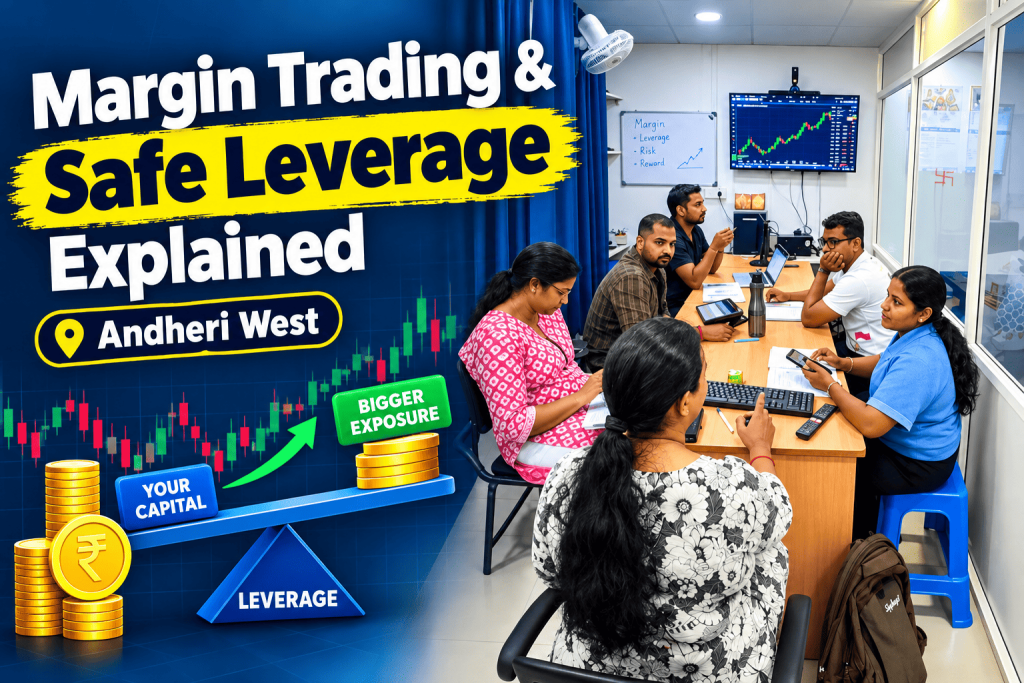
What is margin trading and how much leverage is actually safe? IITA Mumbai breaks down the risks, rules, and smart practices every trader should know.
Margin Trading & Safe Leverage Explained
Bandra Kurla Complex is home to some of the biggest brokerage offices and financial institutions in the country, and if you spend any time around that crowd, you’ll hear the word “leverage” thrown around constantly. Someone made a fortune using margin, someone else lost their entire capital doing the exact same thing. So which is it — a shortcut to bigger profits or a fast track to financial disaster? Honestly, it depends entirely on how well you understand margin trading before you start using it.
This article breaks down what margin trading actually means, how leverage works in the Indian markets, and — more importantly — how to use it safely instead of recklessly.
What Is Margin Trading?
In simple terms, margin trading allows you to buy securities by paying only a fraction of the total transaction value upfront, with your broker funding the rest. Instead of needing the full amount to purchase, say, ₹1,00,000 worth of shares, you might only need to put up ₹20,000 as margin, with the broker covering the remainder temporarily.
This arrangement gives you leverage — the ability to control a position much larger than your actual capital would normally allow. If the trade moves in your favour, your returns are calculated on the full position size, not just your margin amount, which means profits can be significantly amplified. Naturally, the same math applies in reverse when the trade goes against you.
How Leverage Actually Works
Let’s say you have ₹50,000 and your broker offers 5x leverage on a particular stock. That means you can take a position worth ₹2,50,000. If the stock rises by 4%, your profit is calculated on the entire ₹2,50,000, not your original ₹50,000 — turning a 4% market move into a 20% return on your actual capital. Sounds great, right?
Now flip it. If the stock falls 4% instead, you lose 20% of your capital in a single move. This is the part that trips up so many beginners engaging in margin trading for the first time — they see the upside potential clearly but underestimate just how quickly losses compound when leverage is involved.
Types of Margin in the Indian Markets
Margin requirements aren’t uniform across all trades. SEBI mandates different margin structures depending on the segment you’re trading in.
Initial Margin: The upfront amount required to open a position, calculated as a percentage of the total contract value.
Maintenance Margin: The minimum balance you need to maintain in your account once the position is open. If losses push your account below this threshold, you’ll receive a margin call.
Mark-to-Market Margin: In the futures segment particularly, your position is revalued daily, and any losses are deducted from your account balance in real time, not just when you close the trade.
Exposure Margin: An additional buffer required over and above the initial margin, meant to protect against sudden, sharp price swings.
Understanding these categories matters because margin trading isn’t a single fixed concept — the rules and risk exposure change depending on whether you’re trading equity delivery, intraday, or the futures and options segment.
Why SEBI Has Tightened Margin Rules
Over the past few years, SEBI has introduced several changes specifically aimed at reducing excessive leverage available to retail traders. Peak margin requirements, stricter intraday leverage caps, and increased scrutiny on broker-offered leverage products have all been introduced with one goal — protecting retail investors from blowing up their accounts through reckless margin trading.
This isn’t regulatory overreach. SEBI’s own data has repeatedly shown that a large majority of individual traders in the derivatives segment lose money, and excessive leverage is consistently one of the leading causes. If the regulator is actively working to rein in leverage, that alone should tell beginners something important about how it needs to be approached.
What “Safe Leverage” Actually Means
There’s no universal number that defines safe leverage — it depends on your capital, risk tolerance, and trading experience. That said, a few principles hold true across almost every serious trader’s approach to margin trading.
Never use your maximum available leverage. Just because your broker offers 10x doesn’t mean you should use all of it. Experienced traders often use a fraction of what’s technically available to them.
Size your position based on risk, not opportunity. Before entering a trade, calculate how much you’re willing to lose, not just how much you hope to gain, and let that figure determine your position size.
Always use a stop-loss. Leverage without a stop-loss is essentially an open-ended bet. A predefined exit point protects you from a single bad trade wiping out weeks of gains.
Keep a capital buffer. Never deploy every rupee you have into a leveraged position. Keeping reserve capital protects you from margin calls forcing you to exit at the worst possible moment.
Understand the instrument before using leverage on it. Margin trading behaves differently across equity, futures, and options. Using the same leverage logic across all three without understanding their individual risk profiles is a common and costly mistake.
Common Mistakes Beginners Make With Margin
The pattern is fairly consistent across new traders. They start with small, cautious positions, get an early win, and then gradually increase leverage without adjusting their risk management accordingly. A string of losses follows, and instead of stepping back, they often increase leverage further trying to recover losses quickly — a decision that tends to make things considerably worse.
Margin trading rewards discipline far more than it rewards aggression. The traders who last years in this business are rarely the ones taking maximum leverage on every trade; they’re the ones treating leverage as a tool to be respected, not a shortcut to be exploited.
Learning to Use Leverage the Right Way
Understanding margin trading on paper is one thing. Applying it with discipline, under real market pressure, with real money on the line, is an entirely different skill — and it’s usually the part that determines whether a trader survives their first year or not.
At IITA Mumbai, our courses cover margin and leverage concepts in depth, alongside practical risk management frameworks that help you trade with confidence rather than guesswork. If you’re based near BKC or anywhere across the city and want to understand how professional traders actually manage leverage, structured training makes a measurable difference.
Leverage isn’t inherently dangerous. Using it without understanding it is.
Final Thought
Margin trading can genuinely accelerate your returns when used with discipline, but it can just as easily accelerate your losses when used carelessly. The goal isn’t to avoid leverage altogether — it’s to understand it deeply enough that you’re using it as a calculated tool rather than a gamble. Anyone serious about margin trading should prioritise risk management and position sizing well before chasing bigger returns.
Frequently Asked Questions (FAQ)
1. What is margin trading in simple terms? Margin trading allows you to take a position larger than your available capital by borrowing the remaining amount from your broker, using leverage to amplify potential gains and losses.
2. How much leverage is considered safe in margin trading? There’s no fixed number, but experienced traders typically use far less leverage than the maximum offered, basing their position size on how much they’re willing to lose rather than the potential upside.
3. What happens if I don’t maintain the required margin? If your account balance falls below the maintenance margin, you’ll receive a margin call from your broker, requiring you to add funds or risk having your position automatically squared off.
4. Is margin trading the same across equity, futures, and options? No. Margin requirements and risk profiles differ across segments, so it’s important to understand the specific rules for whichever instrument you’re trading before using leverage.
5. Can beginners use margin trading safely? Yes, but only with proper risk management in place — smaller position sizes, mandatory stop-losses, and a clear understanding of margin calls are essential before increasing leverage.
📞 Book Your Free Career & Market Guidance Session Today!
Not sure where to begin? Speak with our academic counselors and discover the right learning path based on your goals.
📍 Office: Andheri West, Mumbai
💻 Training Mode: Both Offline & Online Classes available
📞 Call / WhatsApp: +91 84520 18280, +91 91870 98700
🌐 Website: https://iita.tech/stockmarket-course-in-mumbai/
📸 Follow us on Instagram: @stockmarketcourse_iita
Subscribe to Our YouTube Channels: 🔹 IITA Official: https://www.youtube.com/@iitab 🔹 Sudha Das (Market Learning): https://www.youtube.com/@sudhadas8420 🔹 Subrat Das: https://www.youtube.com/@subratdas2506
Disclaimer: Stock market trading involves financial risk. This article is for educational purposes only and is not investment advice.
IITA – https://iita.tech/stockmarket-course-in-mumbai/