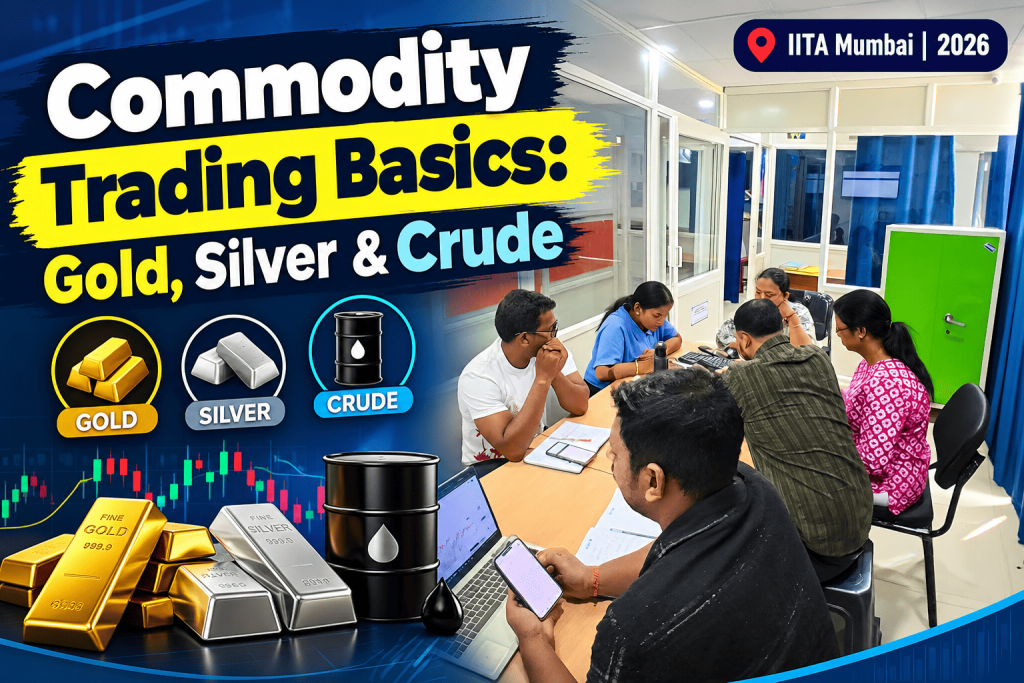
New to commodity trading? Learn how gold, silver, and crude oil are traded in India, what moves their prices, and how beginners can get started.
Commodity Trading Basics: Gold, Silver, Crude
Every Indian household has some relationship with gold, whether it’s an inherited necklace, wedding jewellery, or that one gold coin bought during Diwali “for good luck.” What most people don’t realise is that this same asset, along with silver and crude oil, is actively traded on Indian exchanges every single day — and commodity trading has quietly become one of the more accessible entry points for beginners looking to diversify beyond stocks.
If you’re near Worli or anywhere in Mumbai and curious about how gold, silver, and crude oil actually move as tradeable instruments rather than just household assets, this guide will walk you through the fundamentals.
What Is Commodity Trading?
Commodity trading refers to buying and selling raw materials or primary agricultural and energy products through organised exchanges, rather than physically owning or storing them. In India, this primarily happens through the Multi Commodity Exchange (MCX), which is regulated by SEBI and offers futures contracts on commodities like gold, silver, crude oil, natural gas, copper, and several agricultural products.
Unlike buying physical gold from a jeweller, commodity trading through MCX involves futures contracts — agreements to buy or sell a specific quantity of the commodity at a predetermined price on a future date. You’re speculating on price movement, not actually taking delivery of gold bars or oil barrels (though delivery options do technically exist for certain contracts).
Why Gold Remains a Favourite Among Indian Traders
Gold holds a unique place in commodity trading because of how deeply it’s woven into Indian culture and, more practically, because of how it behaves during periods of economic uncertainty. When stock markets get volatile or global tensions rise, gold prices often move higher as investors treat it as a safe haven asset.
Several factors influence gold prices on MCX: global gold rates (largely driven by international markets), the strength or weakness of the Indian rupee against the US dollar, domestic demand during festival and wedding seasons, and central bank buying patterns across the world. A trader who understands these drivers has a genuine edge over someone simply guessing which way the price will move next.
Silver: Gold’s More Volatile Cousin
Silver often gets overlooked in favour of gold, but it deserves attention in its own right within commodity trading circles. Silver tends to be considerably more volatile than gold, partly because it has significant industrial applications — used in electronics, solar panels, and various manufacturing processes — alongside its investment demand.
This dual nature means silver prices react not just to safe-haven buying like gold, but also to industrial demand cycles and manufacturing data from major economies. For traders comfortable with sharper price swings, silver can offer more frequent trading opportunities, though it also demands tighter risk management given how quickly it can move.
Crude Oil: The Most News-Sensitive Commodity
If there’s one commodity that reacts instantly to global headlines, it’s crude oil. Geopolitical tensions in oil-producing regions, OPEC production decisions, US inventory data released weekly, and global demand forecasts can all send crude prices swinging within minutes of a headline breaking.
Crude oil trading on MCX is priced in Indian rupees per barrel, and because India imports the vast majority of its oil needs, currency fluctuations play a significant role here too. A weakening rupee can push domestic crude prices higher even if global dollar-denominated prices stay flat. This makes crude one of the more complex commodities to trade, but also one of the most active in terms of trading volume and opportunity.
How Commodity Trading Differs From Stock Trading
Beginners often assume commodity trading works exactly like stock trading, just with a different asset. There are important distinctions worth understanding. Commodity markets are influenced heavily by global supply and demand data, weather patterns for agricultural products, currency movements, and geopolitical events, often more than company-specific news that drives stock prices.
Trading hours also differ — MCX commodity trading typically extends into the evening, allowing traders to react to international market cues that occur during Indian business hours’ off-peak periods. Additionally, commodities are traded in specific lot sizes and contract units unique to each product, so understanding contract specifications before trading is essential.
Getting Started With Commodity Trading
If you’re a beginner interested in exploring commodity trading, here’s a sensible starting approach.
Open a commodity trading account with a broker registered with MCX, separate from (though sometimes bundled with) your regular equity trading account.
Start by tracking prices before trading them. Follow gold, silver, and crude oil price movements daily for a few weeks. Notice how they react to news events, rupee movements, and global market cues before risking real capital.
Understand contract specifications. Each commodity has a defined lot size, tick size, and expiry structure. Know these details cold before placing your first trade.
Begin with smaller positions. Commodity futures involve leverage, similar to equity and index futures, so starting small while you learn how price movements actually feel is a smarter approach than diving in with a large position.
Follow global cues, not just domestic news. Since commodities are heavily influenced by international markets, following global economic calendars, OPEC announcements, and US Federal Reserve decisions becomes part of your regular research routine.
Risks Every Beginner Should Understand
Commodity trading carries its own specific risks beyond the general market volatility that applies to any trading instrument. Currency risk plays a bigger role here than in pure equity trading, since most commodities are priced internationally in dollars and then converted to rupees. Geopolitical events can cause sudden, sharp price gaps that are difficult to predict or hedge against quickly. And because leverage is involved, losses can accumulate faster than many beginners initially expect.
Why Structured Learning Matters in Commodity Markets
Commodity trading looks straightforward on the surface — track gold, silver, and crude, place your trades, manage your risk. In practice, understanding the global factors that genuinely move these markets, reading price charts correctly, and building disciplined risk management takes real study and, ideally, guidance from people who’ve navigated these markets themselves.
At IITA Mumbai, our stock and commodity market courses cover these fundamentals in depth, combining theoretical knowledge with practical, hands-on market exposure. Whether you’re based in Worli or elsewhere in the city, our training is designed to take beginners from complete newcomers to confident, informed traders.
Commodities like gold, silver, and crude have been part of human economic life for centuries. Trading them well, however, is a considerably more modern skill — one worth learning properly.
Final Thought
Gold, silver, and crude oil aren’t just household commodities — they’re actively traded instruments shaped by global supply, currency movements, and geopolitical events. Commodity trading offers a genuinely different perspective from equities, rewarding traders who follow global cues as closely as domestic news. Starting small, tracking prices before trading them, and understanding contract specifications will help you approach commodity trading with far more confidence than jumping straight in.
Frequently Asked Questions (FAQ)
1. Where does commodity trading happen in India? Commodity trading in India primarily takes place on the Multi Commodity Exchange (MCX), which is regulated by SEBI and offers futures contracts on gold, silver, crude oil, and several other commodities.
2. Do I need to take physical delivery when trading gold or silver futures? Not usually. Most retail traders square off their positions before expiry rather than taking physical delivery, though delivery options do exist for certain contracts.
3. Why does crude oil react so quickly to global news? Crude oil prices are highly sensitive to geopolitical events, OPEC decisions, and global inventory data, making it one of the most news-driven instruments in commodity trading.
4. Is commodity trading riskier than stock trading? It carries its own specific risks, including currency fluctuations and leverage, which can make it more volatile than delivery-based equity investing, though the risk level ultimately depends on how the trader manages their positions.
5. What is the minimum knowledge needed before starting commodity trading? Understanding lot sizes, contract specifications, margin requirements, and the global factors that influence gold, silver, and crude prices is essential before placing your first trade.
📞 Book Your Free Career & Market Guidance Session Today!
Not sure where to begin? Speak with our academic counselors and discover the right learning path based on your goals.
📍 Office: Andheri West, Mumbai
💻 Training Mode: Both Offline & Online Classes available
📞 Call / WhatsApp: +91 84520 18280, +91 91870 98700
🌐 Website: https://iita.tech/stockmarket-course-in-mumbai/
📸 Follow us on Instagram: @stockmarketcourse_iita
Subscribe to Our YouTube Channels: 🔹 IITA Official: https://www.youtube.com/@iitab 🔹 Sudha Das (Market Learning): https://www.youtube.com/@sudhadas8420 🔹 Subrat Das: https://www.youtube.com/@subratdas2506
Disclaimer: Stock market trading involves financial risk. This article is for educational purposes only and is not investment advice.
IITA – https://iita.tech/stockmarket-course-in-mumbai/