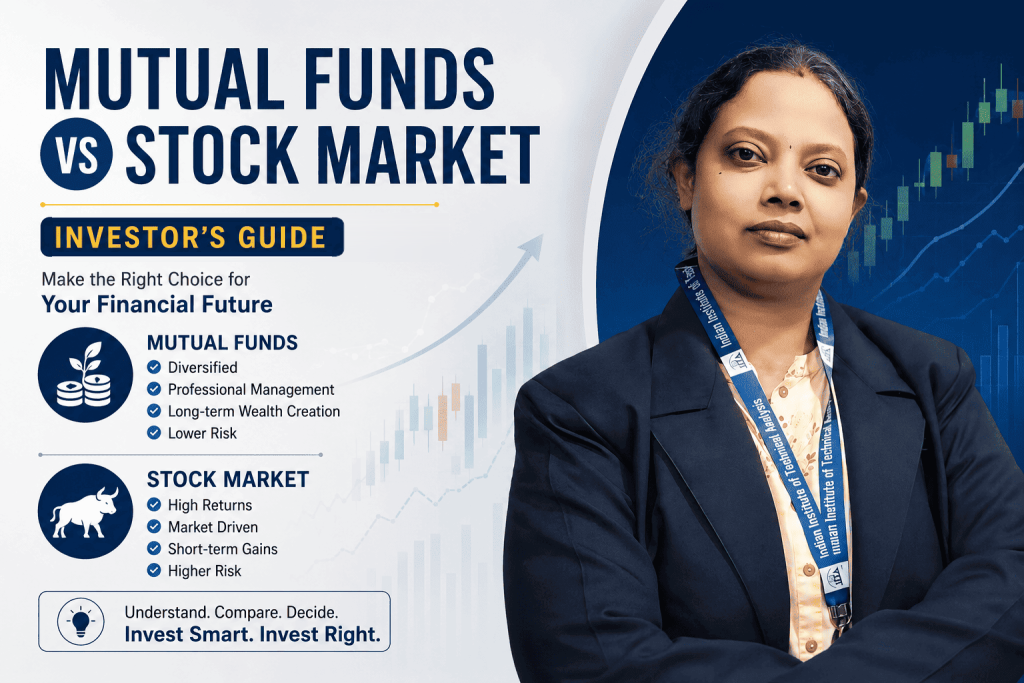
Confused between mutual funds vs stock market investing? Compare risk, returns, time commitment, and suitability in this practical investor’s guide.
Mutual Funds vs Stock Market: A Investor’s Guide
Every new investor eventually faces the same fundamental question: should I invest directly in stocks, or is it smarter to go through mutual funds? The mutual funds vs stock market debate doesn’t have a single right answer — it depends on your available time, knowledge, risk appetite, and financial goals. This guide breaks down both approaches clearly, so you can decide what fits your situation best.
Understanding the Basics
What Is Direct Stock Market Investing?
Investing directly in the stock market means buying individual company shares yourself, based on your own research and analysis. You have full control over which companies you invest in, when you buy or sell, and how your portfolio is structured.
What Are Mutual Funds?
Mutual funds pool money from multiple investors and are managed by professional fund managers who make investment decisions on behalf of the fund’s investors. When you invest in a mutual fund, you’re essentially buying a small stake in a professionally managed, diversified portfolio.

Mutual Funds vs Stock Market: Key Differences
1. Control Over Investment Decisions
In the mutual funds vs stock market comparison, direct stock investing gives you complete control over stock selection and timing. Mutual funds, on the other hand, hand this responsibility to a professional fund manager, which can be an advantage for those without the time or expertise to research individual companies.
2. Time and Effort Required
Direct stock market investing requires ongoing research — reading financial statements, tracking company news, and monitoring your portfolio regularly. Mutual funds require far less active involvement, since the fund manager handles day-to-day decisions, making them appealing for busy professionals.
3. Diversification
Building a well-diversified portfolio through direct stock investing requires significant capital to spread across multiple companies and sectors. Mutual funds offer instant diversification, even with relatively small investment amounts, since your money is pooled with other investors across a broad portfolio.
4. Costs Involved
Direct stock investing typically involves brokerage charges per transaction. Mutual funds charge an expense ratio — an annual fee for fund management — which varies depending on whether the fund is actively or passively managed. Understanding these cost structures is an important part of the mutual funds vs stock market decision.
5. Potential Returns
Direct stock market investing has the potential for higher returns if you pick strong-performing stocks, but it also carries higher risk of underperformance or loss if your stock selection is poor. Mutual funds offer more moderate, diversified returns, generally smoothing out the volatility of individual stock performance.
6. Skill and Knowledge Required
Successfully navigating direct stock market investing requires developing skills in fundamental and technical analysis. Mutual funds require comparatively less specialized knowledge, since professional managers handle the analytical work, though understanding fund categories and performance metrics is still valuable.
Who Should Choose Mutual Funds?
In the mutual funds vs stock market decision, mutual funds tend to suit:
- Beginners who are still building market knowledge
- Busy professionals with limited time for active research and monitoring
- Investors seeking instant diversification without needing significant capital
- Those who prefer a more passive, hands-off investment approach
Who Should Consider Direct Stock Market Investing?
Direct investing tends to suit:
- Investors willing to dedicate time to research and ongoing portfolio monitoring
- Those who have developed skills in fundamental and technical analysis
- Investors seeking potentially higher returns and willing to accept higher associated risk
- People who enjoy the process of researching and following individual companies
Can You Do Both?
Absolutely — and many experienced investors do exactly this. A common approach in the mutual funds vs stock market discussion isn’t choosing one exclusively, but building a core portfolio through mutual funds for stability and diversification, while allocating a smaller portion to direct stock investments for stocks you’ve personally researched and feel confident about.

Types of Mutual Funds to Understand
- Equity Funds: Primarily invest in stocks, offering higher growth potential with higher risk
- Debt Funds: Invest in fixed-income instruments, offering more stability with lower returns
- Hybrid Funds: Combine equity and debt for a balanced risk-return profile
- Index Funds: Passively track a market index like Nifty 50, offering low-cost, diversified exposure
Common Misconceptions
- “Mutual funds are risk-free.” All market-linked mutual funds carry risk, particularly equity funds, though generally less concentrated risk than individual stocks.
- “Direct stock investing always beats mutual funds.” This depends entirely on stock selection skill and market conditions; many individual investors underperform diversified mutual funds over time.
- “You need a lot of money to start either option.” Both mutual funds (through SIPs) and direct stock investing can be started with relatively small amounts.
Making Your Decision
When evaluating mutual funds vs stock market for your own situation, honestly assess:
- How much time can you realistically dedicate to research and monitoring?
- Do you have (or are you willing to build) the analytical skills needed for direct stock picking?
- What is your risk tolerance, and how would you react to individual stock volatility versus a diversified fund’s smoother performance?
- Are you looking for a hands-on learning experience, or a more passive investment approach?
Final Thoughts
The mutual funds vs stock market decision ultimately comes down to your personal circumstances rather than one option being universally superior. Mutual funds offer convenience, diversification, and professional management, making them ideal for beginners and busy professionals, while direct stock investing offers greater control and potential returns for those willing to invest the time and effort to develop genuine market expertise. Many successful investors, find that a thoughtful combination of both serves their long-term financial goals best.

Frequently Asked Questions
1. Which is safer, mutual funds vs stock market direct investing? Mutual funds generally offer more built-in diversification, which can reduce risk compared to concentrated direct stock holdings, though both carry market-related risk.
2. Can beginners start directly in the stock market, or should they start with mutual funds? Most experts recommend beginners start with mutual funds or a combination approach while building the knowledge needed for confident direct stock investing.
3. Do mutual funds guarantee better returns than individual stocks? No, returns depend on market performance and fund/stock selection. Some individual stocks can outperform mutual funds, but this comes with higher risk and requires stronger research skills.
4. How much money do I need to start investing in mutual funds vs stock market? Both can be started with relatively modest amounts — mutual funds through SIPs starting as low as a few hundred rupees, and direct stock investing based on individual share prices.
5. Can I switch between mutual funds and direct stock investing over time? Yes, many investors adjust their approach as they gain experience, often starting with mutual funds and gradually adding direct stock investments as their knowledge and confidence grow.
📞 Book Your Free Career & Market Guidance Session Today!
Not sure where to begin? Speak with our academic counselors and discover the right learning path based on your goals.
📍 Office: Andheri West, Mumbai
💻 Training Mode: Both Offline & Online Classes available
📞 Call / WhatsApp: +91 84520 18280, +91 91870 98700
🌐 Website: https://iita.tech/stockmarket-course-in-mumbai/
📸 Follow us on Instagram: @stockmarketcourse_iita
Subscribe to Our YouTube Channels: 🔹 IITA Official: https://www.youtube.com/@iitab 🔹 Sudha Das (Market Learning): https://www.youtube.com/@sudhadas8420 🔹 Subrat Das: https://www.youtube.com/@subratdas2506
Disclaimer: Stock market trading involves financial risk. This article is for educational purposes only and is not investment advice.
IITA – https://iita.tech/stockmarket-course-in-mumbai/