
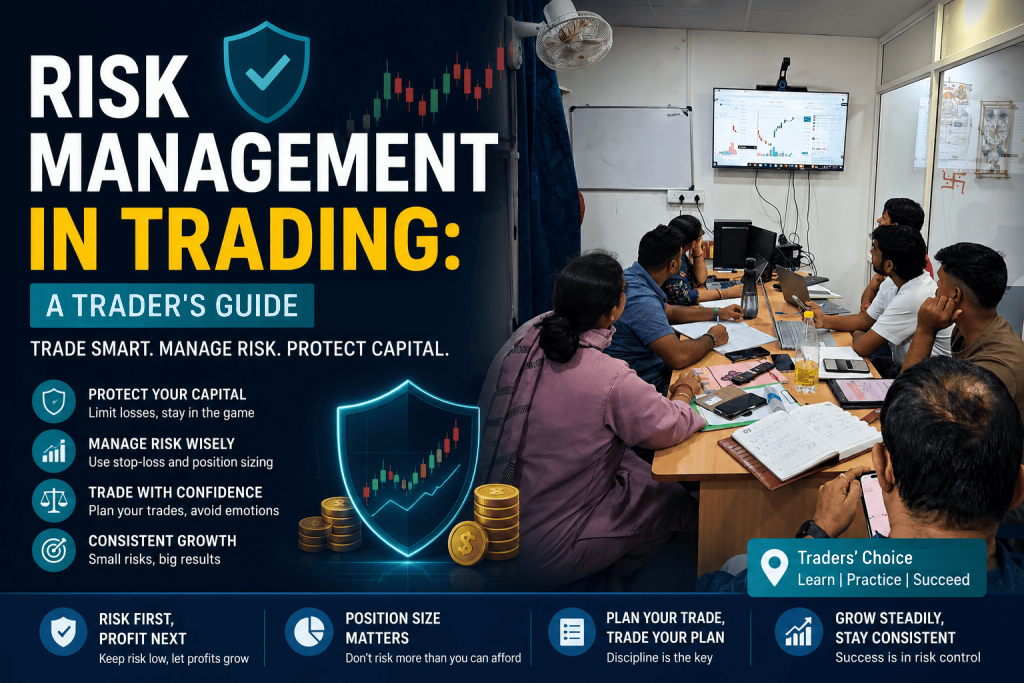
Learn practical risk management in trading — position sizing, stop-losses, and portfolio protection — through the lens of a disciplined trader.
Risk Management in Trading: A Trader’s Guide
Ask any trader who has survived multiple market cycles what separates long-term success from a short-lived trading career, and the answer almost always comes down to one thing: risk management in trading. Strategies, indicators, and market predictions matter, but without disciplined risk control, even the best strategy eventually leads to significant losses. This guide breaks down practical, actionable risk management principles, framed through the routine of a disciplined Mumbai-based trader.
Why Risk Management in Trading Matters More Than Strategy
It’s tempting to believe that finding the “perfect” strategy is the key to trading success. In reality, even a mediocre strategy combined with strong risk management in trading can outperform a brilliant strategy paired with poor risk control. The market is inherently uncertain — no strategy wins every time — which is why protecting your capital during inevitable losing trades matters just as much as capturing gains during winning ones.
Core Principles of Risk Management in Trading
1. Position Sizing
Position sizing determines how much capital you allocate to a single trade. A widely followed rule in risk management in trading is risking no more than 1-2% of your total trading capital on any individual position. This ensures that even a string of consecutive losses doesn’t significantly damage your overall account.
Example: If your trading capital is ₹2,00,000 and you follow a 1% risk rule, you would risk a maximum of ₹2,000 on any single trade, regardless of how confident you feel about the setup.
2. Setting Stop-Losses
A stop-loss is a predetermined price level at which you exit a losing trade to limit further loss. Effective risk management in trading always involves setting a stop-loss before entering a trade, based on a logical technical level rather than an arbitrary number.
3. Risk-to-Reward Ratio
Before entering any trade, disciplined traders calculate the potential risk versus potential reward. A common guideline is seeking a minimum 1:2 risk-to-reward ratio — risking a smaller amount to potentially gain at least twice that amount, ensuring that even a moderate win rate can be profitable over time.
4. Diversification
Concentrating capital in a single stock, sector, or strategy increases vulnerability to unexpected events. Spreading positions across different sectors or asset classes is a fundamental component of risk management in trading, reducing the impact of any single adverse event.
5. Avoiding Overleveraging
While leverage can amplify gains, it equally amplifies losses. A key part of risk management in trading involves using leverage cautiously, understanding margin requirements fully, and avoiding positions so large that a small adverse move could trigger a margin call or significant loss.
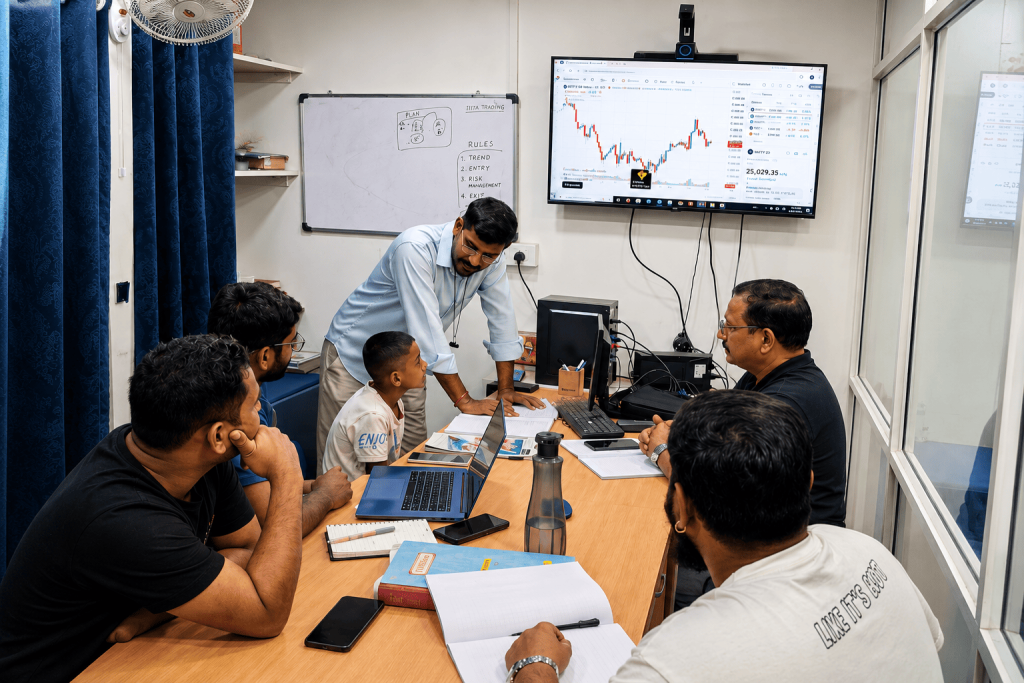
A Belapur Trader’s Practical Risk Management Routine
Before the Trading Day
Reviewing overall portfolio exposure, checking how much capital is already at risk across open positions, and confirming that any new trades won’t push total risk beyond a comfortable threshold.
Before Each Trade
Calculating position size based on the predetermined stop-loss level and the 1-2% risk rule, rather than deciding position size based on gut feeling or excitement about a particular setup.
During the Trading Day
Sticking to predefined stop-losses without moving them further away in the hope of avoiding a loss — a discipline that separates consistent traders from those who let small losses grow into significant ones.
After the Trading Day
Reviewing which trades followed the risk management plan and which didn’t, using this reflection to reinforce discipline for future sessions rather than only focusing on profit and loss numbers.
Common Risk Management Mistakes Traders Make
- Moving stop-losses further away during a losing trade, hoping the price will reverse
- Risking too much capital on trades that “feel” like sure winners
- Ignoring correlation risk, holding multiple positions that are likely to move in the same direction during a market downturn
- Revenge trading after a loss, increasing position size to recover losses quickly rather than sticking to the plan
- Not accounting for overall portfolio risk, focusing only on individual trades in isolation

Risk Management Across Different Trading Styles
Given the fast pace, intraday risk management in trading often involves tighter stop-losses and smaller position sizes, since price can move significantly within minutes.
Swing Trading
With positions held over days or weeks, swing traders often use wider stop-losses based on broader technical levels, while still maintaining strict position sizing rules.
Long-Term Investing
For long-term investors, risk management in trading shifts toward diversification across sectors and asset classes, along with periodic portfolio rebalancing, rather than tight, trade-by-trade stop-losses.
Building Risk Management Into Your Trading Plan
Rather than treating risk management as an afterthought, disciplined traders build it directly into their trading plan from the start — defining maximum risk per trade, maximum daily loss limits, and clear rules for when to stop trading for the day if losses exceed a predetermined threshold.
The Psychological Side of Risk Management
Effective risk management in trading isn’t just a mathematical exercise — it requires emotional discipline to follow the rules consistently, especially during stressful, high-pressure moments when the temptation to deviate feels strongest. Traders who journal their decisions and regularly review their adherence to risk rules tend to build this discipline more effectively over time.
Final Thoughts
Risk management in trading is often the least glamorous part of learning to trade, yet it’s consistently what separates traders who survive long-term from those who experience a promising start followed by a significant setback. By applying disciplined position sizing, setting logical stop-losses, and maintaining a favorable risk-to-reward approach, traders — whether based in Belapur or anywhere else — can build a foundation resilient enough to withstand the market’s inevitable ups and downs.
Frequently Asked Questions
1. What is the most important rule in risk management in trading? Position sizing — typically risking no more than 1-2% of total capital per trade — is widely considered the most fundamental rule in risk management in trading.
2. Should I always use a stop-loss for every trade? Yes, effective risk management in trading involves setting a stop-loss before entering every trade, based on a logical technical level rather than emotion.
3. How does risk management differ between intraday and long-term investing? Intraday trading typically requires tighter stop-losses and smaller position sizes due to rapid price movement, while long-term investing relies more on diversification and periodic rebalancing.
4. What is a good risk-to-reward ratio for trades? A minimum of 1:2 is a commonly recommended risk-to-reward ratio in risk management in trading, meaning potential reward should be at least twice the amount being risked.
5. Can good risk management make up for a mediocre trading strategy? To an extent, yes — disciplined risk management in trading can help preserve capital even when individual strategies aren’t perfect, whereas poor risk management can undermine even a strong strategy.
📞 Book Your Free Career & Market Guidance Session Today!
Not sure where to begin? Speak with our academic counselors and discover the right learning path based on your goals.
📍 Office: Andheri West, Mumbai
💻 Training Mode: Both Offline & Online Classes available
📞 Call / WhatsApp: +91 84520 18280, +91 91870 98700
🌐 Website: https://iita.tech/stockmarket-course-in-mumbai/
📸 Follow us on Instagram: @stockmarketcourse_iita
Subscribe to Our YouTube Channels: 🔹 IITA Official: https://www.youtube.com/@iitab 🔹 Sudha Das (Market Learning): https://www.youtube.com/@sudhadas8420 🔹 Subrat Das: https://www.youtube.com/@subratdas2506
Disclaimer: Stock market trading involves financial risk. This article is for educational purposes only and is not investment advice.
IITA – https://iita.tech/stockmarket-course-in-mumbai/