
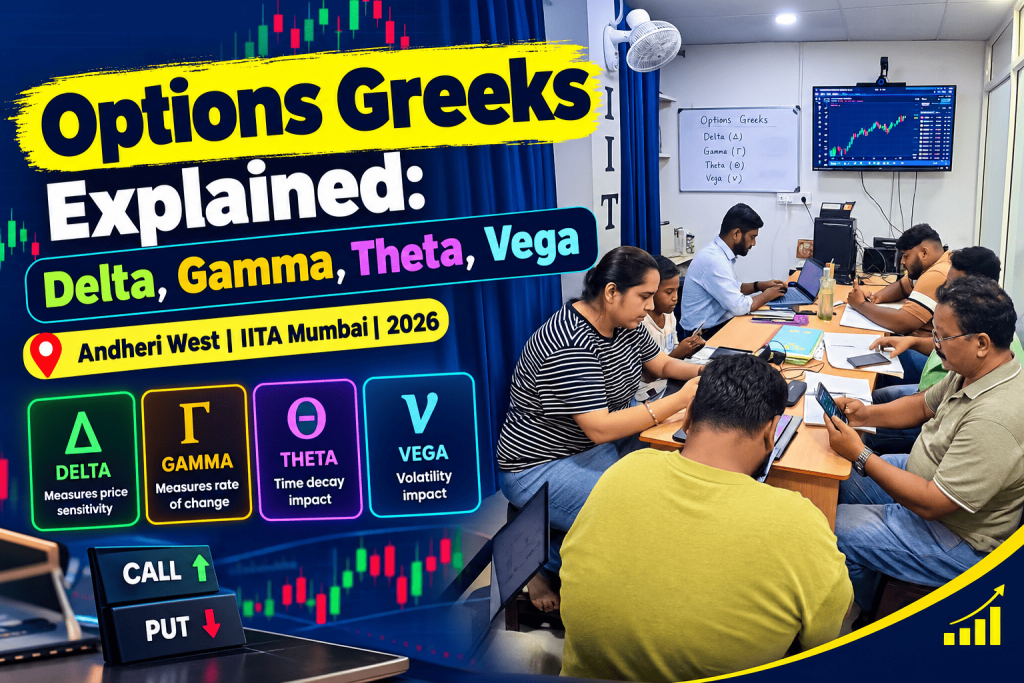
Get options Greeks explained clearly — Delta, Gamma, Theta, Vega, and Rho — with practical examples for Andheri West traders. Learn more at IITA Mumbai.
Options Greeks Explained: Think of Them as Your Dashboard, Not Decoration
An option’s premium looks like one simple number on your screen. It isn’t. Underneath that number are several distinct forces pulling in different directions at once — and once you’ve had options Greeks explained properly, you stop guessing why a premium moved and start actually knowing.
Think of a car’s dashboard. Speed, fuel, engine temperature — each gauge tells you something different about the same vehicle. The Greeks work the same way for an option: five separate readouts, each isolating one specific risk.
Delta: How Fast the Needle Moves
Delta is where everyone starts, because it’s the most intuitive. It tells you how much an option’s price should shift for every ₹1 move in the underlying stock. A call with a delta of 0.5 gains roughly ₹0.50 for every ₹1 the stock climbs. As a bonus, delta doubles as a rough estimate of the probability that option finishes in the money.
Gamma: The Rate the Needle Itself Is Changing
This is the one that trips people up early, mostly because it’s a step removed from what you’re actually watching. Gamma measures how fast delta itself is changing, not the stock price directly. It peaks for at-the-money options and climbs sharply as expiry closes in — which matters a lot if you’re managing a short-term position, because delta can shift on you faster than you’d expect right near the strike.
Theta: The Clock Is Always Running
If you’re trading anywhere near expiry, theta deserves your full attention. It measures how much value an option bleeds purely from time passing, everything else held equal. For buyers, theta is always working against you — less time left means less room for the stock to move in your favour, and that erosion speeds up dramatically in the final days before expiry.
Vega: What the Market Thinks Might Happen
Vega captures sensitivity to implied volatility, and it becomes genuinely important around known event risk — earnings, budget day, any moment where the market is bracing for a reaction. Rising implied volatility inflates premiums even with zero movement in the stock; falling implied volatility deflates them, which can hurt buyers even when they called the direction correctly.
Rho: The One You Can Mostly Ignore for Now
Rho measures sensitivity to interest rate changes, and for most short-term retail positions, it’s genuinely the least consequential of the five. It matters more on longer-dated contracts. As a beginner, don’t feel bad putting this one on the back burner while you build real fluency with the other four first.
Reading Them Together, Not One at a Time
Here’s the thing that makes options Greeks explained individually less useful than you’d hope: no position experiences just one Greek at a time. Hold a call option and you’re simultaneously exposed to Delta (direction), Theta (time bleeding away underneath you), and Vega (volatility swinging the premium around independently). Looking at any single Greek in isolation gives you an incomplete, sometimes misleading, picture.

Turning This Into Actual Decisions
- Delta helps you size a position appropriately for how strongly you actually believe in the direction
- Theta tells option sellers roughly how fast they should expect to collect premium as time decay works in their favour
- Vega warns you against buying right before an event, when implied volatility — and the premium you’re paying — is already inflated
- Gamma flags how quickly your directional exposure can shift as expiry approaches, especially for positions sitting right at the strike
Key Takeaways
- Delta captures direction and doubles as a rough probability of finishing in the money
- Gamma shows how fast delta itself is shifting, especially near expiry
- Theta is the steady erosion of value from time — always against buyers, always in favour of sellers
- Vega ties premium to expected volatility, crucial around known events
- Rho matters far more for longer-dated contracts than for typical short-term trades
- The real value comes from reading all five together, not cherry-picking one
Common Mistakes We See
Beginners latch onto Delta and stop there, completely ignoring what Theta and Vega are quietly doing to their position in the background. Others buy options right before a known event without ever checking whether implied volatility — and therefore Vega risk — is already priced sky-high. And a fair number underestimate how sharply Gamma can amplify losses on short positions sitting close to expiry.
Watching Them Shift in Real Time
Numbers on a page only get you so far. The real learning happens when you pull up an option chain during a live session and watch these figures actually move — Delta ticking up as the stock rallies, Theta quietly shaving off a few rupees every hour that passes, Vega jumping the moment volatility spikes on unexpected news. Doing this for even a single position, tracked across a full trading day, teaches more about how options Greeks explained on paper actually behave than reading about them ever will.
A useful exercise for beginners: pick one at-the-money option on a liquid stock, note all five Greek values first thing in the morning, then check back every hour or two through the session. You’ll start noticing patterns fairly quickly — how Gamma accelerates as the strike gets closer, how Theta’s bite feels sharper in the final trading days before expiry than it did a week out.
Why This Matters More for Sellers Than It First Appears
Buyers tend to focus on Delta because direction feels like the whole game when you’re paying a premium upfront. Sellers, though, live and die by Theta and Vega far more than Delta alone. A option seller collecting premium is essentially betting that time decay and stable-to-falling volatility will work in their favour faster than an adverse price move can hurt them. Once you’ve had options Greeks explained from a seller’s perspective specifically, the entire strategy starts to look less like a directional bet and more like a probability-weighted income trade — which is exactly how experienced sellers actually think about it.
Where Beginners Should Actually Start
Rather than trying to absorb all five Greeks equally on day one, focus on Delta and Theta first — they’re the two most intuitive, and together they cover the two questions that matter most for a beginner: which way is this position exposed, and how much is time working against or for me right now. Once those two feel genuinely comfortable, Vega and Gamma will make far more sense, since both build naturally on the foundation the first two provide.
Final Thoughts
Once you’ve genuinely had options Greeks explained — not just memorised, actually internalised — options trading stops feeling like a black box you’re poking at blindly. Delta, Gamma, Theta, and Vega each isolate a distinct kind of risk, and learning to read them together, rather than fixating on just one, is honestly what separates traders who understand their positions from traders who are just along for the ride.

Frequently Asked Questions
Which of these figures matters most for a beginner to learn first?
Delta is generally the easiest starting point, since it has the most intuitive, direct relationship with the underlying stock’s price movement, before moving on to the more nuanced concepts of time and volatility.
Do these figures change constantly?
Yes, they’re dynamic and shift continuously as the underlying price, time to expiry, and implied volatility change, which is why experienced traders monitor them regularly rather than checking them just once.
Is Theta always a disadvantage for a trader?
Not for option sellers, who benefit from time decay working in their favour, collecting premium as time passes. It’s specifically option buyers who are working against this particular factor.
How does expiry proximity affect these figures?
Gamma and Theta both become more pronounced as expiry approaches, meaning positions near their strike price close to expiry can see faster, larger shifts in value than the same position further from expiry.
📞 Book Your Free Career & Market Guidance Session Today!
Not sure where to begin? Speak with our academic counselors and discover the right learning path based on your goals.
📍 Office: Andheri West, Mumbai
💻 Training Mode: Both Offline & Online Classes available
📞 Call / WhatsApp: +91 84520 18280, +91 91870 98700
🌐 Website: https://iita.tech/stockmarket-course-in-mumbai/
📸 Follow us on Instagram: @stockmarketcourse_iita
Subscribe to Our YouTube Channels: 🔹 IITA Official: https://www.youtube.com/@iitab 🔹 Sudha Das (Market Learning): https://www.youtube.com/@sudhadas8420 🔹 Subrat Das: https://www.youtube.com/@subratdas2506
Disclaimer: Stock market trading involves financial risk. This article is for educational purposes only and is not investment advice.
IITA – https://iita.tech/stockmarket-course-in-mumbai/