
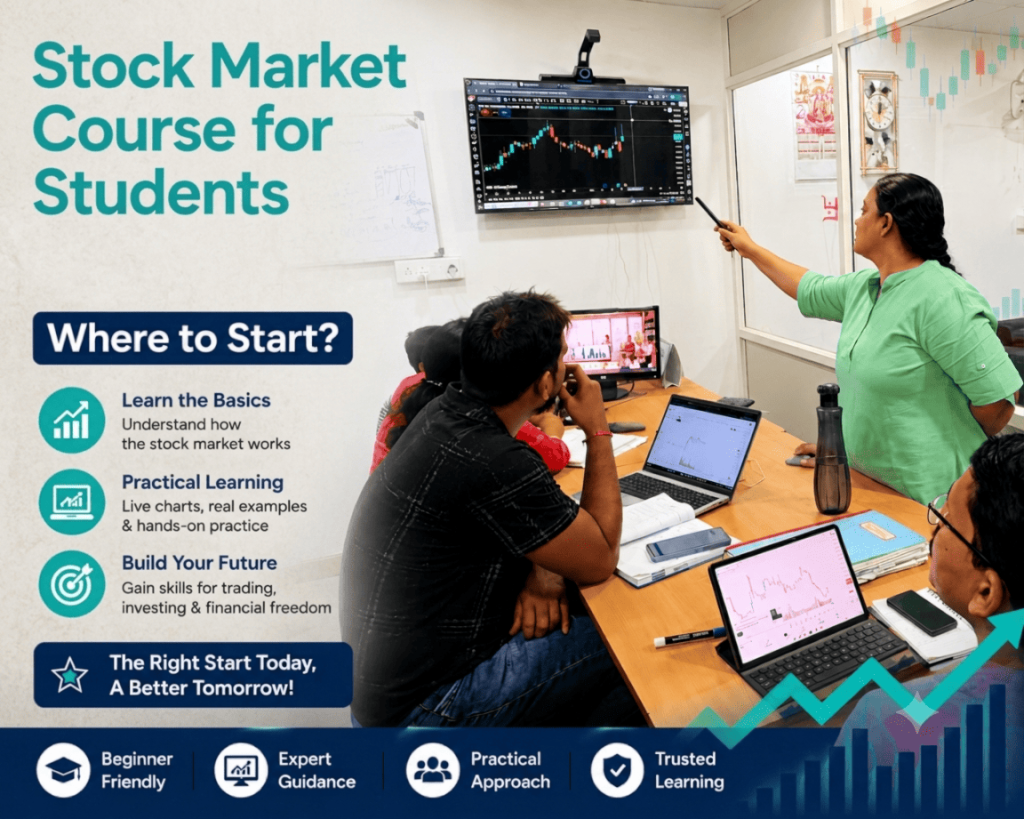
Looking for a stock market course for students? Here’s a beginner-friendly roadmap covering what to learn, in what order, and how to start.
Stock Market Course for Students : Where to Start
Mumbai, with its growing population of college students and young professionals, has become an increasingly active hub for finance education in Mumbai. Many students here are realizing that understanding the stock market isn’t just for finance majors anymore — it’s a practical life skill relevant to anyone who wants to build wealth over time. If you’re a student wondering where to start, this guide lays out a clear, structured path for choosing the right stock market course for students and building genuine market knowledge from the ground up.
Why More Students Are Learning About the Stock Market Early
Financial literacy is increasingly recognized as essential, yet it’s still rarely taught in-depth as part of standard college curriculums. Students who proactively enroll in a stock market course for students gain a head start — not just in potential investing skills, but in understanding how businesses, economies, and personal finance actually connect in the real world.
What Should a Stock Market Course for Students Actually Cover?
Not all courses are created equal, and choosing the right one matters. A well-structured stock market course for students should progress logically through these core areas:
1. Market Basics
Understanding what a stock exchange is, how shares are traded, what indices like Nifty and Sensex represent, and the basic mechanics of buying and selling shares.
2. Fundamental Analysis
Learning to read financial statements, understand key ratios, and evaluate whether a company is fundamentally strong — skills that remain valuable whether a student pursues trading, investing, or a broader finance career.
3. Technical Analysis
Introducing chart reading, candlestick patterns, and basic indicators, giving students the tools to understand price behavior and market sentiment.
4. Risk Management and Psychology
Perhaps the most overlooked but critical component — teaching students how to manage risk, size positions appropriately, and understand the psychological discipline required for consistent decision-making.
5. Practical Exposure
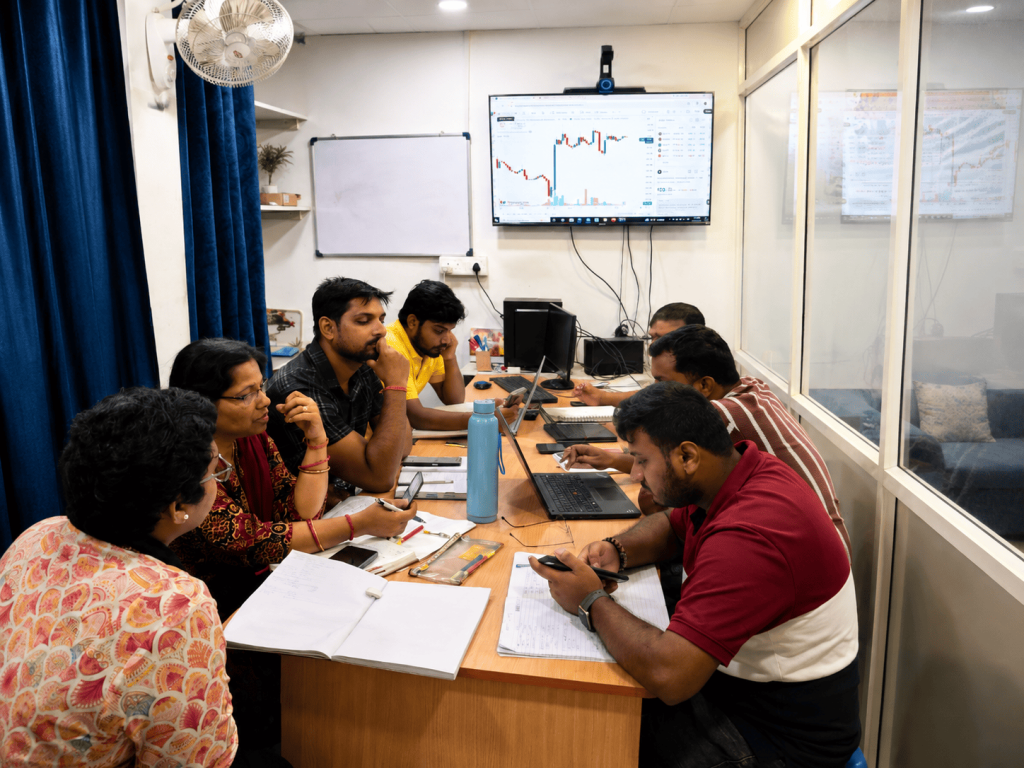
The best stock market course for students includes hands-on practice — paper trading, live market observation sessions, and real case studies — rather than relying purely on theory.

Why Students Have an Advantage in Learning the Market Early
Time Is on Their Side
Unlike someone starting later in their career, students have decades ahead of them to apply what they learn, benefiting from the compounding effect of both knowledge and capital growth over time.
Fewer Financial Obligations
Without the pressure of mortgages, family expenses, or major financial commitments, students often have more flexibility to learn, make small mistakes, and build experience with lower stakes.
Building Habits Early
Developing disciplined financial habits — budgeting, saving, and understanding markets — during student years often shapes a lifetime of better financial decision-making.
How to Choose the Right Course
When evaluating a stock market course for students, consider these factors:
- Curriculum Structure: Does it progress logically from basics to advanced topics, or jump around without clear sequencing?
- Practical Components: Does the course include live practice sessions, or is it purely lecture-based?
- Instructor Experience: Are the trainers actively engaged with markets, or purely academic?
- Flexible Scheduling: Does it offer batches that fit around college hours, exams, and other commitments?
- Doubt Resolution: Is there ongoing mentor support for questions that arise after initial lessons?
A Suggested Learning Path for Students
Phase 1: Foundation (Weeks 1-3)
Focus purely on understanding how markets work, key terminology, and basic concepts — without touching real trading yet.
Phase 2: Analysis Skills (Weeks 4-7)
Build capability in both fundamental and technical analysis, learning to evaluate companies and read price charts confidently.
Phase 3: Practice Without Real Money (Weeks 8-10)
Use paper trading or virtual trading platforms to apply what’s been learned, tracking decisions and outcomes without financial risk.
Phase 4: Small, Real Exposure (Ongoing)
Once comfortable, students can consider starting with very small amounts of real capital — money they’re fully prepared to lose while continuing to learn — treating early trades as tuition rather than expecting immediate profits.
Common Mistakes Students Should Avoid
- Jumping into live trading with significant capital before understanding the basics
- Following social media trading “gurus” without independently verifying claims
- Treating a stock market course for students as a quick path to guaranteed profits rather than a long-term skill-building journey
- Neglecting risk management in favor of focusing only on potential returns
Balancing Studies With Market Learning
Since academics remain the priority for most students, choosing a stock market course for students with flexible timing — weekend batches, recorded sessions, or short daily classes — helps ensure learning doesn’t come at the cost of college performance.
Final Thoughts
Enrolling in a well-structured stock market course for students is one of the most valuable investments a young person in Mumbai can make in their financial future — not because it guarantees quick profits, but because it builds a foundation of financial literacy and disciplined thinking that pays off for decades. Start with the basics, prioritize understanding over speed, and treat early mistakes as part of the learning process rather than setbacks.

Frequently Asked Questions
1. Is a stock market course for students worth it if I don’t plan a finance career? Yes. Understanding the stock market is a valuable life skill for personal wealth-building, regardless of your career path, and the analytical thinking it builds is useful in many fields.
2. What is the ideal age or year of college to start a stock market course for students? There’s no fixed age requirement, but many students start during their undergraduate years when they have relatively flexible schedules and can build habits early.
3. How much money do students need to start practicing what they learn? Students can start with paper trading, which requires no real money at all, and later begin with very small amounts of real capital once they’re confident in their understanding.
4. Does a stock market course for students require a finance background? No prior finance background is necessary. A good course starts from the basics and builds progressively, making it accessible to students from any academic stream.
5. Are online stock market courses effective for students ? Yes, online classes combined with structured curriculums and mentor support can be just as effective as offline classes, offering flexibility around college schedules.
📞 Book Your Free Career & Market Guidance Session Today!
Not sure where to begin? Speak with our academic counselors and discover the right learning path based on your goals.
📍 Office: Andheri West, Mumbai
💻 Training Mode: Both Offline & Online Classes available
📞 Call / WhatsApp: +91 84520 18280, +91 91870 98700
🌐 Website: https://iita.tech/stockmarket-course-in-mumbai/
📸 Follow us on Instagram: @stockmarketcourse_iita
Subscribe to Our YouTube Channels: 🔹 IITA Official: https://www.youtube.com/@iitab 🔹 Sudha Das (Market Learning): https://www.youtube.com/@sudhadas8420 🔹 Subrat Das: https://www.youtube.com/@subratdas2506
Disclaimer: Stock market trading involves financial risk. This article is for educational purposes only and is not investment advice.
IITA – https://iita.tech/stockmarket-course-in-mumbai/