
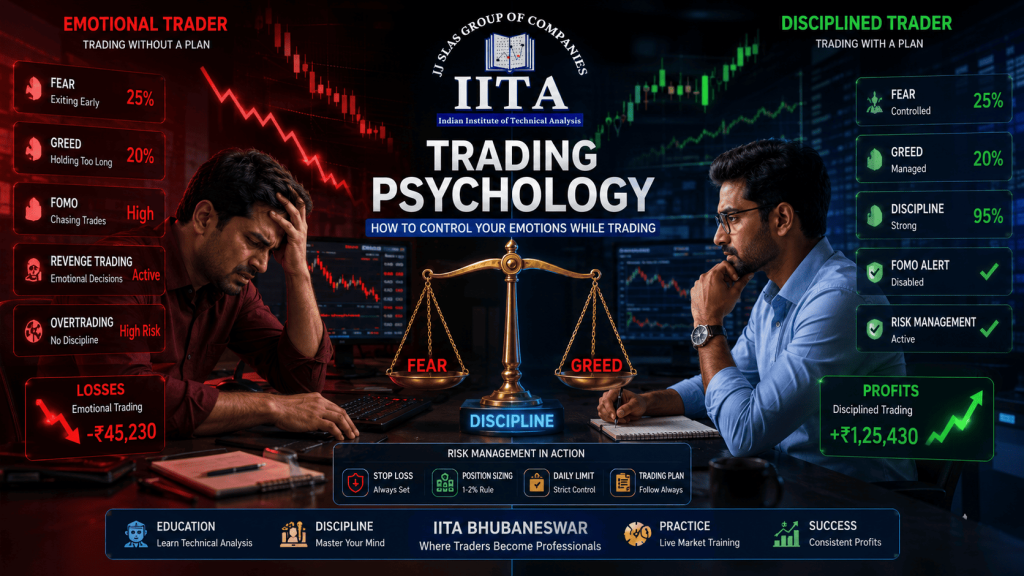
Trading psychology is the emotional and mental side of trading, and it touches every decision you make in the market. You can have a good strategy, solid indicators and clean chart patterns, and still lose money if you can’t stick to your plan when the market moves against you. Fear, greed, impatience and the urge to win a loss back quickly are some of the most common reasons traders abandon their own rules.
To be fair, psychology isn’t the only thing that costs traders money. Poor analysis, oversized positions, trading costs and plain bad luck all play a part, and SEBI’s studies show that most individual traders in equity derivatives lose money, though they don’t say emotions are the main cause. But emotions are the part you can work on, so this guide covers the main psychological traps and some practical ways to handle them.
Why Trading Psychology Matters
Trading is one of the few activities where you can read the market correctly and still lose, because your emotions made you act wrongly. Here’s how that looks in real life:
- You spot a perfect setup, but fear stops you from entering, and you watch the trade work without you.
- You’re in a winning trade, greed makes you hold too long, the market reverses, and your profit turns into a loss.
- You miss a big move, so FOMO makes you chase the next trade at a poor price.
- You take a loss, anger takes over, and you rush into a reckless revenge trade that makes it worse.
The market doesn’t care how you feel. Most experienced traders will tell you that you can’t switch emotions off, and you don’t need to. The goal is to stop them from making your trading decisions.

The Four Emotional Enemies of Every Trader
1. Fear
Fear shows up in a few ways. You might exit trades too early because you’re afraid of losing money. You might skip valid trades because you’re afraid of being wrong. Or you might enter late because you’re afraid of missing out. It’s a very common emotion, and it affects new and experienced traders alike.
How to manage it: Decide your exit before you enter. A stop loss order is one tool for that, and it helps you plan how much you’re willing to risk. But understand what it does and doesn’t do. A stop loss sets your planned risk. It doesn’t set your actual loss. If the price gaps past your stop, or the market is moving so fast that your order fills far away from it, you can lose more than you planned. Our guide to stock market order types explains why a triggered stop isn’t a guaranteed fill.
Here’s an example with assumed numbers. Say your capital is ₹5,00,000 and you decide to risk 1% on a trade, which is ₹5,000. You buy at ₹500 with a stop at ₹450. Risk per share is ₹50, so the position size is 5,000 ÷ 50 = 100 shares. Now imagine bad news arrives overnight and the stock opens at ₹430. Your stop triggers, but the fill is near ₹430. Your loss is (500 − 430) × 100 = ₹7,000. That’s 1.4% of your capital, not the 1% you planned. Read more about gap up and gap down moves.
Position sizing can calm the nerves too. Some traders risk only 1% to 2% of capital per trade. That’s an example of a common approach, not a rule that protects everyone, and the right amount depends on your capital, your experience and how much loss you can handle.
2. Greed
Greed makes traders hold winning trades too long, hoping for more, until the market turns and the profit is gone. It also pushes people to raise their position size after a few wins, because they feel unbeatable, and then a single loss wipes out those gains.
How to manage it: Set a profit target before you enter, and decide what you’ll do when you reach it. If the move keeps going, you can always look for a new entry. Some traders use a trailing stop, which means moving your stop up as the price rises. It can help you stay disciplined about when to exit, but it doesn’t guarantee that any profit is locked in, because the same gap and slippage risks apply.
3. FOMO (Fear of Missing Out)
FOMO hits when a stock or index makes a big move and you feel you have to jump in now, even though you missed the original entry. Chasing a trade like that often means entering late, at a worse price and without a plan, which is why it tends to go badly.
How to manage it: Accept that you’ll miss some trades. The market offers new chances every day. A missed trade costs you nothing, while a rushed one can cost real money. Some traders write a line like “Missing a trade is free. A bad trade costs money.” and read it before the market opens.
4. Revenge Trading
Revenge trading happens after a loss, when you quickly take another trade, often bigger and riskier, to win the money back. It’s driven by ego and anger, not analysis, and it can start a downward spiral.
How to manage it: Set a rule for yourself before you start trading. For example, some traders step away from the screen after two losing trades in a row, for 30 minutes or even the rest of the day. Others set a daily loss limit and stop when they hit it. Those numbers are examples, not universal rules, so choose limits that fit your own capital and risk tolerance, write them down, and respect them.
Watch Out for Correlated Positions
Small risk per trade can add up faster than you think if your trades move together. Using the same assumed numbers (₹5,00,000 capital, 1% or ₹5,000 planned risk per trade), suppose you hold three stocks from the same sector. Your planned risk is 3 × ₹5,000 = ₹15,000, or 3% of capital. A sector-wide shock hits all three at once. If each stock gaps past its stop and loses ₹7,000, as in the example above, your loss is 3 × ₹7,000 = ₹21,000, which is 4.2% of capital. Three separate trades behaved like one big trade.
So a small risk percentage doesn’t cap your total loss. It only describes your plan, and the real result also depends on gaps, slippage and how closely your positions move together. For more on this, see our guide to risk management in trading.
The Trading Journal: An Underrated Tool
A trading journal is a written record of every trade: the setup, entry, exit, result and how you felt. It sounds tedious, but it can teach you a lot. After a few weeks you may notice that you always revenge trade after a loss, or that you exit early out of fear, or that your FOMO trades keep losing. Once you can see a pattern, you can work on it. Without a journal it’s easy to keep repeating the same mistake without realising.
Common Mistakes Related to Trading Psychology
- Blaming the market, the broker or the indicator instead of looking at your own decisions.
- Having no plan, and trading on how you feel.
- Overtrading because of boredom or excitement.
- Holding losing trades in the hope they’ll recover, while cutting winners short.
- Changing strategy after every loss instead of sticking to one plan and improving it.
You can also read about the common mistakes new traders make.
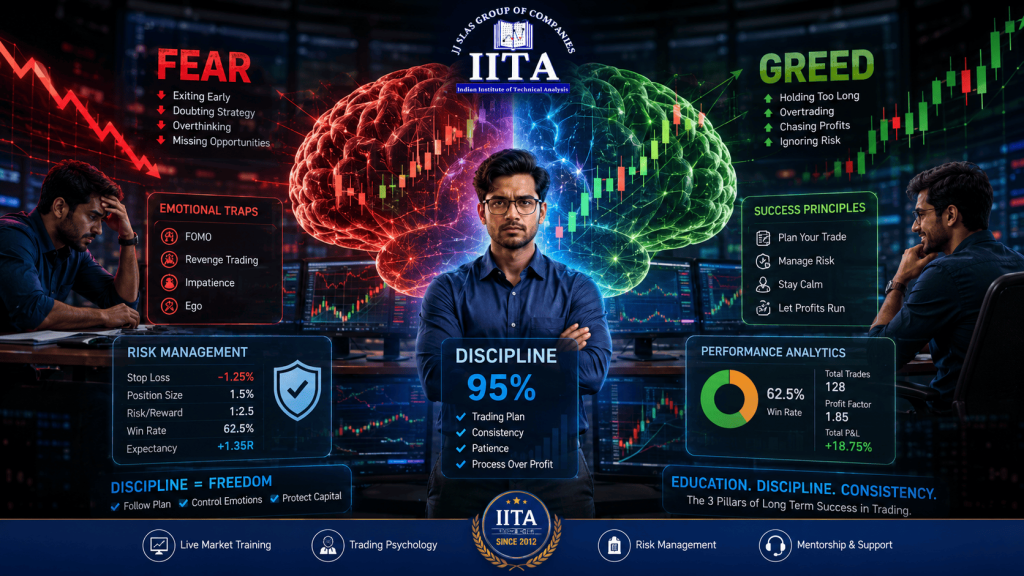
Frequently Asked Questions About Trading Psychology
What is trading psychology in simple words? It’s the emotional and mental side of trading. It covers how you handle fear, greed, losses and the pressure of making decisions with real money at stake. Managing it matters because emotional decisions can push you away from your own plan.
How do I stop emotional trading? Start with a written plan that has clear rules for entry, exit and risk. Keep each position small enough that a loss doesn’t shake you, and remember that a stop loss limits planned risk but can’t cap actual loss. Keep a journal to spot your emotional patterns, and set loss limits that suit you. No method removes emotion completely, but each one can reduce its pull.
Why do most traders lose money? There’s no single reason. Common ones include trading without a plan, using positions that are too big, overtrading, ignoring risk and trading costs, and acting on emotion. SEBI’s studies show that most individual traders in equity derivatives lose money, but they don’t say emotions are the main cause, so be wary of anyone who claims to know the one reason. Learning, practice and careful risk control can improve your odds, but they can’t promise a profit.
Build a Disciplined Approach to Trading at IITA Bhubaneswar
At IITA (Indian Institute of Technical Analysis), Bhubaneswar, [CONFIRM: which course or module covers trading discipline and psychology, what it includes, and the batch timings]. We teach in Hindi, Odia and English, in classroom and live online modes. If you’re starting from scratch, take a look at our beginner roadmap or our stock market course, or contact our IITA experts. If you prefer a style that matches your schedule, see our guide to swing trading.
Book Your Free Career & Market Guidance Session Today!
Not sure where to begin? Speak with our academic counselors and discover the right learning path based on your goals.
Office: Esplanade Mall, Rasulgarh, BBSR
Training Mode: Both Offline & Online Classes available
Call / WhatsApp: +91 8895218280, +91 8328955452
Website: https://iita.tech/best-stock-market-course-in-bhubaneswar/
Follow us on Instagram: @stockmarketcourse_iita
Subscribe to Our YouTube Channels: IITA Official: https://www.youtube.com/@iitab Sudha Das (Market Learning): https://www.youtube.com/@sudhadas8420 Subrat Das: https://www.youtube.com/@subratdas2506
Disclaimer: Stock market trading involves financial risk. This article is for educational purposes only and is not investment advice or a recommendation. The article instead asks readers to learn before they trade. The values given are subject to change as per SEBI. The latest figures can be found on SEBI’s websites or from experts.