
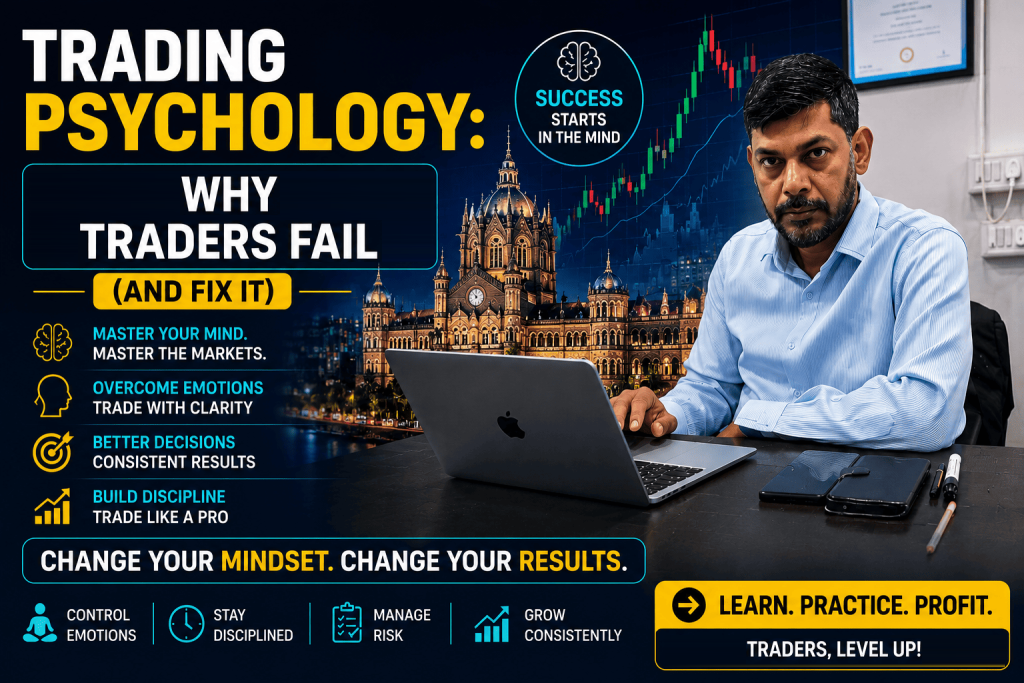
Explore trading psychology and why even skilled traders struggle — plus practical ways to build the discipline needed for consistent trading.
Trading Psychology: Why Traders Fail (and Fix It)
Mumbai is full of sharp, analytically minded professionals — bankers, chartered accountants, and consultants who excel at logical, numbers-driven decision-making in their careers. Yet many of these same skilled individuals struggle when they start trading, often losing money despite genuinely understanding market concepts. The reason usually isn’t a lack of knowledge — it’s trading psychology. This article explores why even intelligent, disciplined professionals fail in trading, and practical ways to fix it.
Why Trading Psychology Matters More Than Strategy
It’s a common misconception that trading success depends primarily on finding the “right” strategy. In reality, most profitable strategies are reasonably well-known and documented. What separates consistently successful traders from struggling ones is far more often trading psychology — the ability to execute a sound strategy consistently, without letting emotions like fear, greed, and impatience override rational decision-making.
Common Psychological Traps That Undermine Traders
1. Fear of Missing Out (FOMO)
Seeing a stock rally sharply and jumping in late, purely out of fear of missing further gains, is one of the most common trading psychology pitfalls. This often leads to buying near short-term tops, right before a pullback.
2. Loss Aversion
Humans are naturally wired to feel the pain of losses more intensely than the pleasure of equivalent gains. In trading psychology, this often manifests as holding onto losing positions far too long, hoping for a reversal, rather than accepting a small loss and moving on.
3. Overconfidence After Winning Streaks
A string of successful trades can create a false sense of mastery, leading traders to increase position sizes recklessly or abandon their risk management rules — right before market conditions shift and losses mount.
4. Revenge Trading
After a losing trade, the urge to immediately “win back” the loss through another impulsive trade is a classic trading psychology trap, often leading to a cascade of increasingly poor decisions driven by frustration rather than analysis.
5. Confirmation Bias
Once traders form an opinion about a stock’s direction, they often unconsciously seek out information that confirms their view while ignoring warning signs that contradict it — a bias that can prevent timely exits from losing positions.
6. Analysis Paralysis
Ironically, highly analytical professionals sometimes overthink trades, second-guessing well-researched setups due to excessive doubt, ultimately missing valid opportunities or exiting prematurely out of anxiety.
Why Skilled Professionals Are Especially Vulnerable
Professionals accustomed to structured, predictable work environments — where effort reliably correlates with outcomes — often struggle to accept that trading psychology requires a different mindset. In corporate roles, hard work and analysis usually lead to proportional results. In trading, even a well-researched, disciplined trade can lose money simply due to market randomness, and this disconnect between effort and outcome is psychologically difficult for many high-achieving individuals to accept.

Practical Ways to Improve Trading Psychology
1. Develop and Follow a Written Trading Plan
Having clearly defined entry rules, exit rules, and risk parameters written down before you trade removes much of the emotional decision-making that occurs in the heat of the moment. A written plan acts as an anchor when emotions run high.
2. Accept Losses as a Cost of Doing Business
Reframing losses as an expected, normal part of trading — similar to operating expenses in a business — rather than personal failures, helps reduce the emotional weight that often triggers poor decisions like revenge trading.
3. Maintain a Trading Journal
Recording not just your trades, but the emotions and reasoning behind each decision, helps identify recurring psychological patterns over time. Many traders discover specific triggers — like trading after a loss, or during periods of personal stress — that consistently lead to poor decisions.
4. Set Daily and Weekly Loss Limits
Predetermined limits on how much you’re willing to lose in a single day or week, with a firm rule to stop trading once that limit is reached, protects against the emotional spiral that often follows a string of losses.
5. Practice Mindfulness and Stress Management
Many experienced traders incorporate mindfulness practices, regular breaks, or physical exercise into their routine specifically to manage the stress and emotional intensity that trading can generate, recognizing that trading psychology is deeply connected to overall mental well-being.
6. Start With Smaller Position Sizes
Reducing position size, especially when working through psychological challenges, lowers the emotional intensity of each trade, making it easier to follow your plan objectively rather than reacting out of fear or excitement.
7. Separate Trading Identity From Self-Worth
One of the deeper aspects of trading psychology involves recognizing that a losing trade doesn’t reflect your intelligence or worth as a person. Professionals who tie their self-esteem too closely to trading outcomes often make increasingly desperate decisions trying to “prove” themselves after a loss.
Building Long-Term Psychological Resilience
Improving trading psychology isn’t a one-time fix — it’s an ongoing practice, much like physical fitness. Regularly reviewing your trading journal, honestly assessing emotional patterns, and gradually building discipline through consistent practice all contribute to long-term psychological resilience that supports sustainable trading performance.
How Structured Education Helps With Trading Psychology
While psychology can feel like a purely personal challenge, structured trading education that explicitly addresses these behavioral patterns — rather than focusing only on strategy and technical analysis — helps traders recognize and manage their own psychological tendencies more effectively, often accelerating the path toward consistent, disciplined trading.
Final Thoughts
For many skilled professionals, the biggest obstacle to trading success isn’t a lack of intelligence or market knowledge — it’s trading psychology. Fear, greed, overconfidence, and loss aversion can undermine even the most well-researched strategies if left unmanaged. By building self-awareness through journaling, following a structured trading plan, and treating psychological discipline as seriously as technical skill, traders can significantly improve their consistency and long-term results.

Frequently Asked Questions
1. Why does trading psychology matter more than strategy for many traders? Because most strategies are reasonably well-documented, but consistently executing them without emotional interference — the essence of trading psychology — is what actually determines long-term success.
2. What is the most common trading psychology mistake beginners make? Loss aversion — holding onto losing trades too long hoping for a reversal instead of accepting a small, planned loss — is one of the most common and costly trading psychology mistakes.
3. Can trading psychology be improved, or is it a fixed trait? Trading psychology can absolutely be improved through practices like journaling, following a written trading plan, and gradually building discipline through consistent, deliberate practice.
4. Why do highly analytical professionals sometimes struggle more with trading psychology? Professionals used to environments where effort predictably leads to results often struggle to accept trading’s inherent randomness, making the emotional aspect of trading psychology particularly challenging for them.
5. How can a trading journal help with trading psychology? A trading journal helps identify recurring emotional patterns and triggers behind poor decisions, allowing traders to recognize and address specific psychological weaknesses over time.
📞 Book Your Free Career & Market Guidance Session Today!
Not sure where to begin? Speak with our academic counselors and discover the right learning path based on your goals.
📍 Office: Andheri West, Mumbai
💻 Training Mode: Both Offline & Online Classes available
📞 Call / WhatsApp: +91 84520 18280, +91 91870 98700
🌐 Website: https://iita.tech/stockmarket-course-in-mumbai/
📸 Follow us on Instagram: @stockmarketcourse_iita
Subscribe to Our YouTube Channels: 🔹 IITA Official: https://www.youtube.com/@iitab 🔹 Sudha Das (Market Learning): https://www.youtube.com/@sudhadas8420 🔹 Subrat Das: https://www.youtube.com/@subratdas2506
Disclaimer: Stock market trading involves financial risk. This article is for educational purposes only and is not investment advice.
IITA – https://iita.tech/stockmarket-course-in-mumbai/