
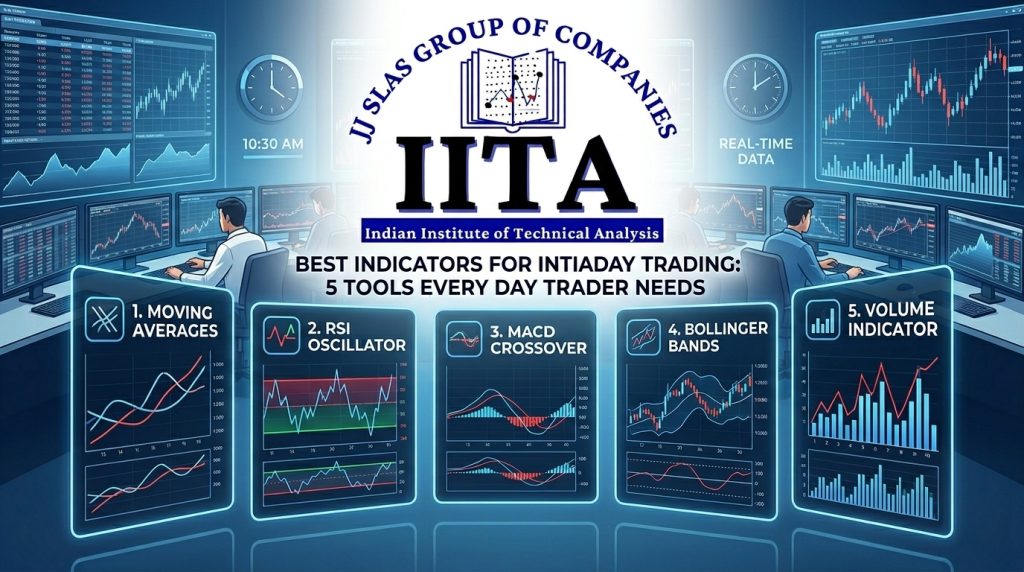
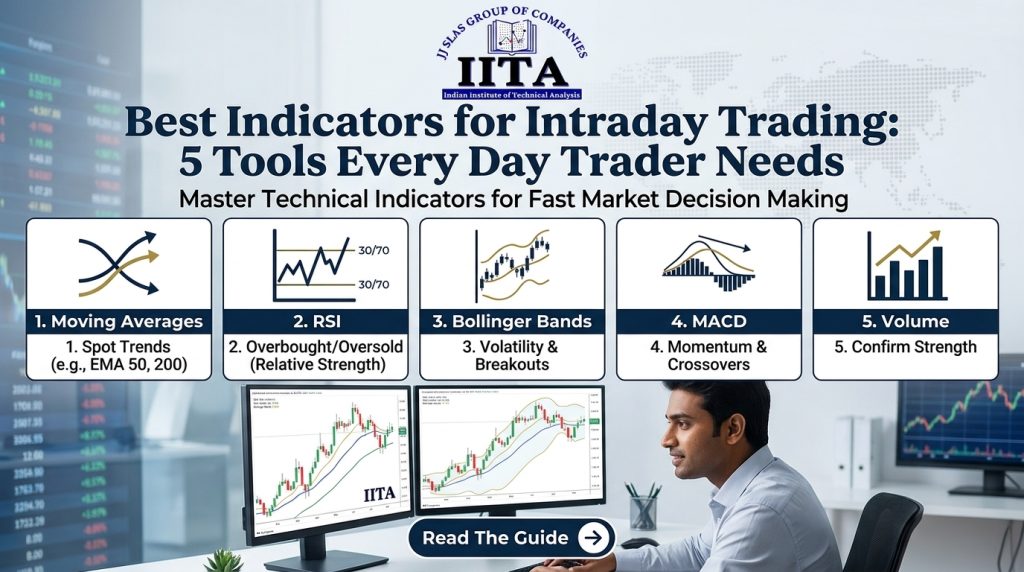
Best Indicators for Intraday Trading: 5 Tools Every Day Trader Needs
Intraday trading (day trading) means buying and selling within the same trading day, closing all positions before the market shuts. Because price moves happen fast and decisions need to be quick, intraday traders rely on technical indicators to help them identify the trend direction, spot entry and exit points, and confirm the strength of a move.
But with hundreds of indicators available on any charting platform, beginners often make the mistake of piling too many onto their chart until it becomes an unreadable mess. This guide covers the 5 best indicators for intraday trading that professional day traders actually use, explains each one in simple English, and shows you how to combine them for a clean, effective setup.
best indicators for intraday trading
What Is a Technical Indicator?
A technical indicator is a mathematical calculation based on price, volume, or both, displayed on your chart as a line, band, or histogram. Indicators do not predict the future. They organise past and current information to help you make better decisions in the present. The goal is to use a small number of indicators that complement each other, not to stack a dozen that repeat the same information.
1. Moving Averages (For Trend Direction)
Moving Averages (MA) are the foundation of most intraday trading strategies. A moving average smooths out price fluctuations by calculating the average closing price over a set number of periods, creating a flowing line on your chart that shows the underlying trend direction.
Types of Moving Averages
- Simple Moving Average (SMA) – a straightforward average of the last N closing prices. Equal weight to each price.
- Exponential Moving Average (EMA) – gives more weight to recent prices, making it react faster to new moves. Most intraday traders prefer the EMA for this reason.
How Intraday Traders Use Moving Averages
The most common intraday setup uses two EMAs: a fast one (like the 9-period EMA) and a slower one (like the 21-period EMA). When the 9 EMA crosses above the 21 EMA, it signals the short-term trend has turned bullish. When it crosses below, the trend has turned bearish. This is called a moving average crossover.
Practical tip: On a 5-minute chart of Nifty or Bank Nifty, the 9/21 EMA crossover is one of the most widely used signals. But never trade a crossover blindly. Always confirm with volume and check whether price is near a key support or resistance level.
2. VWAP – Volume Weighted Average Price (For Fair Value)
VWAP stands for Volume Weighted Average Price. It calculates the average price for the entire day, weighted by how much volume was traded at each price level. Unlike a regular moving average, VWAP gives more importance to prices where heavy trading occurred, making it a true measure of the day’s fair value.
Why VWAP Matters for Day Traders
- VWAP is the single most important indicator for intraday trading, especially for institutional traders
- When price is above VWAP, the day’s sentiment is bullish – buyers who traded today are mostly in profit
- When price is below VWAP, the day’s sentiment is bearish – sellers are in control
- Many intraday traders look to buy dips toward VWAP during a bullish day and sell rallies toward VWAP during a bearish day
3. RSI – Relative Strength Index (For Momentum)
The RSI (Relative Strength Index) measures the speed and magnitude of recent price changes on a scale from 0 to 100. It tells you whether a stock or index has been rising too fast (overbought) or falling too fast (oversold).
How to Read RSI for Intraday Trading
- RSI above 70 – overbought zone: price may have risen too fast and could pull back
- RSI below 30 – oversold zone: price may have fallen too fast and could bounce
- RSI between 40-60 – neutral zone: no strong momentum signal
Important warning: In a strong trending market, RSI can stay overbought (above 70) or oversold (below 30) for extended periods. This is normal. Never use RSI alone to trade against a strong trend. A stock can stay overbought for days while continuing to rally. Use RSI as a timing tool within the context of the broader trend, not as a standalone buy/sell signal.
Intraday tip: On a 15-minute chart, RSI can help you time entries. If the trend is bullish (price above VWAP and above the 21 EMA) and RSI dips to 40–45 and then turns back up, it can be a good pullback entry. This combines trend, VWAP, and RSI for a high-probability setup.
4. Bollinger Bands (For Volatility)
Bollinger Bands consist of three lines: a middle line (usually a 20-period SMA) and two outer bands placed 2 standard deviations above and below the middle line. The bands expand when volatility increases and contract when volatility decreases.
How Intraday Traders Use Bollinger Bands
- Squeeze (bands narrow): The market is quiet and a big move may be coming soon. Traders prepare for a breakout.
- Upper band touch during uptrend: This is not an automatic sell signal. In a strong uptrend, price “rides the upper band” and can stay there. It shows strength, not weakness.
- Lower band touch during downtrend: Similarly, price can ride the lower band during a selloff.
- Mean reversion: In a sideways market, price touching the upper band and turning down, or touching the lower band and turning up, can signal a reversal back toward the middle.
Common mistake: Beginners often sell automatically when price touches the upper Bollinger Band, thinking the price is “too high.” In a trending market, this is a losing strategy. Bollinger Bands measure volatility, not overbought/oversold conditions. Use them in context.
5. Volume (For Confirmation)
Volume is not a fancy indicator, but it is arguably the most important tool on your chart. Volume tells you how many shares or contracts were traded during each period. It confirms whether a price move has real conviction behind it or is just noise.
Volume Rules for Intraday Trading
- Strong move + high volume = trustworthy. A breakout above resistance with surging volume is far more likely to follow through.
- Strong move + low volume = suspicious. A breakout on thin volume is often a false breakout that reverses quickly. This is called a bull trap (on the upside) or bear trap (on the downside).
- Rising price + declining volume = warning. If price keeps rising but volume is dropping, the move is running out of steam.
Think of volume as the lie detector of the market. Price shows you the move. Volume tells you whether to believe it. Always check volume before trusting any signal from your other indicators.
How to Combine Indicators Without Cluttering Your Chart
The biggest mistake beginners make is adding too many indicators until the chart is unreadable and the signals contradict each other. Here is a clean, proven intraday setup using just three layers:
- Trend filter: 9 EMA and 21 EMA crossover + VWAP for directional bias
- Momentum/timing: RSI for spotting pullback entry points within the trend
- Confirmation: Volume bars to validate every signal
That covers trend direction, timing, and confirmation. It is everything you need for a solid intraday trading strategy. Master this simple setup before experimenting with anything more complex. More indicators does not mean better trading; it usually means more confusion.
Risk Management Matters More Than Any Indicator
No indicator wins every trade. Intraday trading is fast, volatile, and unforgiving. The traders who survive long-term are the ones who control risk ruthlessly:
- Always use a stop loss. Decide your exit point before you enter the trade, and stick to it.
- Never risk more than 1–2% of your capital on a single trade. One bad trade should never damage your account significantly.
- Maintain a risk-to-reward ratio of at least 1:2. If your stop loss risks ₹1,000, your target should be at least ₹2,000 in profit.
- Cut losses quickly, let winners run. This sounds simple but is emotionally the hardest part of trading.
An indicator shows you when a setup looks good. Risk management keeps you in the game when a setup fails, and setups will fail regularly.
Common Mistakes with Intraday Indicators
- Using 5+ indicators that all say different things, leading to analysis paralysis
- Relying on a single indicator in isolation without confirming with others
- Ignoring volume confirmation, the most underrated mistake in trading
- Trading without a stop loss because the indicator looked strong
- Using RSI or Bollinger Bands to trade against a strong trend
Frequently Asked Questions About Intraday Trading Indicators
What is the single best indicator for intraday trading?
Do these indicators work on Indian markets like Nifty and Bank Nifty?
Yes. Moving Averages, VWAP, RSI, Bollinger Bands, and Volume are universal tools used by traders in every market worldwide. They work equally well on Nifty, Bank Nifty, individual Indian stocks, and international markets.
Can complete beginners do intraday trading?
Beginners can learn intraday trading, but it is the most challenging and risky form of trading. You should learn chart reading, candlestick patterns, support and resistance, and indicators thoroughly before risking real money. Paper trading (practising without real money) for at least a few months is essential. Start with small position sizes when you do go live.
Which timeframe should I use for intraday trading indicators?
The 5-minute and 15-minute charts are the most popular for intraday trading in Indian markets. The 15-minute chart is less noisy and better for beginners. Always check the daily chart first for the bigger picture before zooming into intraday timeframes.
Build Your Intraday Trading Skills with IITA Bhubaneswar
Reading about indicators is one thing. Using them to make real-time decisions in a fast-moving market is something entirely different. At IITA (Indian Institute of Technical Analysis), Bhubaneswar, we bridge that gap with live, hands-on training.
Our students do not just learn what VWAP or RSI means. They learn when to act on these indicators, when to ignore them, and how to combine them into a disciplined trading system. Training happens on live Nifty, Bank Nifty, and stock charts, not on textbook examples.

Why IITA for Intraday Trading Training
- Live intraday trading sessions – watch indicators in action during market hours
- Practical indicator setups – learn exactly which indicators to use, which settings, and how to combine them
- Risk management focus – we teach you to survive first, profit second
- One-on-one doubt clearing – small batches ensure personal attention
- Post-course market support – stay connected with mentors for ongoing guidance
- Indian + Forex markets – apply your skills across multiple markets
Disclaimer: Stock market trading involves financial risk. This article is for educational purposes only and is not investment advice.