
What Is Nifty 50 and Bank Nifty? A Simple Guide for Beginners
Nifty 50 is a stock market index that tracks the performance of the 50 largest and most actively traded companies listed on the National Stock Exchange (NSE) of India. It is the single most important number in the Indian stock market, watched by every trader, investor, fund manager, and financial news channel in the country. When people say “the market is up” or “the market crashed,” they are almost always talking about Nifty 50.
This guide explains what Nifty 50 is, how it works, what Bank Nifty means, and why both matter to you as a beginner, all in plain, simple English.
What Does Nifty 50 Actually Mean?
The word “Nifty” comes from combining National Stock Exchange and Fifty (the number of companies). Nifty 50 is an index, which is simply a number that represents the combined performance of a group of stocks. Instead of tracking 2,000+ stocks individually, Nifty gives you one number that tells you how the overall market is doing.
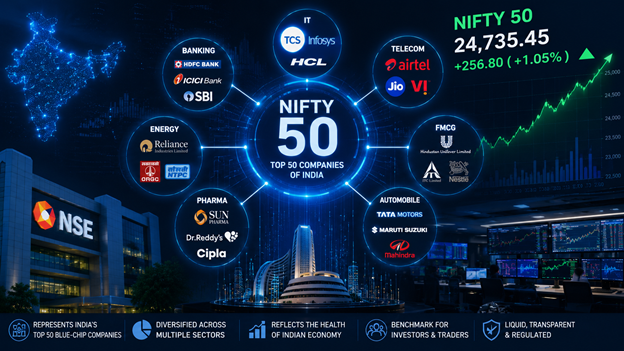
The 50 companies in Nifty are chosen from different sectors like banking, IT, energy, FMCG, pharma, and automobiles. Together, they represent roughly 60–65% of the total market value of all companies on NSE. So when Nifty moves, it reflects the health of the broader Indian economy.
Examples of Nifty 50 Stocks
Nifty 50 includes household names like Reliance Industries, TCS, HDFC Bank, Infosys, ICICI Bank, Bharti Airtel, ITC, Hindustan Unilever, State Bank of India, and Kotak Mahindra Bank, among others. The list is reviewed by NSE every six months, and companies can be added or removed based on their market value and trading volume.
How Is Nifty 50 Calculated?
Nifty is calculated using the free-float market capitalisation method. In simple terms, it measures the total market value of the 50 companies, but only counts the shares that are available for public trading (not shares held by promoters or the government). The current value is compared to a base value from November 3, 1995, which was set at 1,000 points.
You do not need to calculate it yourself. NSE updates the Nifty value every second during market hours. What matters is understanding that when Nifty goes up, it means the combined value of these 50 companies has increased, and when it goes down, their combined value has decreased.
What Is Bank Nifty?
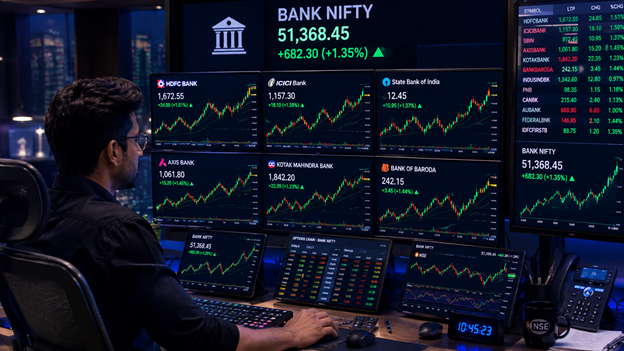
Bank Nifty (officially called Nifty Bank) is a sector-specific index that tracks the 12 most liquid and large banking stocks listed on NSE. It includes both private banks like HDFC Bank, ICICI Bank, Kotak Mahindra Bank, and Axis Bank, and public sector banks like State Bank of India, Bank of Baroda, and Punjab National Bank.
Bank Nifty is extremely popular among intraday and options traders because banking stocks tend to move sharply and offer high volatility, creating more trading opportunities within a single day. If you hear someone say they are “trading Bank Nifty,” they are typically trading Bank Nifty futures or options, not buying individual bank shares.
Nifty 50 vs Sensex: What Is the Difference?
Nifty 50 tracks 50 companies on the National Stock Exchange (NSE)
Sensex (also called BSE 30) tracks 30 companies on the Bombay Stock Exchange (BSE)
There is significant overlap because many large companies are listed on both exchanges. In practice, Nifty and Sensex move in the same direction almost all the time. However, Nifty is more widely used for trading (especially derivatives like futures and options) because NSE has much higher trading volume than BSE. Most active traders focus on Nifty and Bank Nifty rather than Sensex.
Why Do Traders Watch Nifty and Bank Nifty?
Market direction: If Nifty is rising, the overall market mood is bullish. If falling, bearish. Traders use this as their first filter before taking individual stock trades.
Trading instruments: You can directly trade Nifty and Bank Nifty through futures and options contracts. These are among the most heavily traded instruments in the world by volume.
Benchmark: Fund managers and investors compare their portfolio performance against Nifty. If your portfolio made 15% but Nifty made 20%, you underperformed the market.
Volatility and opportunity: Bank Nifty’s high daily moves make it the most popular index for intraday and options traders in India.
How Can You Trade Nifty and Bank Nifty?
You cannot buy “Nifty” directly the way you buy a share. Instead, you trade it through:
Nifty Futures – a contract that lets you buy or sell the Nifty index value at a future date. Requires a margin (deposit) in your trading account.
Nifty Options – call and put options on Nifty that expire weekly (every Thursday) and monthly. Options are popular because they need less capital than futures. (See our guide on options trading for beginners.)
Index ETFs and Index Funds – for investors (not traders), you can buy exchange-traded funds like Nifty BeES that track the Nifty 50 index. This is a passive investment strategy.
Bank Nifty can be traded the same way through Bank Nifty futures and Bank Nifty options, which also expire weekly.
Key Facts Every Beginner Should Know
Nifty 50 was launched on April 22, 1996, with a base date of November 3, 1995 and a base value of 1,000
It is managed by NSE Indices Limited (formerly India Index Services & Products Limited)
Indian stock market trading hours are 9:15 AM to 3:30 PM IST, Monday to Friday
Nifty options have weekly expiry every Thursday and monthly expiry on the last Thursday
Bank Nifty is one of the most traded index derivatives in the world by contract volume
Frequently Asked Questions About Nifty 50 and Bank Nifty
What is Nifty 50 in simple words?
Nifty 50 is a stock market index that tracks the top 50 companies listed on the National Stock Exchange of India. It acts as a barometer of the overall Indian stock market. When Nifty goes up, the market is generally doing well. When it falls, the market is declining.
What is the difference between Nifty and Bank Nifty?
Nifty 50 tracks the 50 largest companies across all sectors. Bank Nifty tracks only the 12 largest banking stocks. Bank Nifty is more volatile (moves more sharply in a day) and is the most popular index for intraday and options trading in India.
Can beginners trade Nifty?
Beginners can trade Nifty, but they should first learn chart reading, technical analysis, risk management, and options basics before trading with real money. Nifty futures and options involve leverage, which amplifies both profits and losses. Start with paper trading and small positions.
How much money do I need to trade Nifty?
Nifty options can be bought for as little as a few hundred rupees (the premium amount). Nifty futures require a margin of approximately ₹1–1.5 lakh depending on market conditions. However, having enough capital and knowing how to manage risk matters more than the minimum amount.
Is Nifty 50 a good investment?
Understand the Market Before You Trade It – Learn with IITA Bhubaneswar
Knowing what Nifty and Bank Nifty are is the starting point. Knowing how to read their charts, spot trends, place trades with proper risk management, and build a trading plan is what turns knowledge into skill. IITA Bhubaneswar teaches you all of this through live market practice.
At IITA (Indian Institute of Technical Analysis), our trainers do not just explain concepts. They trade Nifty and Bank Nifty live in front of you, showing you exactly how decisions are made in real time. That kind of learning cannot be replaced by watching YouTube videos.
Why IITA for Index Trading
Live Nifty and Bank Nifty trading sessions during market hours
Options strategies explained with real-time examples, not textbook theory
Risk management built into every lesson – we teach you to survive before you profit
Small batches for personal attention and doubt-clearing
Post-course mentorship so you are not left alone after class ends
Both classroom and online options available for students across Odisha

Visit iita.tech or call us to book a free introductory workshop.
Disclaimer: Stock market trading involves financial risk. This article is for educational purposes only and is not investment advice.