
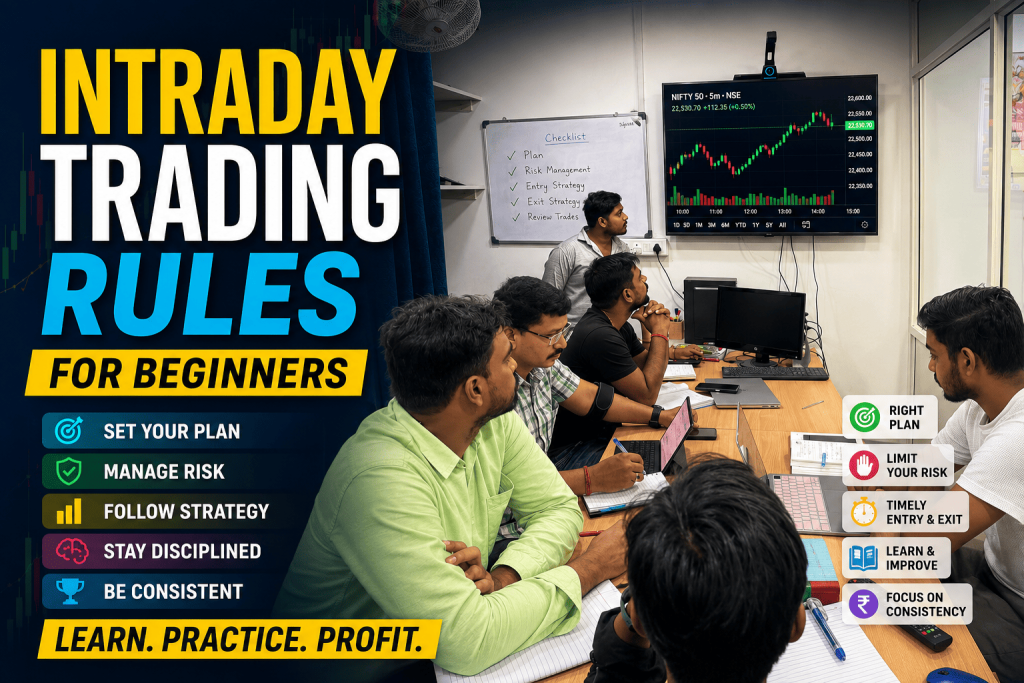
Learn essential intraday trading rules for beginners in Dombivli — from risk management to stock selection. Start your journey with IITA Mumbai.
Intraday Trading Rules for Beginners: A Dombivli Starter’s Guide
Every week, we meet aspiring traders from Dombivli who are excited to start intraday trading after watching a few YouTube videos or hearing success stories from friends. The enthusiasm is great, but intraday trading without a proper rulebook is one of the fastest ways to lose money in the stock market. Unlike investing, where time works in your favor, intraday trading demands discipline, speed, and strict rules because every position must be closed before the market shuts for the day.
This guide lays out the essential intraday trading rules for beginners that we teach at IITA, designed to help Dombivli’s new traders build a solid foundation before risking real capital.
Rule 1: Trade with a Plan, Not Emotions
The single biggest mistake beginners make is entering trades on impulse — a hot tip, a sudden price spike, or FOMO after seeing a stock rally. Every trade you take intraday should have a predefined entry point, stop-loss, and target before you click “buy” or “sell.” Write it down if you have to. A trading plan removes emotion from the equation and keeps you accountable to your own strategy rather than the market’s noise.
Rule 2: Always Use a Stop-Loss
This is non-negotiable. A stop-loss is your safety net — it automatically exits your position if the trade moves against you beyond a level you are comfortable losing. Beginners often skip stop-losses hoping a losing trade will “come back,” and this single habit has wiped out more trading accounts than almost anything else. Decide your stop-loss before entering the trade, not after you are already in a loss.
Rule 3: Risk Only a Small Percentage of Capital Per Trade
Professional traders typically risk no more than 1-2% of their total trading capital on any single trade. If you have ₹1,00,000 in your trading account, that means risking ₹1,000-₹2,000 per trade at most. This rule ensures that even a string of losing trades — which happens to every trader — will not wipe out your account. Dombivli beginners who ignore position sizing often blow up their accounts within weeks, regardless of how good their strategy is.
Rule 4: Trade Liquid Stocks Only
Stick to stocks with high daily trading volume, typically the Nifty 50 or well-known Nifty 500 names. Illiquid, low-volume stocks have wider bid-ask spreads and can move erratically, making it difficult to enter and exit at your intended price. Liquidity is your friend in intraday trading — it ensures your stop-loss and target orders actually execute close to where you expect.
Rule 5: Avoid Overtrading
Taking ten trades a day out of boredom or restlessness is a recipe for accumulating losses through brokerage costs, taxes, and impulsive decisions. Quality over quantity matters far more in intraday trading. Many of our most successful Dombivli students eventually settle into taking just two or three well-planned trades a day rather than chasing every small movement on the screen.
Rule 6: Have a Fixed Trading Routine
Successful intraday traders follow a consistent daily routine — reviewing overnight global market cues, checking key support and resistance levels before the market opens, and having a shortlist of stocks to watch. Randomly opening the trading app at 10 AM and reacting to whatever is moving is not a strategy; it is gambling.
Rule 7: Set a Daily Loss Limit
Decide in advance the maximum amount you are willing to lose in a single day, and once you hit that limit, stop trading for the day — no exceptions. This single rule protects you from the classic “revenge trading” spiral, where a trader tries to recover a loss by taking bigger, riskier trades and ends up losing even more.
Rule 8: Understand Margin and Leverage Carefully
Brokers offer intraday leverage that can multiply both your gains and losses several times over. Beginners are often drawn to high leverage because it lets them trade larger positions with smaller capital, but this magnifies risk just as much as reward. Understand exactly how much leverage you are using and the potential downside before placing a trade.
Rule 9: Keep a Trading Journal
Record every trade you take — the entry, exit, reasoning, and outcome. Reviewing your journal weekly helps you identify patterns in your mistakes, refine your strategy, and build genuine self-awareness as a trader. Most beginners skip this step, but it is one of the fastest ways to improve.
Rule 10: Never Trade with Money You Cannot Afford to Lose
Intraday trading capital should be money set aside specifically for trading, separate from your essential savings, emergency fund, or household expenses. Trading with money you cannot afford to lose adds emotional pressure that clouds your judgment and leads to poor decisions.
Why Structured Learning Beats Trial and Error
Many Dombivli beginners try to learn intraday trading purely through trial and error, which usually means learning through losses. The market does not forgive undisciplined trading, and every mistake has a real financial cost. A structured course that teaches technical analysis, risk management, and psychology together — with live practice and mentorship — dramatically shortens the learning curve and helps you avoid the expensive mistakes that self-taught traders typically make in their first year.
At IITA, our intraday trading course is built specifically around these fundamentals, combining classroom sessions with live market practice, so students genuinely understand not just what to do, but why each rule matters. We offer both offline batches at our Andheri West center and online classes, making it accessible for students traveling in from Dombivli and beyond.
Final Thoughts
Intraday trading can be a rewarding skill, but only when approached with discipline and a clear rulebook. The traders who succeed long-term are rarely the ones chasing every opportunity — they are the ones who follow their rules consistently, manage risk carefully, and treat trading as a skill to be developed over time rather than a shortcut to quick money. Start with these fundamentals, practice patiently, and let discipline become your biggest edge in the market.

Frequently Asked Questions
1. What are the most important intraday trading rules for beginners?
The most critical rules include always using a stop-loss, risking only 1-2% of capital per trade, trading only liquid stocks, avoiding overtrading, and setting a fixed daily loss limit. Following these consistently matters far more than any single strategy or indicator.
2. How much capital do I need to start intraday trading?
There’s no fixed minimum, but what matters more is position sizing. Beginners should risk only a small percentage — typically 1-2% — of their total trading capital per trade, so the actual amount depends on how much capital you’re comfortable setting aside specifically for trading.
3. Why is a stop-loss so important in intraday trading?
A stop-loss automatically exits a losing position before losses grow beyond a level you can tolerate. Skipping it in the hope that a losing trade will recover is one of the most common reasons beginner trading accounts get wiped out.
4. How many trades should a beginner take in a day?
Fewer is usually better. Taking too many trades out of boredom or restlessness increases costs and impulsive decisions. Most successful beginners eventually settle into two or three well-planned trades a day rather than reacting to every price movement.
5. Should beginners use leverage in intraday trading?
Leverage should be used cautiously. While it allows trading larger positions with less capital, it also magnifies both gains and losses. Beginners should fully understand how much leverage they’re using and the potential downside before placing a trade.
6. What stocks should beginners choose for intraday trading?
Stick to liquid, high-volume stocks such as Nifty 50 or Nifty 500 names. Illiquid stocks have wider bid-ask spreads and erratic price movement, making it harder to enter and exit trades at the intended price.
7. What is a daily loss limit and why does it matter?
A daily loss limit is a predetermined maximum amount you’re willing to lose in a single day. Once you hit it, you stop trading for the day. This rule protects against revenge trading, where a trader tries to recover losses by taking bigger, riskier trades.
8. Is it necessary to keep a trading journal as a beginner?
Yes. Recording every trade’s entry, exit, reasoning, and outcome helps identify recurring mistakes and refine your strategy over time. It’s one of the fastest ways beginners can improve, yet it’s frequently skipped.
9. Can I learn intraday trading on my own through YouTube and online resources?
While free resources can build basic awareness, intraday trading rewards discipline and structured knowledge of risk management, technical analysis, and psychology together. Self-taught traders often learn through costly trial and error, which is why structured courses with live market practice and mentorship, like those offered at IITA Mumbai, can shorten the learning curve significantly.
📞 Book Your Free Career & Market Guidance Session Today!
Not sure where to begin? Speak with our academic counselors and discover the right learning path based on your goals.
📍 Office: Andheri West, Mumbai
💻 Training Mode: Both Offline & Online Classes available
📞 Call / WhatsApp: +91 84520 18280, +91 91870 98700
🌐 Website: https://iita.tech/stockmarket-course-in-mumbai/
📸 Follow us on Instagram: @stockmarketcourse_iita
Subscribe to Our YouTube Channels: 🔹 IITA Official: https://www.youtube.com/@iitab 🔹 Sudha Das (Market Learning): https://www.youtube.com/@sudhadas8420 🔹 Subrat Das: https://www.youtube.com/@subratdas2506
Disclaimer: Stock market trading involves financial risk. This article is for educational purposes only and is not investment advice.
IITA – https://iita.tech/stockmarket-course-in-mumbai/