Nifty 50 and Bank Nifty come up in almost every market conversation, so it helps to know what they are before you read a single chart. This guide explains Nifty 50 and Bank Nifty in plain English: what the numbers mean, how they’re worked out, and how people actually trade them. A quick warning first. NSE changes contract details like expiry days from time to time, so we won’t print dates or margins here. For current figures, check NSE’s contract specifications or ask our IITA experts.
What is Nifty 50?
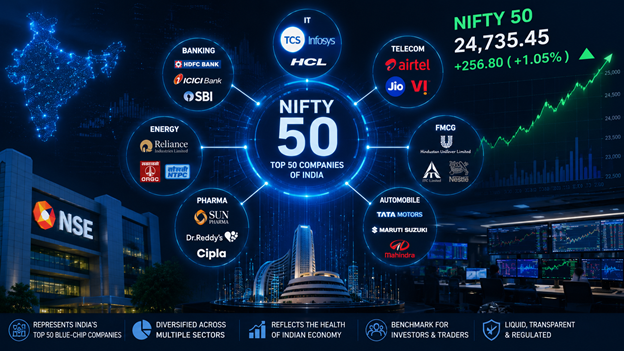
Nifty 50 is an index. That’s just a single number that stands for the combined performance of a group of stocks, in this case 50 large, actively traded companies listed on the National Stock Exchange of India. The name comes from “National Stock Exchange” plus “Fifty”. When someone says “the market is up today”, they often mean Nifty 50 or Sensex has gone up.
The 50 companies come from different sectors, such as banking, IT, energy, consumer goods, pharma and automobiles. NSE Indices Limited manages the index and reviews the list from time to time, so companies can come in or drop out. You can see the current list on the NSE Indices website. We’re not listing names here, because any list we print would go out of date.
How Nifty 50 is calculated
Nifty uses what’s called free-float market capitalisation. That sounds heavy, but the idea is simple. A company’s market value is its share price multiplied by its number of shares. “Free-float” means you only count the shares that the public can actually trade, so shares held by promoters or the government are left out.
Here’s a made-up example. Two banks are each worth ₹10 lakh crore on paper. Bank A has all its shares available to the public, so it counts as ₹10 lakh crore. Bank B has only 40% available, so it counts as ₹4 lakh crore. Bank A then has a bigger say in the index even though the two are the same size.
The index level is then compared with a base: 3 November 1995, when the value was set at 1,000. The index itself began on 22 April 1996. You never have to do this sum yourself. NSE updates the number all through the trading day. What matters is the direction. If the combined free-float value of the 50 companies rises, Nifty rises, and if it falls, Nifty falls.
What is Bank Nifty?
Bank Nifty, officially called Nifty Bank, is a sector index. It follows a group of large, liquid banks listed on NSE, and it includes both private sector and public sector banks. The number of banks in the index has changed over time, so check NSE’s factsheet for the current list and weights.
People love Bank Nifty because bank stocks tend to move quickly, and quick moves give intraday and options traders more to work with. They also mean more risk. When someone says they’re “trading Bank Nifty”, they usually mean Bank Nifty futures or options, not buying bank shares.
One thing to watch for in older articles. Bank Nifty used to have weekly options, but those were discontinued after regulators limited each exchange to one weekly index expiry. If a guide still talks about weekly Bank Nifty expiries, it’s out of date. See our guide to what Bank Nifty is for more.
Nifty 50 and Bank Nifty vs Sensex
Sensex is the main index of the Bombay Stock Exchange (BSE). It tracks 30 companies, against Nifty’s 50. Many big companies sit in both, so the two usually move in the same direction. Active traders tend to focus on Nifty and Bank Nifty, because that’s where most of the index derivatives trading happens.
Why traders watch Nifty 50 and Bank Nifty
Traders use Nifty 50 and Bank Nifty as a quick read on market mood. If Nifty is rising, the general mood is positive, and if it’s falling, it isn’t. That’s usually the first thing people check before looking at an individual stock.
They’re also benchmarks. Say your portfolio gained 15% in a year and Nifty gained 20%. You made money, but you did worse than the market. And because both indices have actively traded futures and options, they’re popular for short-term trading too.
How can you trade or invest in Nifty 50 and Bank Nifty?
You can’t buy “Nifty” the way you buy a share. There are three common routes:
- Futures. A contract to buy or sell the index value on a future date. You put up a margin, which is a fraction of the contract’s value, and your losses can be bigger than that margin.
- Options. Call and put contracts on the index. You pay a premium upfront, and if the option expires worthless you lose all of it. If you pay ₹5,000 and it expires worthless, that ₹5,000 is gone. NSE decides which expiry cycles exist, and it has changed them before, so read the current contract specifications instead of trusting a number from an article.
- Index funds and ETFs. These track the index. They suit investors who want broad exposure without picking stocks, and they aren’t the same thing as trading derivatives.
If you’re thinking about futures, read our guide to futures trading in India and F&O lot size and margin first.
A note on historical returns
You’ll often see a line like “Nifty has returned about 12% a year”. Be careful with figures like that. The answer changes with the start and end dates, and with whether you’re counting only price changes or total returns, which include dividends. Past returns also don’t tell you what will happen next. If you want a number, look at NSE’s index data for a specific period.
A few facts worth remembering
- Nifty 50 began on 22 April 1996, with a base date of 3 November 1995 and a base value of 1,000.
- NSE Indices Limited manages it. The company was earlier called India Index Services & Products Limited.
- The regular trading session runs on weekdays from 9:15 AM to 3:30 PM. The exchange can change timings, so check its calendar.
Nifty 50 and Bank Nifty: questions beginners ask
What is Nifty 50 in simple words?
It’s a number that tracks 50 large companies listed on NSE. When it rises, those companies are worth more in total, and when it falls, they’re worth less.
What’s the difference between Nifty and Bank Nifty?
Nifty 50 covers many sectors. Bank Nifty covers only banks, so it’s more concentrated and can move more sharply in a day.
Can beginners trade Nifty?
They can, but it’s wise to learn chart reading, risk management and options basics first. Futures and options use leverage, which magnifies both gains and losses. Practise with paper trading and keep your size small. Our technical analysis guide is a good place to start.
How much money do I need?
There’s no single figure. Option premiums, futures margins and lot sizes all change, so use your broker’s margin calculator on the day you trade. And remember that having the money to place a trade isn’t the same as having the skill to manage it. See our guide to risk management in trading.
Is Nifty 50 a good investment?
Many long-term investors use a Nifty 50 index fund or ETF as a simple, low-effort way to own the market. It doesn’t guarantee returns, and it’s very different from trading Nifty futures and options, which carry much higher risk.
Learn more with IITA
Knowing what Nifty 50 and Bank Nifty are is the starting point. Reading their charts and managing risk is a separate skill, and it takes practice. IITA’s courses cover technical analysis, risk management and an introduction to exchange-traded markets, with live market examples, simulated practice and doubt-clearing sessions, in classroom and online batches. If you’re new to options, start with how to start option trading. For current contract details, contact our IITA experts or visit our Bhubaneswar course page.
Book Your Free Career & Market Guidance Session Today!
Not sure where to begin? Speak with our academic counselors and discover the right learning path based on your goals.
Office: Esplanade Mall, Rasulgarh, BBSR
Training Mode: Both Offline & Online Classes available
Call / WhatsApp: +91 8895218280, +91 8328955452
Website: https://iita.tech/best-stock-market-course-in-bhubaneswar/
Follow us on Instagram: @stockmarketcourse_iita
Subscribe to Our YouTube Channels: IITA Official: https://www.youtube.com/@iitab | Sudha Das (Market Learning): https://www.youtube.com/@sudhadas8420 | Subrat Das: https://www.youtube.com/@subratdas2506
Disclaimer: Stock market trading involves financial risk. This article is for educational purposes only and is not investment advice or a recommendation to buy or sell any security. It encourages readers to learn before they trade. Figures, rules and rates mentioned may change as per SEBI and other regulators. Check the latest figures on the official SEBI, exchange or other regulator websites, or consult experts.
IITA – https://iita.tech/