
Options Greeks Explained Simply: Delta, Theta, Gamma, and Vega

If you trade options without understanding the Greeks, you are driving a car without knowing what the dashboard gauges mean. The car still moves, but you have no idea why it is accelerating, slowing down, or about to run out of fuel. Options Greeks are the gauges that tell you exactly why your option’s price is changing and what to expect next.
This guide explains the four most important Greeks – Delta, Theta, Gamma, and Vega – in plain, simple English, with practical examples from Nifty and Bank Nifty options that you can apply immediately.
Why Options Greeks Matter
An option’s price does not move only because the stock or index price moves. It also changes because of time passing (every minute erodes value), volatility shifting (a calm market versus an event day), and how close the option is to being in or out of the money. The Greeks measure each of these forces separately so you know which one is helping or hurting your position at any moment.
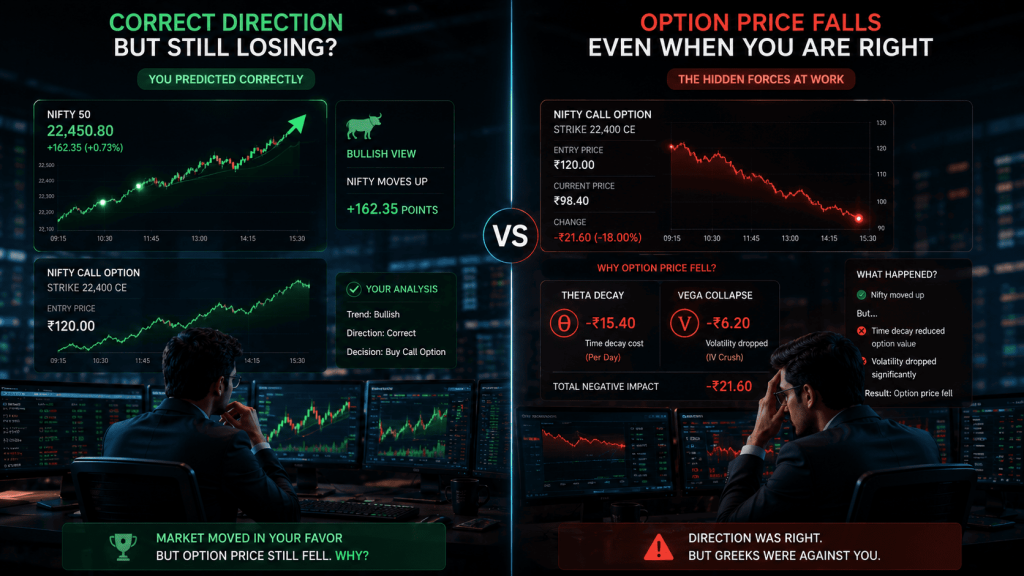
Without this understanding, traders are constantly surprised: “Nifty moved 50 points in my direction, why did my option barely move?” or “I held the right direction but still lost money.” The Greeks explain every one of these situations.
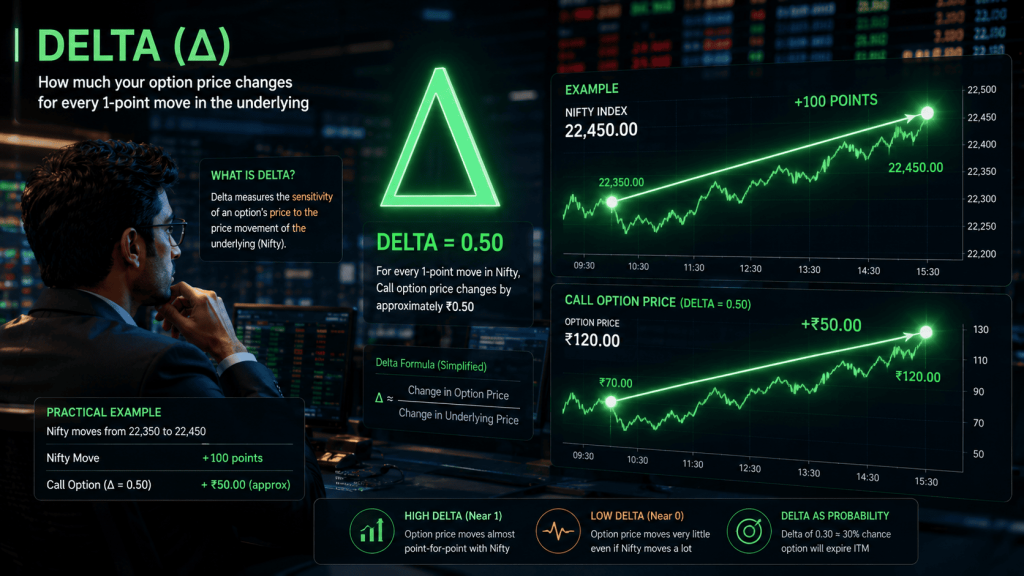
Delta (Δ) – How Much Your Option Moves with the Underlying
Delta tells you how many points your option’s price will change for every 1-point move in the underlying (Nifty, Bank Nifty, or the stock). It ranges from 0 to 1 for calls and 0 to -1 for puts.
- Call option with Delta 0.50: if Nifty rises 100 points, the option price rises approximately ₹50
- Put option with Delta -0.40: if Nifty falls 100 points, the put price rises approximately ₹40
- Deep in-the-money options have Delta near 1 (or -1 for puts) – they move almost point-for-point with the underlying
- Far out-of-the-money options have Delta near 0 – they barely respond to underlying moves, which is why cheap OTM options often expire worthless even when the market moves
Practical use: Delta tells you how responsive your option is. Buying a low-Delta option means you need a very large move to profit. Buying a high-Delta option means you participate more in the move but pay a higher premium. Delta is also used as a rough probability estimate – a Delta of 0.30 suggests roughly a 30% chance the option will expire in the money.
Delta and direction: If you are bullish, you want positive Delta (buy calls or sell puts). If bearish, you want negative Delta (buy puts or sell calls). Your total position Delta tells you your net directional exposure.
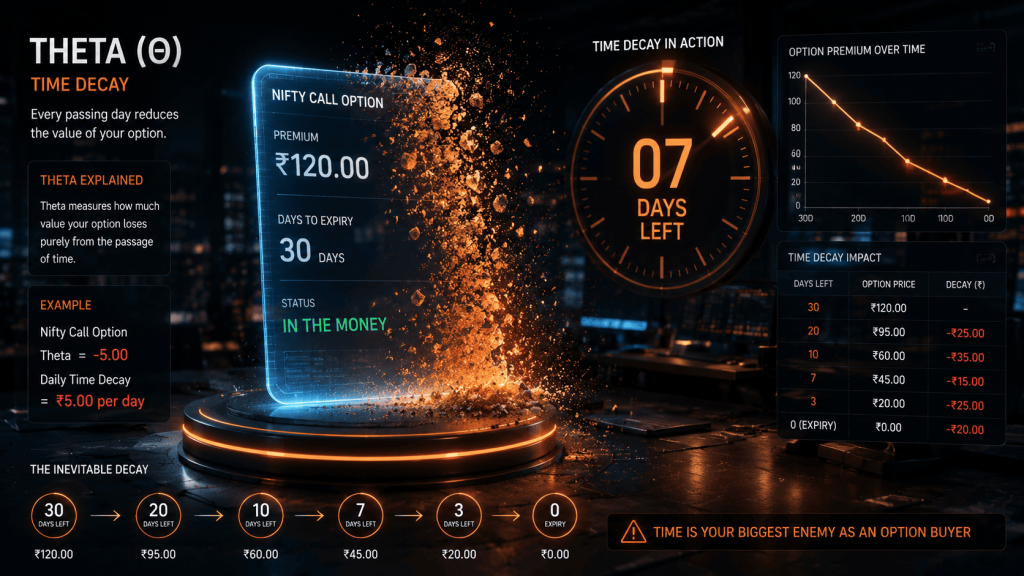
Theta (Θ) – How Much Time Costs You Every Day
Theta measures how much value your option loses per day purely from the passage of time – a force called time decay. It is always negative for option buyers (time works against you) and positive for option sellers (time works for you).
- Example: A Nifty call option with Theta of -5 loses ₹5 in value every day, even if Nifty does not move at all
- Theta accelerates near expiry: An option with 30 days left might lose ₹2/day. The same option with 3 days left might lose ₹20/day. On expiry day itself, Theta is devastating – options can lose their entire remaining value in hours
- At-the-money options have the highest Theta because they have the most “time value” to lose
Why this matters practically: If you buy options (especially weekly options), Theta is your enemy – you are paying rent every day you hold the position. The market needs to move fast enough in your direction to overcome the daily Theta bleed. This is why many beginners buy the right direction but still lose money: the move was too slow to beat Theta. Option sellers profit from Theta because they collect premium that decays in their favour as time passes.
Practical rule: Never hold option buys overnight near expiry unless you have a strong conviction, because Theta will eat your premium while you sleep.
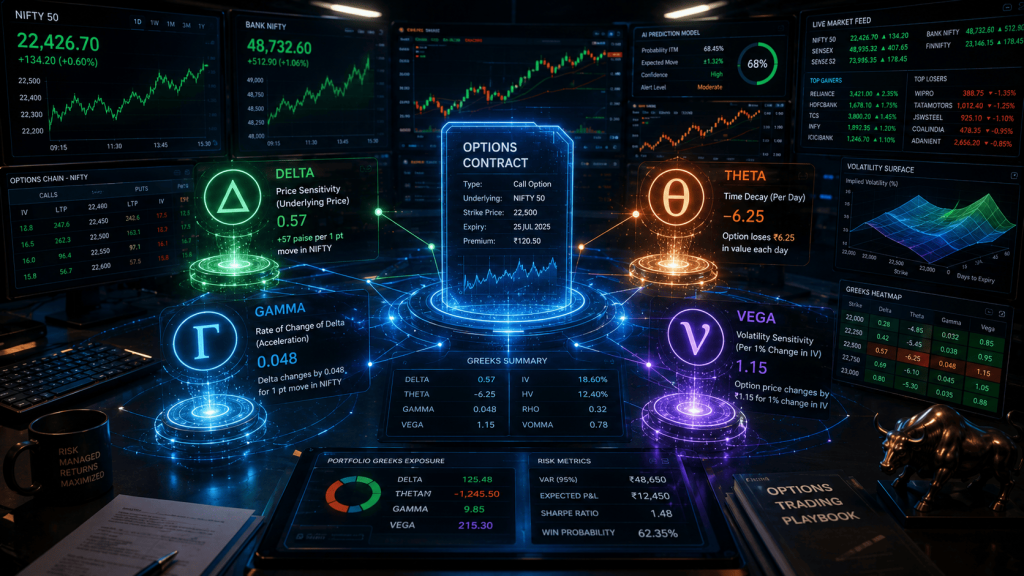
Gamma (Γ) – How Fast Delta Changes
Gamma measures the rate at which Delta changes for each 1-point move in the underlying. Think of Delta as speed and Gamma as acceleration. High Gamma means your Delta is changing rapidly, which means your option’s responsiveness to market moves is shifting quickly.
- At-the-money options have the highest Gamma – their Delta changes the fastest as price moves
- Deep ITM and far OTM options have low Gamma – their Delta is relatively stable
- Near expiry, Gamma spikes for ATM options – this is what causes wild swings in option prices on expiry day
Why Gamma matters: High Gamma is exciting for option buyers because a small move in the right direction can quickly push Delta higher, accelerating profits. But it is equally dangerous because a move in the wrong direction rapidly reduces Delta. For option sellers, high Gamma is risky because sudden moves can turn a comfortable position into a large loss very quickly. This is called Gamma risk and it is why selling ATM options near expiry is dangerous even for professionals.
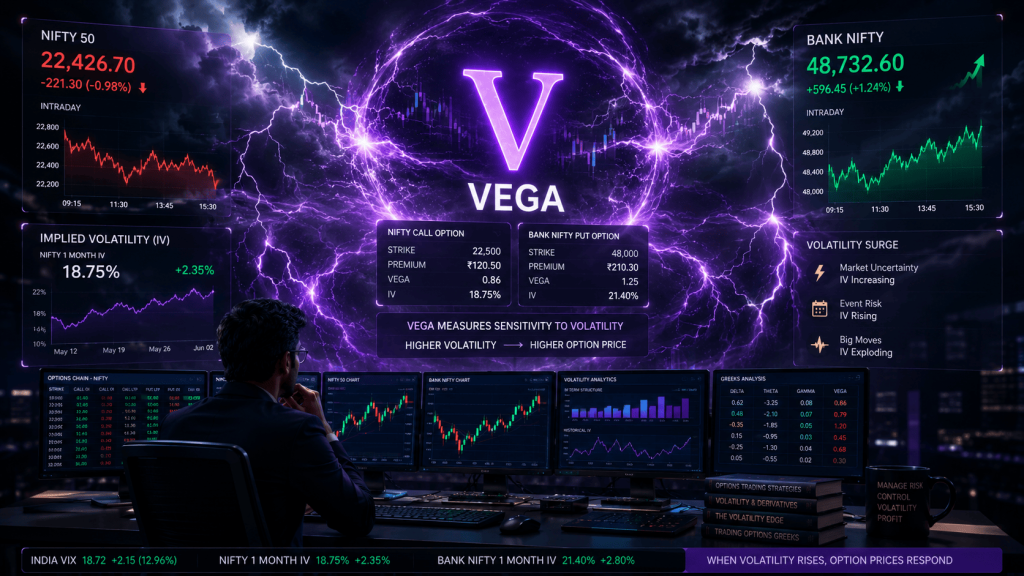
Vega (V) – How Volatility Affects Your Option
Vega measures how much an option’s price changes when implied volatility (IV) increases or decreases by 1 percentage point. Implied volatility reflects the market’s expectation of future price movement – before events like budget announcements, RBI decisions, or election results, IV tends to rise.
- High Vega option: a Nifty option with Vega of 8 gains ₹8 for every 1% increase in IV, even if Nifty itself does not move
- After the event passes, IV crashes (called “IV crush”) – and the option loses value from Vega alone, even if the market moves in your direction
Practical trap beginners fall into: Buying options before a big event because “the market will move.” The option premium is already inflated by high IV. When the event passes and IV drops, the option loses value from Vega collapse even if the market direction was correct. This is one of the most common ways beginners lose money in options – winning on direction but losing on Vega.
How to use Vega: If you expect volatility to increase (before events), buy options (positive Vega). If you expect volatility to decrease (after events), sell options (negative Vega). Understanding Vega prevents the painful experience of being right about direction and still losing money.
How the Greeks Work Together
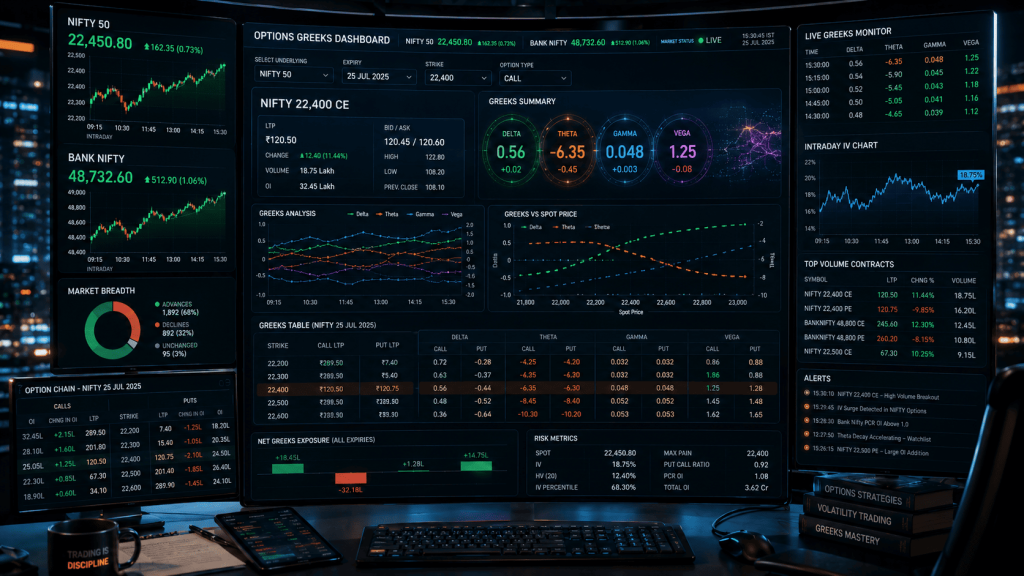
In real trading, all four Greeks act simultaneously on your option position:
- Delta determines how much the underlying’s move helps or hurts you
- Theta charges you rent every day you hold the position
- Gamma accelerates or decelerates Delta as price moves
- Vega adds or removes value based on volatility shifts
A winning options trade is one where the positive forces (favourable Delta movement, Vega expansion if you are long) outweigh the negative forces (Theta decay, unfavourable Gamma). Understanding which Greek is the dominant force in your specific trade is what separates informed options trading from gambling.
Frequently Asked Questions
What are options Greeks in simple words?
Options Greeks are measurements that tell you how and why an option’s price changes. Delta measures sensitivity to the underlying’s price, Theta measures time decay per day, Gamma measures how fast Delta changes, and Vega measures sensitivity to volatility.
Which Greek is most important?
For option buyers, Theta is the most critical because it is the constant cost of holding the position. For option sellers, Gamma is the biggest risk because sudden moves can create large losses. Delta and Vega matter for both. No single Greek can be ignored.
Do I need to calculate Greeks myself?
No. Every trading platform (Zerodha, TradingView, Sensibull) displays the Greeks for each option contract. Your job is to understand what they mean and factor them into your decisions.
Can I trade options without knowing Greeks?
You can, and most beginners do – which is why most beginners lose money in options. Understanding Greeks is the difference between knowing why your option behaved the way it did and being constantly surprised by it.

Learn Options Greeks and Advanced Options Strategies with IITA Bhubaneswar
At IITA (Indian Institute of Technical Analysis), Bhubaneswar, concepts like these are not taught from slides alone. Our trainers demonstrate on live market charts, letting you practise in real conditions with mentor guidance.
- Live market sessions – learn by doing, not just watching
- Experienced traders as trainers who practise what they teach
- Small batches for personal attention and doubt-clearing
- Post-course mentorship so support continues after class ends
- Classroom and online options available across Odisha
Visit iita.tech or call us to book a free introductory workshop.
Disclaimer: Stock market trading involves financial risk. This article is for educational purposes only and is not investment advice.