
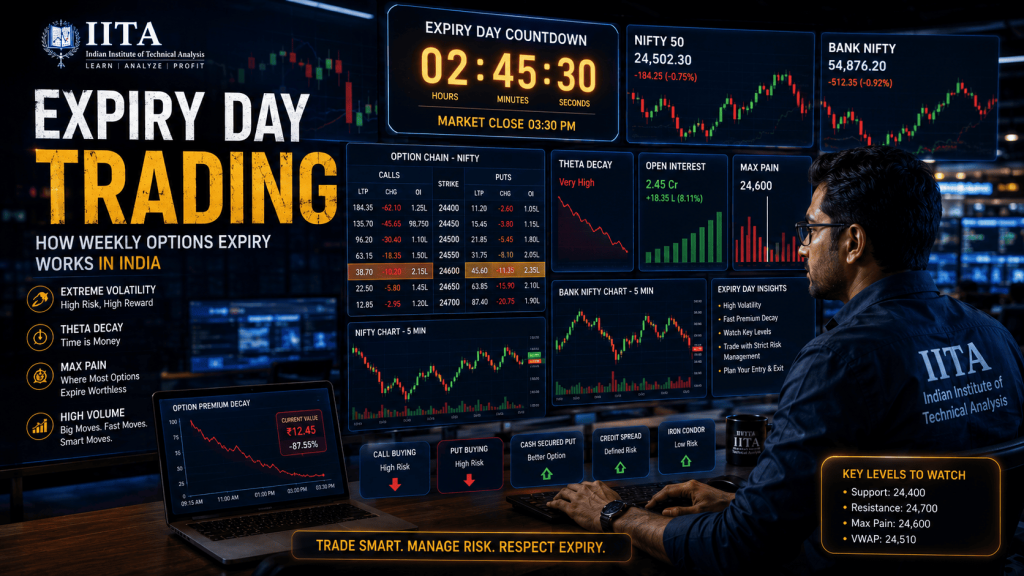
Expiry Day Trading Explained: How Weekly Options Expiry Works in India
In short: Expiry day trading means buying and selling options on the day they expire, when time decay speeds up and prices can swing sharply. The exchange decides the expiry day and which indices have weekly options, and both have changed over the years, so contact our IITA experts for the current schedule. A person who buys an option can lose the whole premium. A person who sells one can lose far more.
Expiry day trading is the practice of trading options on the day they expire. It’s famous for fast-moving prices, rapid changes in option premiums and very heavy trading volume. It pulls in thousands of traders who want quick profits, and it’s also behind some of the biggest losses beginners ever take. SEBI’s own studies have found that most individual traders in equity derivatives lose money, and expiry day adds speed and volatility on top of that.
This guide explains how expiry works, why options behave so differently on the last day, and what you should understand before you even think about trading it. If options are new to you, it helps to know what Nifty 50 and Bank Nifty are first.
What Is Options Expiry?
Every options contract has a fixed end date, called the expiry date. On that date the contract either has value, if it’s “in the money”, or it becomes worthless, if it’s “out of the money”. After expiry, the contract no longer exists.
Who decides the schedule? The exchange. It sets the expiry day and chooses which indices get weekly options and which get only monthly ones. These choices have changed more than once. For example, weekly options on Bank Nifty and a few other indices were discontinued in late 2024, and the expiry day itself has been changed too. Because of that, we don’t quote a day here. For the current schedule, contact our IITA experts or check the exchange’s contract specifications.
One rule that stays constant: if the expiry day turns out to be a market holiday, expiry moves to the previous trading day.
Why Expiry Day Is Different from Every Other Day
The big difference is time decay, which traders call theta.
Options lose a little value every day as expiry gets closer, because there’s less time left for the expected price move to happen. On the last day that loss speeds up a lot for options near the money. Picture an option worth ₹50 in the morning. If the market doesn’t move in its favour, it might be worth ₹5 by the afternoon and nothing by the close. These are illustrative numbers, but the shape is real.
That creates two things at once. First, the opportunity: options can be very cheap on expiry day, so a small market move can make a premium multiply in minutes. Second, the risk: those same cheap options can fall to zero just as quickly. For anyone who has bought an option, time is working against you every minute.
The Attraction: Why Beginners Are Drawn to Expiry Trading
You’ve probably seen the posts: “I turned ₹5,000 into ₹50,000 on expiry!” Some of those stories are true, but they mislead, because of survivorship bias. You only hear from the few who got lucky. You never hear from the many who lost their whole premium that same day.
Low prices add to the illusion. When an option costs just ₹5, it feels like you’re risking almost nothing. Let’s do the arithmetic with an assumed lot size of 75 units (assumed for this example, not the current lot size). One lot at ₹5 costs 5 × 75 = ₹375. Five lots cost ₹1,875 and ten lots cost ₹3,750. That money can disappear in an afternoon, and most very cheap options do expire worthless.
What You Can Lose: Buyers, Sellers and Spreads
How much you can lose depends on which side you’re on. Same assumed lot of 75 and the same ₹5 option.
If you buy the option, the most you can lose is the premium you paid: ₹5 × 75 = ₹375 per lot. If the premium rises to ₹25, you gain (25 − 5) × 75 = ₹1,500 per lot. The loss is capped, but losing all of it is common.
If you sell the option, you collect ₹375 up front, but your loss isn’t capped. Say the index moves sharply and the option is worth ₹100 at expiry. You lose (100 − 5) × 75 = ₹7,125 on one lot, and a bigger move means a bigger loss. Sellers also need to keep margin in their account. Our guide to margin trading and leverage explains how that works.
If you trade a spread, you sell one option and buy another at a different strike, which limits the damage. Suppose you sell a call at ₹5 and buy a call 100 points further out at ₹1. Your net credit is (5 − 1) × 75 = ₹300, which is also your maximum profit. Your maximum loss is (100 − 4) × 75 = ₹7,200, which is the 100-point gap minus the credit, times the lot. It’s capped, but it can still be much larger than the credit you collected. A spread limits the loss. It doesn’t make expiry safe.
How Experienced Traders Approach Expiry Day
People with years of experience treat expiry day very differently from beginners. They usually trade from a clear plan with risk limits set in advance, instead of hope and excitement. They watch price levels such as support, resistance and VWAP, and they don’t chase random moves. Many prefer defined-risk strategies like spreads over naked option positions. They also accept that most expiry day trades will be small, and they often cut their position size on expiry compared with other days, because of the higher volatility.
None of that makes expiry day easy or safe. It just means they know what they’re up against.
Key Concepts for Expiry Day Trading
Theta Decay
Theta tells you how much an option loses in value as time passes. Near expiry, options close to the current price lose value fast, so buyers are racing the clock while sellers collect that decay. But sellers carry the larger risk, as the example above shows, so selling isn’t a free lunch. If you want to understand all the Greeks, our guide to options Greeks is a good place to start.
Max Pain
Max pain is the price level where the most options, calls and puts together, would expire worthless, causing the least payout by option sellers. Some traders watch it as a reference point, and some claim the market drifts toward it on expiry day. The evidence is mixed. Treat it as a rough reference, never as a prediction. Looking at option chain data is one way to see where open interest sits.
Pin Risk
When the market price sits very close to a strike price at expiry, nobody can be sure whether the option will finish in the money or out of it. That’s pin risk, and it can cause unpredictable moves in the last minutes of trading.
Common Mistakes in Expiry Day Trading
- Buying cheap out-of-the-money options and hoping for a jackpot. Most expire at zero.
- Overtrading because prices are moving fast and it feels exciting.
- Skipping an exit plan because “the premium is already small”.
- Revenge trading after an early loss, chasing the next move.
- Trading without understanding theta decay and how it affects option prices.
- Using position sizes that are too big for expiry day volatility. A written trading plan helps you set the limit before the market opens.
Should Beginners Trade on Expiry Day?
Our blunt answer: no, not until you have real experience. Expiry day moves fast and can be very unpredictable. It asks for a grasp of option pricing, quick decisions, strict risk management and emotional control, and those take months to build.
A better path looks like this. First, learn chart reading, technical analysis and basic options concepts. Then trade options on ordinary days, when time decay is slower and the moves are less erratic. Finally, watch expiry days for a while, and if you do take part, use very small positions. Practising on paper trading first costs you nothing.
Frequently Asked Questions About Expiry Day Trading
What is expiry day trading in simple words? It’s buying and selling options on the day those contracts expire. On that day, options can lose value very fast because of time decay. That makes it a high-risk day, with big gains possible for a few and big losses for many.
When is Nifty expiry? The exchange sets the expiry day and has changed it before, so don’t rely on an old article for it. Check the current contract specification or contact our IITA experts. If the expiry day is a market holiday, expiry moves to the previous trading day.
Is expiry day trading profitable? It can be for some experienced traders with strict risk management, but it’s never guaranteed. SEBI’s own studies have found that most individual traders in equity derivatives lose money. For beginners, expiry day can be an especially quick way to lose it.
What is theta decay? It’s the drop in an option’s value as expiry gets closer. On the last day it can be very fast, and an option can lose most of its value in hours. Buyers are hurt by it and sellers can benefit from it, but sellers also take on much larger risk.
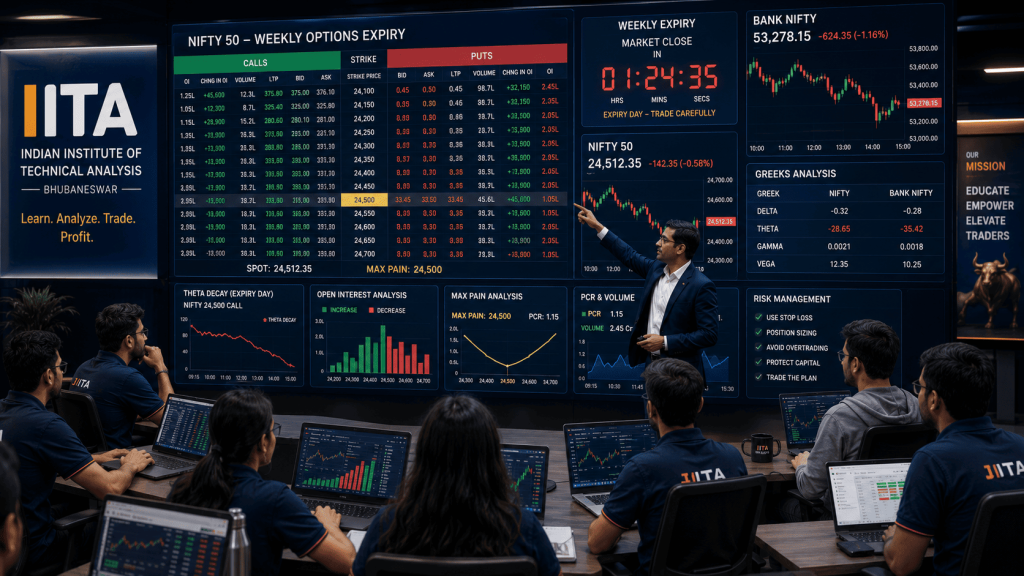
Learn Options and Expiry Trading at IITA Bhubaneswar
Expiry day trading isn’t something to teach yourself with real money. At IITA (Indian Institute of Technical Analysis), Bhubaneswar, [CONFIRM: which course or module covers options and expiry day trading, what it includes, and the batch timings]. We teach in Hindi, Odia and English, in classroom and live online modes. If you’re starting from scratch, have a look at our beginner roadmap or our stock market course, or contact our IITA experts.
Prices, lot sizes and rules change over time. For the latest figures, contact our IITA experts or check the exchange.
Book Your Free Career & Market Guidance Session Today!
Not sure where to begin? Speak with our academic counselors and discover the right learning path based on your goals.
Office: Esplanade Mall, Rasulgarh, BBSR
Training Mode: Both Offline & Online Classes available
Call / WhatsApp: +91 8895218280, +91 8328955452
Website: https: https://iita.tech/best-stock-market-course-in-bhubaneswar/
Follow us on Instagram: @stockmarketcourse_iita
Subscribe to Our YouTube Channels: IITA Official: https://www.youtube.com/@iitab Sudha Das(Market Learning): https://www.youtube.com/@sudhadas8420 Subrat Das: https://www.youtube.com/@subratdas2506
Disclaimer: Stock market trading involves financial risk. This article is for educational purposes only and is not investment advice or a recommendation. The article instead asks readers to learn before they trade. The values given are subject to change as per SEBI. The latest figures can be found on SEBI’s websites or from experts.