
What Is Margin Trading? How Leverage Works in India

Margin trading allows you to buy more shares than your own money would normally permit by borrowing additional funds from your broker. This borrowing power is called leverage, and it is one of the most powerful and most dangerous features in trading. Margin trading can multiply your profits, but it can equally multiply your losses, sometimes beyond your initial investment.
This guide explains margin trading and leverage in simple words, how it works in India, what a margin call is, and why it demands extreme caution.
What Is Leverage?
Leverage is the use of borrowed money to increase the size of your trading position. It is usually expressed as a ratio, like 5x or 10x. With 5x leverage, ₹10,000 of your own money lets you take a position worth ₹50,000. The broker effectively lends you the difference.
Here is the double-edged nature of leverage: if that ₹50,000 position rises 10%, you make ₹5,000, a 50% return on your ₹10,000. But if it falls 10%, you lose ₹5,000, half your capital, from a move that would be minor for an unleveraged investor. Leverage amplifies everything, gains and losses alike.
How Margin Trading Works in India
In India, margin trading is offered in a few main forms:
1. Intraday Margin
For intraday (same-day) trades, brokers offer leverage because the position is closed before the market shuts, reducing overnight risk. Leverage levels are regulated by SEBI and have been reduced in recent years for retail protection.
2. Margin Trading Facility (MTF)
MTF allows you to buy shares for delivery (holding beyond a day) by paying only a portion of the value, with the broker funding the rest. You pay interest on the borrowed amount. This lets you hold leveraged positions for longer, but interest costs accumulate.
3. Margin Against Shares (Pledging)
You can pledge your existing shares as collateral to get margin for trading. The shares stay in your demat account but are pledged to the broker as security.
What Is a Margin Call?
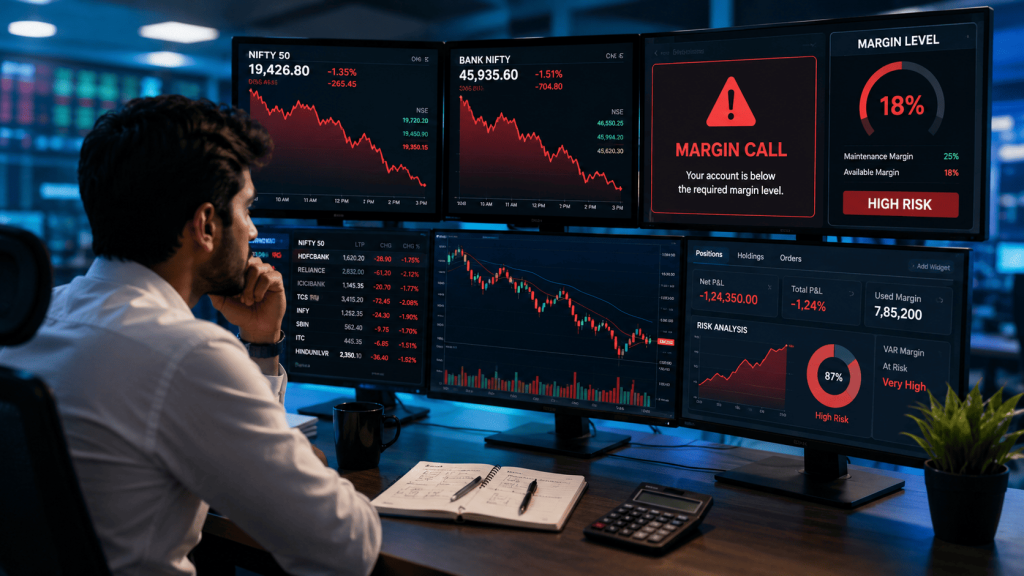
A margin call is one of the most important concepts in margin trading. When your leveraged position moves against you and your account value falls below the broker’s required margin level, the broker issues a margin call, demanding that you either add more funds or close positions. If you do not act, the broker can automatically square off (close) your positions to limit their risk, often at a loss to you.
Example: You take a leveraged position and the market moves sharply against you. Your losses eat into the margin. The broker calls you to add money. If you cannot, they close your position at the current loss, and you have no chance to recover if the market later reverses.
The Real Risks of Margin Trading
- Amplified losses – leverage multiplies losses just as much as gains
- Margin calls – you can be forced to add funds or have positions closed at a loss
- Interest costs – borrowed money (in MTF) accrues interest, eating into profits
- Losing more than you invested – in some cases, losses can exceed your initial capital
- Emotional pressure – leveraged positions move fast, triggering panic decisions
Margin Trading and Risk Management
Because leverage amplifies risk, disciplined risk management is absolutely essential when margin trading:
- Always use a stop loss – with leverage, an unprotected position can cause severe damage
- Use less leverage than offered – just because you can take 10x does not mean you should
- Risk only 1–2% of capital per trade, accounting for the leveraged position size
- Keep a cash buffer to handle margin calls without forced liquidation
(See our complete guide on risk management in trading.)
Should Beginners Use Margin Trading?
The honest answer: beginners should avoid or minimise leverage until they have proven consistent profitability without it. Leverage does not make a losing strategy profitable; it makes losses bigger and faster. Many beginners are attracted to leverage because it promises bigger returns from small capital, then are wiped out when the market moves against their leveraged position.
Learn to trade profitably with your own capital first. Add leverage gradually, with full understanding and strict risk management, only once you have a proven track record.
Common Margin Trading Mistakes
- Using maximum leverage without understanding the amplified risk
- Trading on margin without a stop loss
- Ignoring interest costs in MTF positions
- Not keeping a cash buffer, leading to forced square-offs during margin calls
- Believing leverage can rescue a poor strategy (it only accelerates losses)

Frequently Asked Questions About Margin Trading
What is margin trading in simple words?
Margin trading means borrowing money from your broker to buy more shares than your own capital allows, using leverage. It can amplify profits but equally amplifies losses. If your position moves against you, you may face a margin call to add funds or have positions closed.
What is leverage in trading?
Leverage is using borrowed funds to increase your position size, expressed as a ratio like 5x or 10x. With 10x leverage, ₹10,000 controls a ₹1,00,000 position. It magnifies both gains and losses proportionally.
What is a margin call?
A margin call happens when your leveraged position loses value and your account falls below the required margin level. The broker demands you add funds or close positions. If you do not, the broker may automatically close your positions at a loss.
Is margin trading safe for beginners?
No, margin trading is high-risk and not recommended for beginners. Leverage amplifies losses and can lead to losing more than your initial capital. Beginners should learn to trade profitably with their own capital before considering leverage.

Understand Leverage Before You Use It – IITA Bhubaneswar
Margin and leverage are where many traders blow up their accounts. Before you ever use borrowed money, you need to deeply understand how it works and how to manage its risks. IITA teaches you exactly that.
Our training covers leverage, margin, intraday positions, and the risk management discipline needed to use them safely, all demonstrated on live markets with real examples.
Why Learn Leverage and Risk at IITA
- Clear explanation of leverage and margin with real examples
- Risk management for leveraged trading as a core focus
- Live market demonstrations of margin scenarios
- Discipline training to avoid the leverage traps that ruin beginners
- Both classroom and online options available
Visit iita.tech or call us to book a free workshop.
Disclaimer: Stock market trading involves financial risk. This article is for educational purposes only and is not investment advice.